Mode Speeds, Cherenkov Bounds, and Stability
Scrollable formula. Use Left and Right arrow keys to reveal hidden content.
Scrollable table. Use Left and Right arrow keys to reveal additional columns.
Scrollable figure. Use Left and Right arrow keys to inspect hidden content.
Mode speeds in a preferred-frame theory perform three different jobs. Their signs test short-wavelength gradient stability, their cones determine causal propagation relative to the æther, and their ordering relative to the matter cone controls vacuum Cherenkov kinematics. None of these replaces a kinetic-energy test. This page derives the theory-side inequalities for the flat Einstein–æther branch and explains precisely where an observational bound begins.
Required background. Frames, Tetrads, and Spinors supplies the æther-rest tetrad and spin decomposition.
Helpful background. Einstein Equations supplies the metric perturbation equations; Gravitational Actions and Boundary Terms supplies the quadratic action; Formulations of General Relativity distinguishes constraints from evolution; and Gravity Beyond General Relativity supplies the wider viability tests.
The three characteristic sectors
Section titled “The three characteristic sectors”Use the site signature , a Minkowski metric, a constant unit æther , minimally coupled matter with limiting speed one, and Fourier phase . With
the squared infrared speeds are
The full action and derivation are developed on Einstein–Æther Gravity. The original linearized calculation and five-mode polarization count are Jacobson and Mattingly 2004, Table I and the discussion following Eqs. (43)–(45), PDF; the convention translation is cross-checked against Jacobson 2008, §4, Eqs. (4.1)–(4.3), PDF, which uses the opposite metric signature and unit-vector sign.
For each , the effective inverse metric
gives . In the rest frame this is . Thus is the frozen-coefficient gradient condition. A zero or divergent value generally signals a change of principal or constraint rank and cannot be classified by continuity from the ordinary region.
The inverse of this effective inverse metric is . Its null rays obey in a one-dimensional spatial slice. In the figure, compare the distance reached by each ray at the same preferred time: increasing the speed widens the propagation cone.
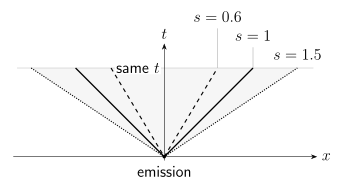
Characteristic cones in the æther rest frame, with equal spatial and temporal axis scales and matter speed one. The dashed, solid, and dotted rays have illustrative speeds , , and ; they do not represent one selected set of æther couplings. This schematic infrared comparison shows propagation speed, not kinetic-energy positivity or the ultraviolet causal structure.
Kinetic signs are independent
Section titled “Kinetic signs are independent”After the nondynamical variables have been eliminated, a healthy quadratic mode has the schematic action
excludes a kinetic ghost, whereas excludes an arbitrarily fast high-momentum gradient instability. Multiplying both kinetic and gradient terms by a negative number leaves positive but makes the Hamiltonian unbounded below, so a real speed is insufficient.
For the normalization used here, the spin-2 energy is positive when the gravitational sign is standard. The spin-1 energy has the sign of
and the spin-0 energy has the sign of . These linearized wave-energy results are Eling 2006, §V, Eqs. (39)–(41), PDF, including the 2009 correction to the paper’s æther stress tensor; see also Jacobson 2008, §4, paragraph following Eqs. (4.4)–(4.6), PDF. Finite attractive Newtonian gravity also requires
These conditions apply to the declared flat, constant-æther branch within the two-derivative effective theory. A cosmological or black-hole background requires its own reduced kinetic and principal matrices.
A useful two-parameter cross-check
Section titled “A useful two-parameter cross-check”The parametrized post-Newtonian (PPN) parameters and describe weak-field preferred-frame effects. On the generic branch, the particular relations
set both to zero. Define and substitute these relations into the general speeds. They reduce to
and . Away from degenerate boundaries,
makes all three speeds at least luminal relative to the chosen matter metric and gives positive spin-1 and spin-0 energies. The algebra and its endpoint qualifications follow Jacobson 2008, §4, Eqs. (4.7)–(4.11), PDF. This is a diagnostic slice, not the complete theory space; imposing its PPN relations is already an additional assumption.
Superluminal propagation relative to is not automatically acausal in a theory with a preferred time direction. Causality must be formulated using a common future orientation and a well-posed evolution surface for the widest relevant cone. Conversely, “subluminal” is not automatically safe because it opens an energy-loss channel for fast matter.
Vacuum Cherenkov kinematics
Section titled “Vacuum Cherenkov kinematics”Let a gravitational mode have approximately constant phase speed over a momentum interval and define its refractive index . An ultrarelativistic particle with can conserve energy and momentum while emitting that mode. In the soft-emission limit, energy conservation reads , while the mode dispersion gives . Thus has a real emission angle only when . A nonzero interaction is still needed to produce a rate. For a minimally coupled, pointlike relativistic particle and a tensor graviton, in the regime
Moore and Nelson obtain the energy-loss magnitude
and hence a loss time scaling as Moore and Nelson 2001, §3, Eqs. (3.2)–(3.4), PDF. The steep dependence makes propagation of very energetic particles a sensitive test of any subluminal gravitational phase velocity.
The theory prediction consists of , the polarization-dependent coupling to matter, the emission rate within the EFT, and the momentum range where that calculation is valid. An empirical bound additionally needs the observed particle energy, composition and parton structure, travel distance, source population, and a likelihood or exclusion rule. Moore and Nelson’s concrete inference uses specified cosmic-ray assumptions in Moore and Nelson 2001, §4, PDF; mutable numerical constraints and data updates belong to Tests of Gravity, not this theory page.
Requiring is therefore a clean sufficient filter for a mode that couples normally over the relevant momentum range. It is not universally necessary: a mode may decouple, acquire dispersive superluminal behavior before emission is efficient, or lie beyond the EFT cutoff. Each escape route is a model-dependent calculation, not permission to ignore the channel.
Common pitfalls
Section titled “Common pitfalls”Calling “stable.” It tests a gradient sign only. Check , mass scales, constraint rank, and the actual background separately.
Treating the metric cone as the only causal cone. Preferred-frame theories possess several effective metrics. State which field and frequency regime define the cone.
Quoting a Cherenkov number as a coupling identity. Data constrain a propagation-and-emission model under source assumptions. They do not directly replace the algebraic speed formulas.
Exercises
Section titled “Exercises”On the vanishing-PPN slice take and . Check the theory-side inequalities and compute all three squared speeds. Does the calculation itself constitute an observational bound?
Solution
The upper limit is
so . The speeds are
and
Also , so the quoted energy and Newtonian-sign checks pass. All three constant infrared speeds exceed the matter speed, closing the leading vacuum Cherenkov channel on this branch. This is not an empirical bound: no particle data, travel model, dispersion range, or statistical comparison has been supplied.
References
Section titled “References”- Eling, C. “Energy in the Einstein-Aether Theory.” Physical Review D 73 (2006) 084026; erratum 80 (2009) 129905. DOI. Erratum DOI. Open PDF.
- Jacobson, T. “Einstein-æther gravity: a status report.” Proceedings of Science QG-PH (2007) 020. DOI. Open PDF.
- Jacobson, T., and D. Mattingly. “Einstein-Aether Waves.” Physical Review D 70 (2004) 024003. DOI. Open PDF.
- Moore, G. D., and A. E. Nelson. “Lower Bound on the Propagation Speed of Gravity from Gravitational Cherenkov Radiation.” Journal of High Energy Physics 09 (2001) 023. DOI. Open PDF.