Cosmic History
Scrollable formula. Use Left and Right arrow keys to reveal hidden content.
Scrollable table. Use Left and Right arrow keys to reveal additional columns.
Scrollable figure. Use Left and Right arrow keys to inspect hidden content.
https://blackhole.org/universe/cosmology/
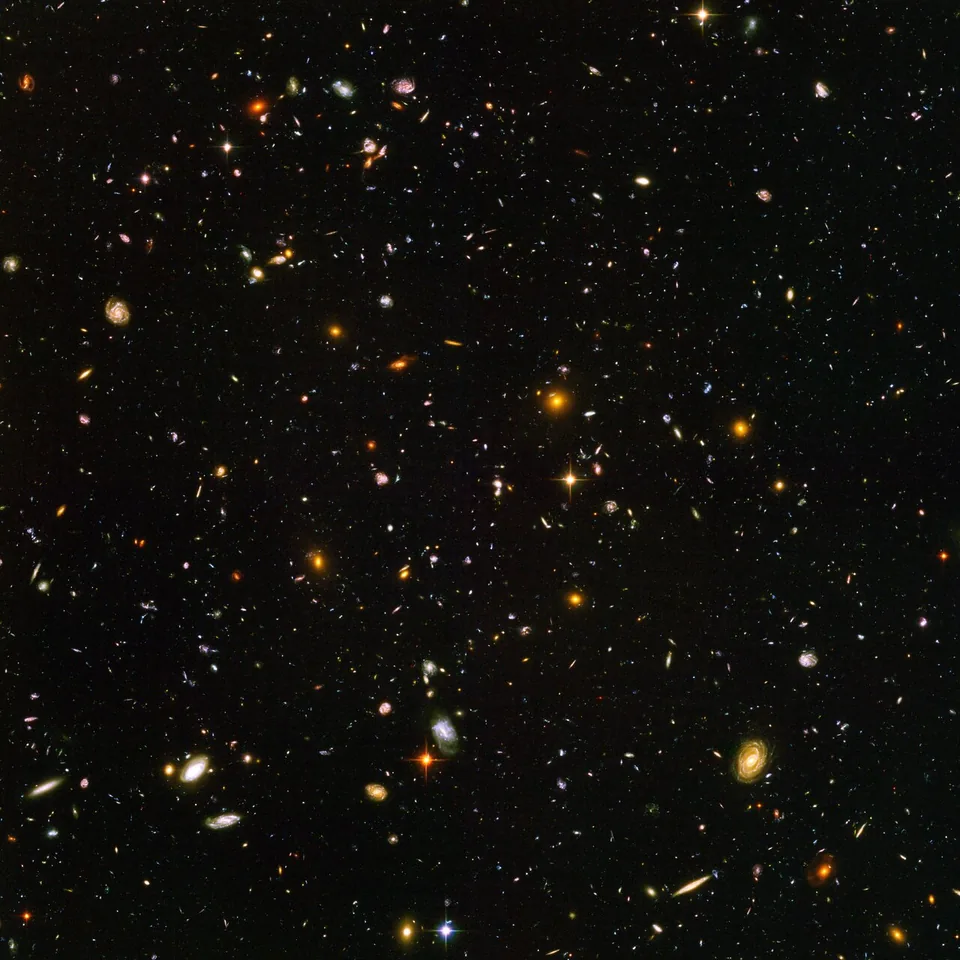
The Hubble Ultra Deep Field collects light from galaxies at many distances. Its colours combine visible and near-infrared bands; it is a view of different past times along different sightlines.
Credit: NASA, ESA, and S. Beckwith (STScI) and the HUDF Team. Image source · Reuse terms
Cosmology asks what observations tell us about the universe on its largest scales and across its history. We cannot watch billions of years pass, but we can compare evidence that carries information about different epochs.
Reconstruct the past, then test the expansion history
Section titled “Reconstruct the past, then test the expansion history”Start with what cosmic expansion means: on large scales, distances between suitable reference markers change together. Then explore the cosmic microwave background. Its nearly thermal spectrum and tiny variations carry different information about the early universe.
Go further back with what the young universe made: hydrogen, helium and trace light isotopes provide a nuclear-physics test of the first minutes. Distinguish the fraction of mass in helium from the fraction of nuclei that are helium, and examine both the successes and the lithium discrepancy.
Bring those strands together in How do we know the universe was hotter and denser?. Expansion, the microwave background, and primordial light elements provide different pieces of the argument.
Then ask why astronomers talk about dark energy. Evidence for a changing expansion rate is not a direct identification of the underlying cause. Dark energy and dark matter answer different questions.
Finally, investigate what might happen to the universe in the distant future. Predictions depend on how the ingredients driving expansion behave beyond the era we can observe. Separate measurements of the past from a model’s extrapolation into the future.
Questions to explore
Section titled “Questions to explore”- Cosmic History What does it mean for the universe to expand? Use changing distances and redshift to understand expansion and its limits. Ratios; optional algebra
- Cosmic History What is the cosmic microwave background? Read the thermal afterglow of the early universe and its small directional variations. No prior astronomy
- Cosmic History How do we know the universe was hotter and denser? Bring together expansion, the microwave background, and primordial elements. No prior astronomy
- Cosmic History Why do astronomers talk about dark energy? Connect distance measurements to expansion history without confusing dark energy and dark matter. Reading a labeled graph
- Cosmic History What did the young universe make? Use primordial light-element abundances as a hot-universe test, distinguishing mass fractions from counts of nuclei. No prior astronomy
- Cosmic History How might the universe end? Connect alternative futures to stated expansion assumptions, not predictions of certainty. Visual reasoning
Take the next step
Section titled “Take the next step”Distinguish three conclusions: distances grow on large scales, the early universe was hot, and the expansion history includes an accelerating phase in the standard interpretation. Match each to an observation and state why none alone identifies the physical nature of dark energy.
Return to galaxies and cosmic structure to see the matter within this expanding universe. A bound galaxy and the large-scale expansion describe different physical regimes.