Galaxies & Cosmic Structure
Scrollable formula. Use Left and Right arrow keys to reveal hidden content.
Scrollable table. Use Left and Right arrow keys to reveal additional columns.
Scrollable figure. Use Left and Right arrow keys to inspect hidden content.
https://blackhole.org/universe/galaxies/
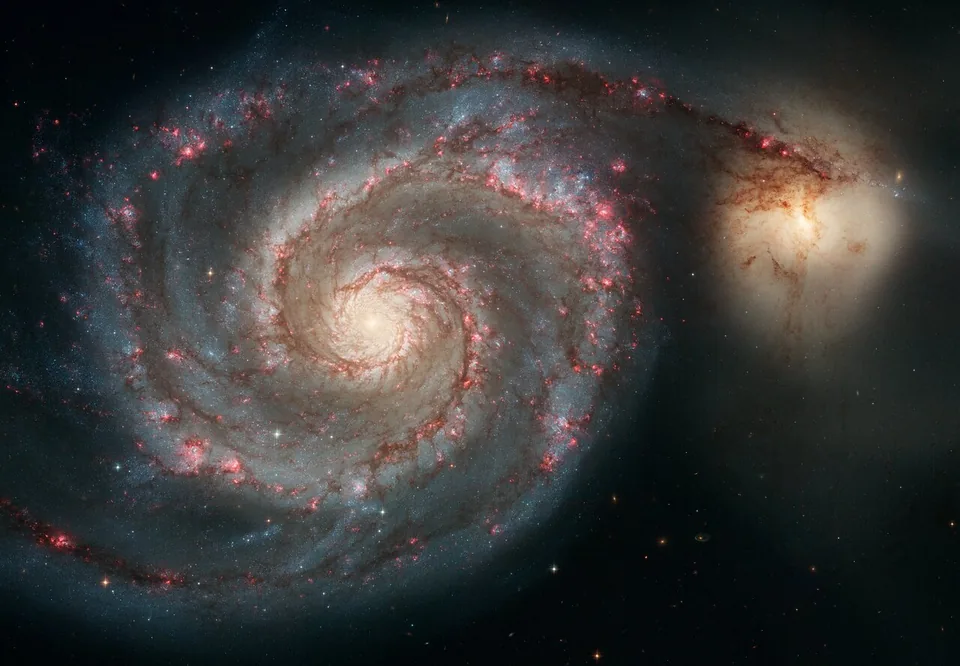
M51 is a spiral galaxy viewed nearly face-on. Hubble's multiband composite reveals curved arms, dust lanes and star-forming regions.
Credit: NASA, ESA, S. Beckwith (STScI), and The Hubble Heritage Team (STScI/AURA). Image source · Reuse terms
A galaxy is a physical system of stars, gas, dust, and gravitating matter, not merely a pattern of lights. Its motions offer a second kind of information alongside its image. Comparing the two requires a model of how matter is distributed.
Compare galaxies, then ask what holds them together
Section titled “Compare galaxies, then ask what holds them together”Begin by comparing why galaxies have different shapes. Look for spiral arms, smooth light and irregular patches, then test what viewing direction and image quality might hide. Next, try mapping the Milky Way from inside it. A band across the sky becomes a three-dimensional structure only when we add distances and account for dust.
Then ask what holds a galaxy together. Compare observed motions with predictions from a specified distribution of mass.
The article uses a limited gravitational model to expose the reasoning. It explains why flattened galaxies need more careful calculations than a spherical example, and why the broader evidence for dark matter comes from more than one rotation curve.
For an independent way to investigate mass, explore gravitational lensing. A foreground mass changes the apparent directions of background light. The resulting images constrain a mass distribution through a lens model, complementing the information in motions.
Questions to explore
Section titled “Questions to explore”- Galaxies & Cosmic Structure How do we map the Milky Way from inside it? Connect our view of the sky with the disk, bulge, and halo of our home galaxy. No prior astronomy
- Galaxies & Cosmic Structure What holds a galaxy together? Compare orbital observations with an explicit mass model and ask what dark matter means. Simple graphs
- Galaxies & Cosmic Structure How does gravity bend what we see? Use lens geometry to explain multiple images and why their positions constrain mass through a model. No prior astronomy
- Galaxies & Cosmic Structure Why do galaxies have different shapes? Classify a small observed image set, then identify projection and wavelength ambiguities. Visual reasoning
Take the next step
Section titled “Take the next step”Describe two reasons why a photograph alone cannot give a complete galaxy mass map. Consider both material hidden from view and the information carried by motion. Then compare the Milky Way’s bound stars with cosmic expansion, which describes a different scale and regime.