Stars & Stellar Systems
Scrollable formula. Use Left and Right arrow keys to reveal hidden content.
Scrollable table. Use Left and Right arrow keys to reveal additional columns.
Scrollable figure. Use Left and Right arrow keys to inspect hidden content.
https://blackhole.org/universe/stars/
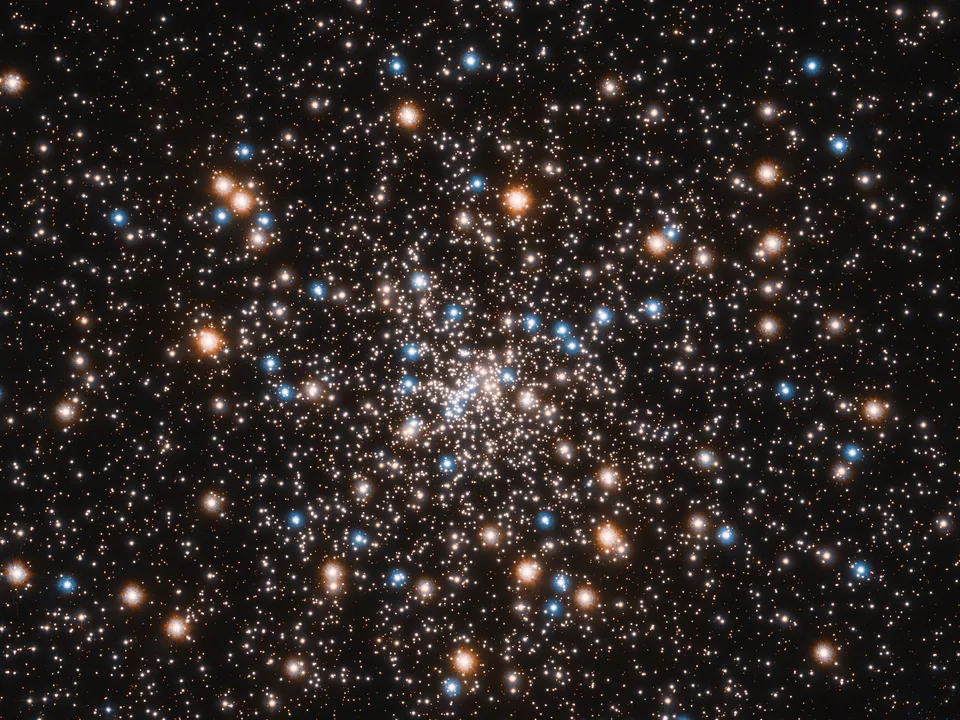
NGC 6397 contains stars at different stages of evolution. This Hubble composite combines blue and red optical bands; a star's image size is not its physical diameter.
Credit: NASA, ESA, and T. Brown and S. Casertano (STScI). Acknowledgement: NASA, ESA, and J. Anderson (STScI). Image source · Reuse terms
Stars that look similarly bright need not emit the same amount of light. A nearby faint star can outshine a distant luminous one in our sky. To understand a star physically, astronomers combine distance, spectrum, brightness, and—when available—orbital motion.
Compare properties before telling a life story
Section titled “Compare properties before telling a life story”Start with stellar distances, then separate the light received from a star from the power it emits. These measurements prepare the H–R diagram: a comparison of temperature and luminosity. A cool star can be highly luminous if its radiating area is large enough. The diagram is a map of properties, not automatically a path through time.
Then investigate binary stars. Their motion lets us infer mass, provided the orbit and its orientation are sufficiently constrained. Change that orientation in the binary-star lab. These properties prepare the ground for stellar evolution.
Why does the Sun keep shining? connects those measurements to the physical interior. Separate the energy that replaces escaping radiation from the pressure gradient that balances gravity. They answer different questions about the same star.
Questions to explore
Section titled “Questions to explore”- Stars & Stellar Systems How do we measure the distance to a star? Use Earth's orbit as a baseline to measure stellar distances through parallax. Angles and ratios
- Stars & Stellar Systems Why can a powerful star look faint? Separate luminosity from received light and use distance and magnitudes to compare stars. Ratios; optional logarithms
- Stars & Stellar Systems Why are some stars bright but cool? Use temperature, radius, and luminosity to understand the H–R diagram. Ratios and graphs
- Stars & Stellar Systems How do you weigh a star? Infer a binary system's mass from orbital motion and identify missing information. Ratios; optional algebra
- Stars & Stellar Systems Why does the Sun keep shining? Compare contraction with nuclear energy and distinguish energy supply from the pressure that supports a star. No prior astronomy
Take the next step
Section titled “Take the next step”Imagine two stars that look equally bright. Describe a distance measurement that could show they have different luminosities, and an orbital measurement that could constrain their masses. Keep luminosity, temperature and mass as separate quantities: one observed brightness cannot determine all three.
Once those properties are clear, follow how stars grow old. Their changing place in the H–R diagram connects what we measure now to models of their interiors and histories.