Life & Intelligence
Scrollable formula. Use Left and Right arrow keys to reveal hidden content.
Scrollable table. Use Left and Right arrow keys to reveal additional columns.
Scrollable figure. Use Left and Right arrow keys to inspect hidden content.
https://blackhole.org/universe/life/
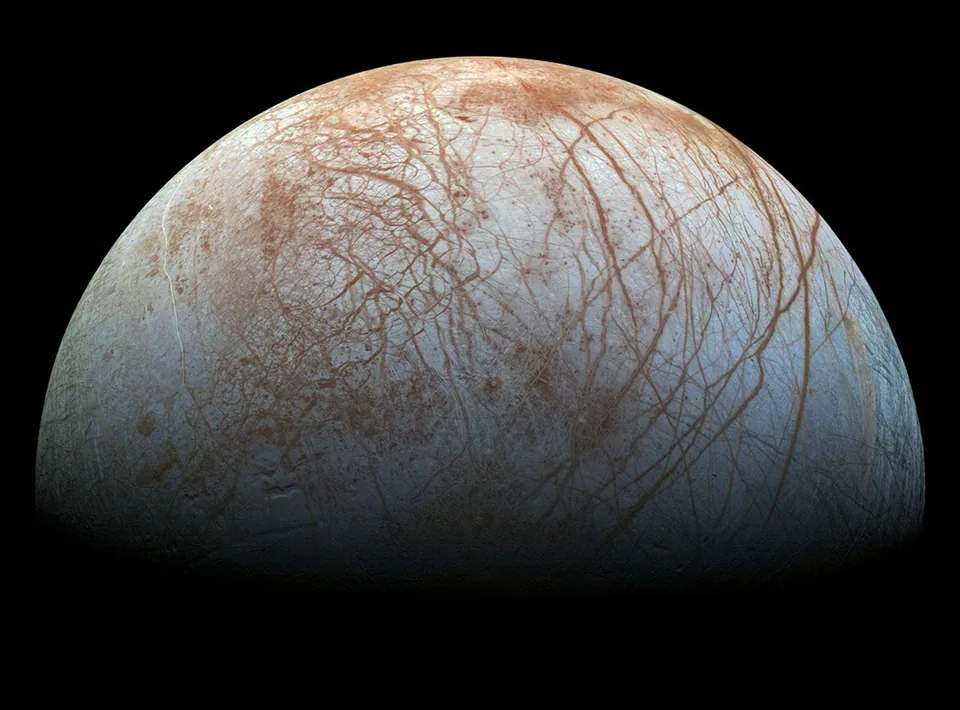
Galileo's reprocessed view shows Europa's fractured ice. The mosaic approximates natural colour and fills data gaps with colours inferred from similar nearby terrain; it does not show an ocean or life.
Credit: NASA/JPL-Caltech/SETI Institute. Image source · Reuse terms
A world can have conditions that might support life without being inhabited. A possible sign of biology can also have nonbiological explanations. Searching well means asking what an observation would actually establish, and what follow-up could distinguish competing explanations.
Separate three different questions
Section titled “Separate three different questions”Start with what makes a world potentially habitable. Stellar energy, an atmosphere, surface conditions and subsurface environments ask different questions. Then read Are we alone? to compare searches for habitable environments, biological activity and technology. Each needs its own evidence.
Continue with how we could detect another civilization. A promising signal must survive tests for instrumental effects, human interference and natural sources. A search that finds nothing constrains the signals it could have detected; it does not settle every possibility of life or technology elsewhere.
Connect these questions to finding exoplanets and reading starlight. Before interpreting a signal, understand how it was obtained.
Questions to explore
Section titled “Questions to explore”- Life & Intelligence What makes a world potentially habitable? Compare stellar energy, atmospheres, and planetary conditions without confusing habitability with life. No prior astronomy
- Life & Intelligence Are we alone? Evaluate habitability, possible biosignatures, and searches for technology with appropriate uncertainty. No prior astronomy
- Life & Intelligence How would we recognize a signal from another civilization? Compare interference, natural sources, and a possible technosignature; design follow-up checks. Visual reasoning
Take the next step
Section titled “Take the next step”A planet receives the same stellar power per square metre as Earth. List what this establishes and what it leaves unknown. In particular, separate incident energy, climate, liquid water and life. Then propose an observation that would narrow one of those uncertainties.