Solar System & Other Worlds
Scrollable formula. Use Left and Right arrow keys to reveal hidden content.
Scrollable table. Use Left and Right arrow keys to reveal additional columns.
Scrollable figure. Use Left and Right arrow keys to inspect hidden content.
https://blackhole.org/universe/solar-system/
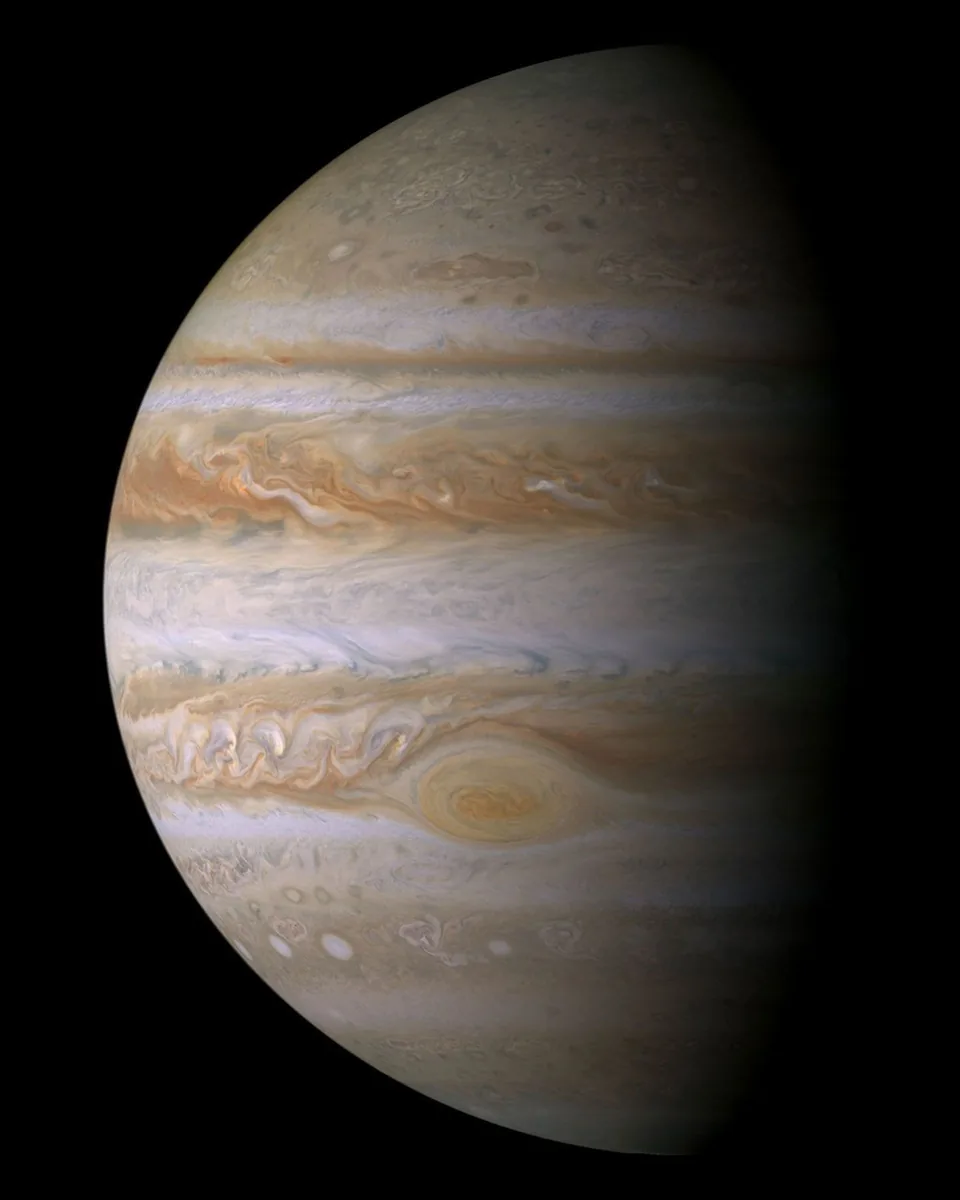
Cassini's red, green and blue camera exposures form an approximately natural-colour mosaic of Jupiter's cloud tops.
Credit: NASA/JPL/Space Science Institute. Image source · Reuse terms
Planetary systems contain enormous gaps. A planet’s diameter, its distance from its star, and the star’s distance from us are different kinds of scale. Keeping them separate helps you understand both our Solar System and the methods used to find planets elsewhere.
Build a sense of scale
Section titled “Build a sense of scale”Begin with How big is our Solar System?. A proportional distance model makes clear why a picture with large visible planets cannot usually show their separations on the same scale. Then compare rocky planets, giant planets, moons and rings. Photographs reveal surfaces and clouds; mass and size measurements add information that appearance alone cannot supply.
Next, ask why planets stay in orbit. Their sideways motion and gravitational acceleration connect the shape and timing of an orbit to a mass. With those ideas in place, investigate how astronomers find planets around other stars, even when a planet is not resolved as a separate point of light. The transit activity connects a tiny fractional dimming to a geometric model.
Then ask where the arrangement came from: why do planets mostly orbit in one plane? A rotating gas disk connects stellar birth to planetary building materials. Energy loss and angular momentum help explain the pattern; migration and encounters help explain why the finished systems need not be simple copies of that disk.
Questions to explore
Section titled “Questions to explore”- Solar System & Other Worlds How big is our Solar System? Build a proportional model that separates planet size from the distances between planets. Ratios
- Solar System & Other Worlds Why do planets stay in orbit? Combine falling motion with Kepler's laws to predict orbital speeds and periods. Ratios and graphs
- Solar System & Other Worlds How can we find a planet around another star? Read a transit signal and ask what else is needed before calling it a planet. Ratios and simple graphs
- Solar System & Other Worlds Why do planets mostly orbit in one plane? Follow angular momentum and energy loss from a collapsing cloud to a planetary disk, including orbital exceptions. No prior astronomy
- Solar System & Other Worlds Why are the planets so different? Compare rocky planets, giant planets, moons, and small bodies using images and measured properties. Visual reasoning
Take the next step
Section titled “Take the next step”Give a model planet two labels: its radius and its orbital distance. Explain which label controls an ideal transit’s depth and which enters Kepler’s period relation. Then test what additional information each inference needs in the transit lab or binary-star lab.
A planet’s discovery opens another question: could its conditions support life? Carry the distinction between a measured size and an inferred environment into the Life & Intelligence section.