Earth, Sky & Time
Scrollable formula. Use Left and Right arrow keys to reveal hidden content.
Scrollable table. Use Left and Right arrow keys to reveal additional columns.
Scrollable figure. Use Left and Right arrow keys to inspect hidden content.
https://blackhole.org/universe/sky/
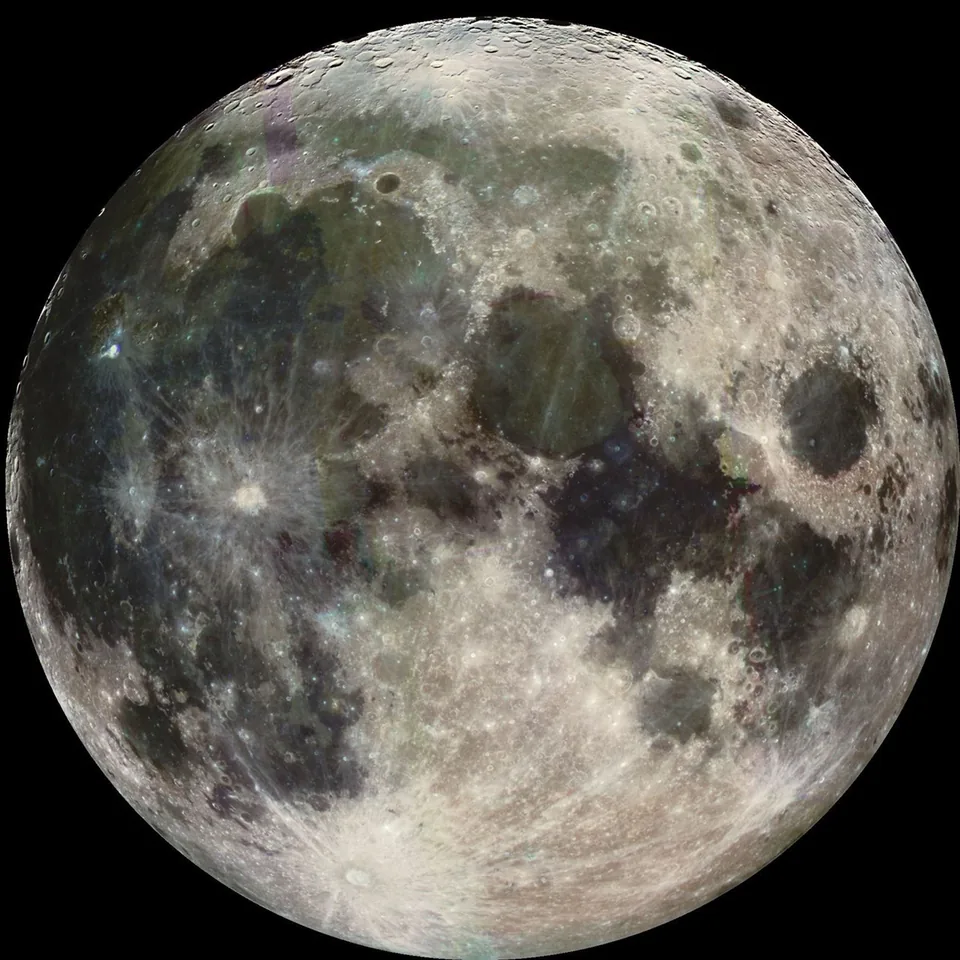
Galileo's Moon composite combines violet and near-infrared measurements; the displayed colour is enhanced. The dark plains and bright crater rays are surface features.
Credit: NASA/JPL/USGS. Image source · Reuse terms
The Moon changes appearance, stars rise and set, and calendars try to fit repeating cycles into a useful human system. These patterns become easier to understand when you separate what the sky looks like from your location from how Earth and its neighbors move.
Begin with the Moon
Section titled “Begin with the Moon”Start with Why does the Moon change shape?. It connects a familiar sight to a three-dimensional arrangement of the Sun, Earth, and Moon. The central skill is changing viewpoint without changing the physical situation.
Extend that geometry with eclipses: a phase depends on viewpoint, while an eclipse requires a shadow alignment. Then investigate seasons, where Earth’s tilted axis changes the Sun’s height and the length of daylight. Sky coordinates provide precise directions; calendars turn imperfectly matching cycles into a useful civil system.
Tides add a different question: how does the Moon’s gravity vary across Earth? Compare the motion of the whole Earth with the stretching around its centre. That distinction explains a two-bulge equilibrium picture without mistaking it for the tide schedule at a particular coast.
Questions to explore
Section titled “Questions to explore”- Earth, Sky & Time Why does the Moon change shape? Predict the Moon's appearance by following its sunlit half around Earth. Visual reasoning
- Earth, Sky & Time Why isn't there an eclipse every month? Use orbital tilt, shadows, and apparent size to explain when solar and lunar eclipses occur. Moon phases
- Earth, Sky & Time Why do we have seasons? Connect Earth's axial tilt with the Sun's height, daylight hours, and opposite seasons in the two hemispheres. No prior astronomy
- Earth, Sky & Time How do you give a star an address? Compare directions tied to your horizon with coordinates tied to the celestial sphere. Angles and compass directions
- Earth, Sky & Time Why do we need leap years? See why days, lunar months, and years do not fit neatly together. Whole-number arithmetic
- Earth, Sky & Time Why are there two tidal bulges? Subtract Earth’s common acceleration to explain tidal stretching and the limits of a two-bulge ocean model. No prior astronomy
Take the next step
Section titled “Take the next step”Compare a crescent Moon, a lunar eclipse, and a winter day. Which involves seeing part of an illuminated hemisphere, which involves Earth’s shadow, and which involves solar height and daylight? Explain each with a different arrangement of the same Sun–Earth–Moon system. The Moon lab is an indoor way to begin.
To place those familiar motions in a wider setting, continue to the scale of the Solar System. Keep an object’s direction in our sky separate from its distance through space.