Black Holes
Scrollable formula. Use Left and Right arrow keys to reveal hidden content.
Scrollable table. Use Left and Right arrow keys to reveal additional columns.
Scrollable figure. Use Left and Right arrow keys to inspect hidden content.
https://blackhole.org/universe/black-holes/
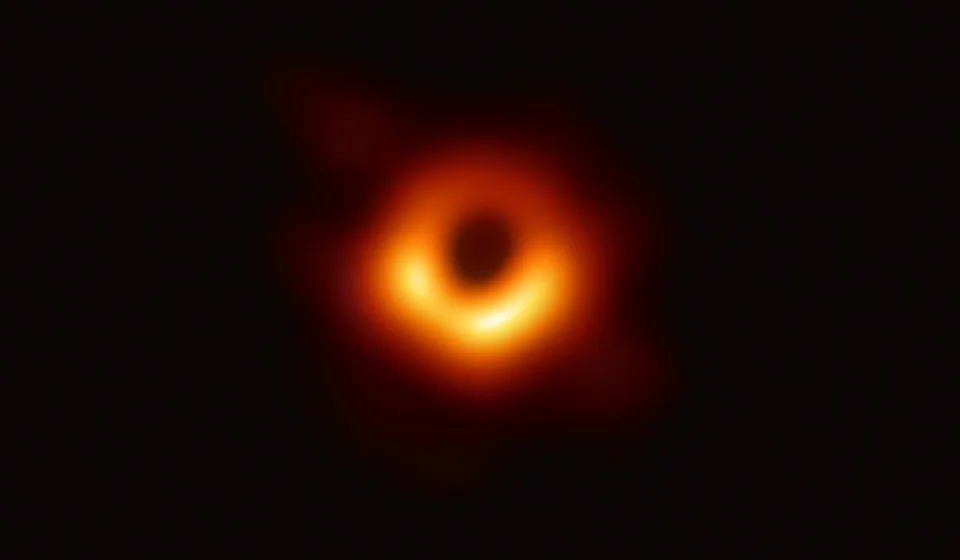
The EHT reconstructed this asymmetric ring around M87* from 1.3 mm radio measurements. Orange shows radio brightness; the dark centre is associated with the black-hole shadow.
Credit: EHT Collaboration. Image source · Reuse terms
A black hole is an extreme spacetime region with a boundary beyond which light cannot escape to distant observers. We investigate these objects through what happens around them: moving stars, glowing gas, images formed by surrounding emission, and gravitational waves.
Begin with the evidence
Section titled “Begin with the evidence”Black Holes: Start Here brings four evidence channels together and separates an event horizon from the light we observe. It also explains where our current understanding reaches its limits.
Next, investigate what a black-hole image actually shows: measured radio signals, a reconstructed image, and comparisons with physical models play distinct roles. Then use the black-hole scale explorer to calculate how mass sets a horizon radius in the nonrotating model. Keep that radius separate from the surrounding bright ring.
Detecting merging black holes develops another evidence channel. It follows small changes in an interferometer through comparisons between detectors and waveform models. Ask which features are measured directly and which source properties are inferred.
After the evidence, explore what would happen if you fell into a black hole. A deliberately idealized model separates an infalling clock, the signals reaching a distant observer and the tidal forces across an extended body. It helps explain why a horizon is a causal boundary rather than a solid surface.
Questions to explore
Section titled “Questions to explore”- Black Holes Black Holes: Start Here Build an evidence-led picture of horizons, falling matter, and open questions. No prior astronomy
- Black Holes What does a black-hole image actually show? Connect radio measurements, image reconstruction, and models of hot gas near black holes. Light and telescope resolution
- Black Holes How do we detect merging black holes? Trace a gravitational-wave signal from small arm-length changes to model-based inference about a merging binary. No prior astronomy
- Black Holes What would happen near a black hole? Separate a traveler’s clock, received signals, tidal effects, and environmental hazards. Visual reasoning
Take the next step
Section titled “Take the next step”Explain why a bright ring, a dark central region and an event horizon are three different things. Then choose a second evidence channel—stellar motion or gravitational waves—and describe what it adds. Return to stellar evolution for the formation context of stellar-origin black holes.