Stellar Evolution & Remnants
Scrollable formula. Use Left and Right arrow keys to reveal hidden content.
Scrollable table. Use Left and Right arrow keys to reveal additional columns.
Scrollable figure. Use Left and Right arrow keys to inspect hidden content.
https://blackhole.org/universe/stellar-evolution/
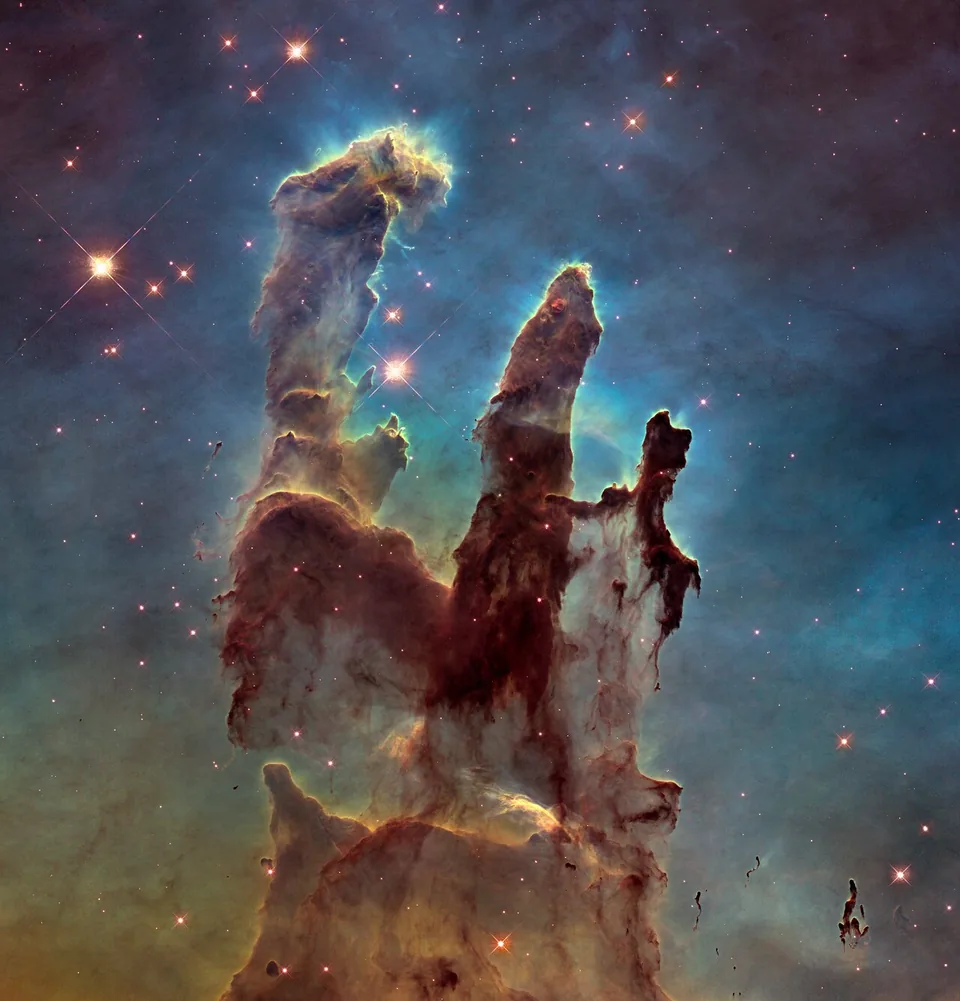
Dusty pillars in the Eagle Nebula, observed with Hubble. Blue, green and red display different narrow wavelength bands rather than the scene's eye colours.
Credit: NASA, ESA/Hubble and the Hubble Heritage Team. Image source · Reuse terms
A star’s changing appearance reflects changing conditions inside it. The fuel available, gravity, pressure, composition, mass loss, and interactions with a companion all influence what happens next. A single arrow from birth mass to final remnant can hide important conditions.
Follow a conditional pathway
Section titled “Follow a conditional pathway”Begin with how a cloud becomes a star. Gravitational contraction and accretion can make a protostar shine before sustained core hydrogen fusion begins. Then ask what happens when stars grow old. Compare how stars can leave white dwarfs, neutron stars, or black holes, and why neither every star nor every supernova has the same outcome.
If the distinction between temperature and luminosity is unfamiliar, visit the H–R diagram first. To connect the remnants to observations, continue to Black Holes: Start Here.
Between birth and the final remnant, nuclear energy explains how stars can maintain their radiation for long periods. Then compare two kinds of compact remnant: white dwarfs retain heat and are supported by electron degeneracy pressure, while neutron stars and pulsars turn a repeated flash into a question about rotation and viewing geometry. Not every remnant is a black hole, and not every neutron star sends a visible pulse toward us.
Questions to explore
Section titled “Questions to explore”- Stellar Evolution & Remnants How does a cloud become a star? Follow gravitational contraction, cooling, and the onset of sustained fusion. No prior astronomy
- Stellar Evolution & Remnants What happens when stars grow old? Trace conditional stellar pathways to white dwarfs, neutron stars, and black holes. No prior astronomy
- Stellar Evolution & Remnants Why do some dead stars pulse? Use periodic signals to understand a rotating neutron star and why its beam need not sweep across every observer. No prior astronomy
- Stellar Evolution & Remnants How can a dead star resist gravity? Distinguish quantum pressure, residual heat, and ongoing fusion. Visual reasoning
Take the next step
Section titled “Take the next step”Draw a sequence from a collapsing cloud to a main-sequence star and a possible remnant. Label the energy source at each stage and mark where the path can branch. The stars-to-black-holes journey helps connect these stages to observations.