Light & Telescopes
Scrollable formula. Use Left and Right arrow keys to reveal hidden content.
Scrollable table. Use Left and Right arrow keys to reveal additional columns.
Scrollable figure. Use Left and Right arrow keys to inspect hidden content.
https://blackhole.org/universe/observing/
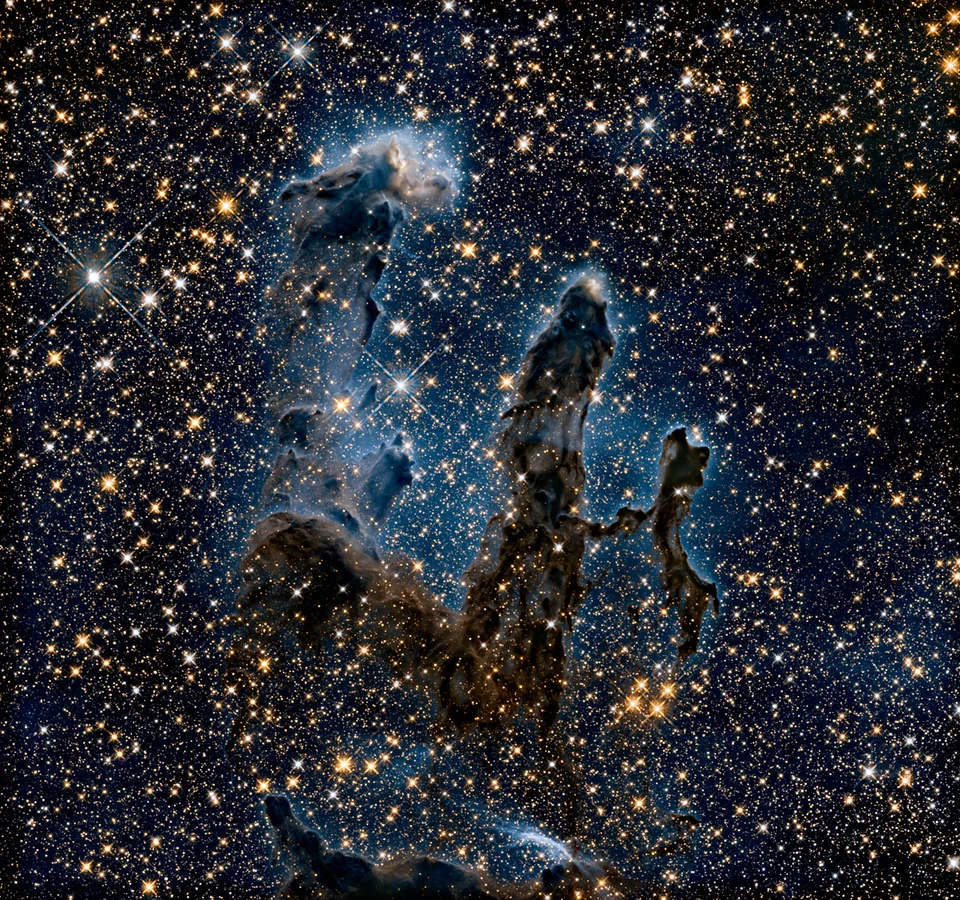
Near-infrared Hubble measurements reveal many stars behind the dusty pillars. Blue and yellow are assigned to two infrared bands.
Credit: NASA, ESA/Hubble and the Hubble Heritage Team. Image source · Reuse terms
Most astronomical objects are too far away for us to visit. Light provides a way to investigate them anyway. An instrument records something concrete—brightness in a band, a spectrum, an image—and a physical model connects that record to a source.
Follow the light to the inference
Section titled “Follow the light to the inference”Start with What can starlight tell us?. A spectrum separates wavelengths, making patterns available that a single color or brightness cannot reveal.
Then ask what a telescope contributes. Collecting more light and resolving smaller details depend on aperture in different ways; magnification alone cannot supply information the instrument did not record. Finally, learn to read the colours in astronomical images, where detector bands and display choices both matter.
Questions to explore
Section titled “Questions to explore”- Light & Telescopes What can starlight tell us? Use a spectrum to reason about temperature, elements, and motion. Reading a labeled graph
- Light & Telescopes What does a telescope actually do? Compare collecting light with resolving small details. Ratios
- Light & Telescopes Are the colours in space pictures real? Read filters, colour assignments, and image processing to understand what an astronomical picture measures. No prior astronomy
Take the next step
Section titled “Take the next step”Choose an astronomical image with a documented wavelength key. Identify one measured quantity and one display choice. Then explain why a colourful image, a spectrum, and a brightness measurement can carry different information about the same source. The black-hole imaging article takes this distinction into radio interferometry.
To use these tools on more familiar objects, continue to Stars & Stellar Systems. Distance, brightness, spectrum and orbital motion work together to reveal properties no single photograph determines.