Relativistic Thin Disks
Scrollable formula. Use Left and Right arrow keys to reveal hidden content.
Scrollable table. Use Left and Right arrow keys to reveal additional columns.
Scrollable figure. Use Left and Right arrow keys to inspect hidden content.
A relativistic thin disk is a conservation-law solution with a restrictive ordering: the flow is stationary, nearly circular, optically thick, geometrically thin, and able to radiate locally the heat generated by stress. Its celebrated flux profile follows only after an inner torque is supplied. The model is powerful precisely because its assumptions are explicit; a fitted inner radius or efficiency is meaningful only while the source remains in that regime.
Required background. Fluid and Kinetic Theory: continuum kinematics and balance laws supplies mass, angular-momentum, and energy fluxes.
Helpful background. Black-Hole Geometry supplies Kerr circular orbits and the ISCO; Relativistic Matter and Compact Objects supplies radiative and material closure.
The thin-disk ordering
Section titled “The thin-disk ordering”Let be the pressure scale height and the local circumferential radius. The thin approximation requires
where both velocities are measured in the same local orthonormal frame outside the plunging region. Thus radial drift is slow compared with orbital motion. Vertical hydrostatic balance, large optical depth, and cooling faster than inflow allow the dissipated energy to emerge locally. In the Newtonian limit, the height-integrated mass flux is approximately constant when winds are negligible,
where is mass per disk area, is the radial velocity, and inward accretion has positive . Relativistically, the conserved rest-mass flux is instead the surface integral ; a coordinate component should not be compared directly with a locally measured orbital speed.
The reference relativistic model further assumes a stationary, axisymmetric spacetime; equatorial circular geodesics; a time-averaged stress that transports angular momentum outward; and negligible torque at the chosen inner edge, usually the ISCO. Magnetic fields can generate the stress, but their detailed turbulence is replaced by the conserved height-integrated flux. Page and Thorne 1974, § II, pp. 499–500 states this model before deriving its relativistic flux.
Newtonian conservation and the flux profile
Section titled “Newtonian conservation and the flux profile”The Newtonian limit exposes where the inner boundary enters. The specific angular momentum and orbital angular velocity are
Let be the outward viscous torque across a cylinder. Steady angular-momentum conservation gives
For a zero inner torque, , so
Work done by the torque and orbital binding-energy release determine the dissipated flux. The result per disk face is
To see the normalization, neighboring rings rotate at slightly different rates. The stress dissipates power , and the two radiating faces have combined annular area . Dividing power by that area gives and the expression above. Stress both transports energy between rings and produces heat; assigning all local binding-energy loss to local radiation would miss that transport.
Three checks are immediate. The dimensions are power per area; for the imposed zero torque; and far outside the edge . Integrating both faces gives
the Newtonian orbital binding energy released down to . A formula with the same local behavior but a different boundary factor has a different torque or energy flux.
The hottest annulus is not the inner edge. Writing , differentiating gives a flux maximum at . Integrating only out to gives
Thus half the total luminosity emerges inside and half outside it, even though the flux per unit area peaks much closer to the edge. Annular area explains the difference between local flux and integrated luminosity. These radii belong to this Newtonian, zero-torque benchmark; the relativistic profile differs.
Compare the sharp local maximum with the slower accumulation of total power in the figure. The upper panel weights a unit area; the lower panel includes the increasing area of successive annuli.
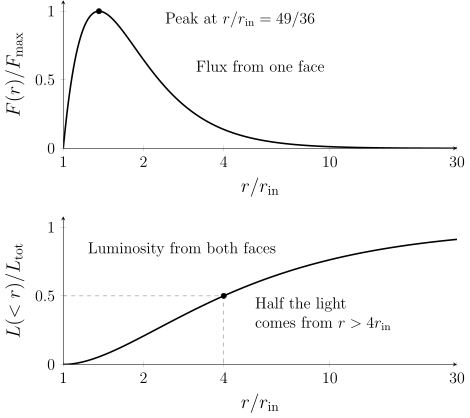
One-face flux and two-face cumulative luminosity of the steady Newtonian zero-torque disk. The inner flux vanishes, the local maximum is at , and , with for a disk extending to infinity. Both panels are quantitative and use a logarithmic radius axis. They illustrate the Newtonian benchmark, not the relativistic flux profile.
Relativistic flux and the ISCO
Section titled “Relativistic flux and the ISCO”In a stationary axisymmetric metric, let , , and be the conserved specific energy, specific angular momentum, and angular velocity of equatorial circular geodesics. Here , remains explicit, and is a chosen radial coordinate. Energy and angular momentum conservation are coupled because stress carries both. Use proper vertical distance for the height integration and define the reduced metric factor
For Boyer–Lindquist Kerr coordinates ; it is not the four-dimensional on that plane. With a zero-torque inner boundary, the emitted flux per face in the comoving frame is
All quantities in the integral are evaluated at . The identity connects the conserved quantities to the comoving orbital frame. In the Newtonian limit , , and the integral becomes , recovering the flux derived above. This also checks the radial measure: inserting the full spherical-coordinate determinant would introduce a spurious extra factor of . Page and Thorne 1974, § II, equation (1), and § IIIa, equations (11b)–(12), pp. 500–502 defines the height coordinate, determinant, and emitted flux.
Setting and neglecting photon capture and returning radiation gives the ideal radiative efficiency
For Schwarzschild, in ordinary units, , and . The Newtonian estimate of the radiated fraction at that radius would give , so the relativistic binding and redshift cannot be reproduced by substituting a relativistic radius into the Newtonian efficiency.
The inner-stress decision
Section titled “The inner-stress decision”If , the disk receives additional angular-momentum and energy flux from its inner boundary. The surface flux need not vanish at , and the integrated luminosity changes. Magnetic fields can couple the plunging region, disk, and black hole; whether that coupling is negligible depends on disk thickness, field topology, magnetization, and state.
The zero-torque condition is best treated as a controlled reference model. A successful fit does not prove the stress vanishes. An independent check varies the inner torque and verifies whether the inferred radius or efficiency is stable. Numerical GRMHD comparisons should measure conserved fluxes after inflow equilibrium and separate stress-generated heating from an assumed radiative closure.
Applicability and failure modes
Section titled “Applicability and failure modes”Abramowicz and Fragile 2013, §§ 5.1–5.3 organizes the thin-disk assumptions and relativistic structure. The model becomes unreliable when is not small, radial pressure and advection matter, optical depth falls, winds make radius dependent, the flow is time dependent, or magnetic support changes the vertical and orbital balance.
Even within a thin state, observation introduces disk-atmosphere hardening, limb angular dependence, returning radiation, absorption, distance, inclination, and possible misalignment. McClintock, Narayan, and Steiner 2014, §§ 3.1–3.2 and 4.1–4.2 explains how these enter continuum-based radius and spin work.
Detailed spectra and instrument likelihoods are beyond this page’s boundary. The next chapter develops the atmosphere and transfer calculation needed to predict a measured continuum, and the electromagnetic inference chapter explains the conditional mapping from inner radius to spin. Here the output is the physical flux and efficiency for declared disk and inner-boundary assumptions.
Common pitfalls
Section titled “Common pitfalls”Calling every optically thick flow a thin disk. Optical depth alone does not guarantee , local cooling, or slow radial drift.
Treating the ISCO as a material wall. It marks the loss of stable circular geodesics. Gas and fields continue inward, and the stress condition is an additional model choice.
Using when the energy budget has winds or inner work. Efficiency must use the actual horizon, radiation, wind, and jet fluxes.
Verify the Newtonian luminosity
Section titled “Verify the Newtonian luminosity”Starting from
verify the zero-edge flux and integrate both disk faces to obtain the luminosity. How does a positive inner torque change the result qualitatively?
Solution
At the bracket vanishes, so . For two faces,
A positive torque at the inner edge adds outward angular-momentum and energy transport. The flux no longer has to vanish there, the inner profile gains a boundary term, and the total luminosity can exceed the zero-torque binding-energy value. The sign and magnitude must come from a physical stress and a closed energy budget.
References
Section titled “References”- Abramowicz, Marek A., and P. Chris Fragile. “Foundations of Black Hole Accretion Disk Theory.” Living Reviews in Relativity 16 (2013): 1. DOI.
- McClintock, Jeffrey E., Ramesh Narayan, and James F. Steiner. “Black Hole Spin via Continuum Fitting and the Role of Spin in Powering Transient Jets.” Space Science Reviews 183 (2014): 295–322. DOI.
- Page, Don N., and Kip S. Thorne. “Disk-Accretion onto a Black Hole. Time-Averaged Structure of Accretion Disk.” Astrophysical Journal 191 (1974): 499–506. DOI.