Adiabatic Superradiant Growth
Scrollable formula. Use Left and Right arrow keys to reveal hidden content.
Scrollable table. Use Left and Right arrow keys to reveal additional columns.
Scrollable figure. Use Left and Right arrow keys to inspect hidden content.
When a bosonic cloud grows much more slowly than the orbital time of its bound state, the evolution can be approximated by a sequence of Kerr backgrounds plus a slowly changing cloud. Conservation of energy and angular momentum then fixes the trajectory in parameter space. Growth reduces the horizon angular velocity until the dominant mode reaches ; this is the kinematic saturation line, provided no faster nonlinear or environmental process intervenes.
Helpful background. Black-Hole Geometry and Mechanics supplies Kerr mechanics; Black-Hole Perturbation Theory supplies quasibound modes; Formulations of General Relativity supplies flux evolution; Relativistic Matter and Compact Objects supplies bosonic stress tensors; Computational Relativity supplies nonlinear checks.
Adiabatic mode growth and timescales
Section titled “Adiabatic mode growth and timescales”Let the bound mode have complex frequency
under the convention. Its amplitude grows as and its energy approximately as . The adiabatic approximation requires
These conditions compare evolution with the carrier oscillation. Adiabatic following also requires slow change relative to the relevant mode separations and orbital dynamics: in the hydrogenic regime, an adjacent-level spacing is of order , much smaller than . Growth and background variation must be slow on those timescales too, or transitions and mode mixing invalidate a single instantaneous eigenmode. The cloud is assumed sufficiently dilute that its self-gravity, self-interaction, and emitted radiation are perturbative.
For a mode with azimuthal number , the energy and angular-momentum transfers satisfy
where infinity fluxes can be neglected only in the leading idealization. The flux ratio follows from the mode dependence and is reviewed in Brito, Cardoso, and Pani 2020, §4.7.2, pp. 58–59, and §6.1, pp. 160–167, PDF.
Motion toward synchronization
Section titled “Motion toward synchronization”For Kerr,
Here , is physical mass, is a length, and . In ordinary units and the dimensionless spin is .
For co-rotating extraction, the single-mode flux relation decreases both and . Since the mass decreases too, the decrease of must be checked from the complete Kerr expression rather than inferred from alone. Growth stops kinematically when
The cloud trajectory is not vertical in a mass–spin plane because both horizon mass and angular momentum change. Ignoring radiation to infinity and treating as constant gives
Integrating from the initial black hole to the threshold supplies an estimate of the cloud energy and final spin. Because itself depends on , an accurate trajectory solves the coupled relation rather than freezing the frequency.
For the constant-frequency idealization, introduce , , and , where and refer to the initial hole. Then
The synchronization curve is derived on Saturation and Spin-Down. Its intersection with this trajectory fixes the approximate endpoint. For , , and , it gives and . Thus about of the initial hole’s mass-energy is transferred to the cloud in this idealized balance. This is a calculation with fixed frequency, negligible radiation, and instantaneous Kerr horizon parameters, not a prediction from a self-gravitating cloud evolution; the fairly large cloud fraction makes that distinction consequential.
The figure plots angular momentum against mass so the fixed-frequency extraction law is a straight line. Follow its arrow toward the synchronization curve: the final hole still rotates, and continuing the line beyond that intersection would leave the superradiant regime for this mode.
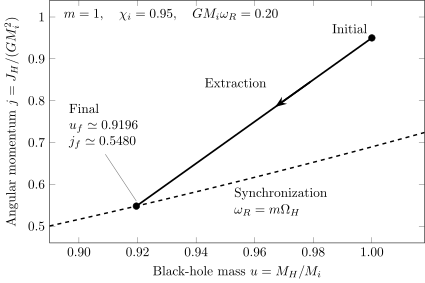
Ideal constant-frequency Kerr spin-down for , , and . The quantitative extraction track meets at , . Here and . Radiation, frequency drift, competing modes, self-interaction, and cloud self-gravity are omitted; this ideal kinematic example does not predict a fully nonlinear cloud endpoint.
This evolution model and the associated exclusion regions in mass–spin space are developed in Brito, Cardoso, and Pani 2020, §§6.1.1–6.1.2, pp. 160–167, PDF. They depend on comparing the growth time with the system age and competing accretion time, not merely on the existence of an unstable eigenmode.
First-law check
Section titled “First-law check”The Kerr first law is
During ideal superradiant extraction, insert , with . Then
In the superradiant regime , so both factors on the right are negative and . At synchronization the reversible limit has . This is an independent sign check: extraction reduces mass and spin without violating the horizon area law.
For the plotted example, evaluating gives . The horizon area grows by about even though the mass falls by about ; the extracted energy comes from rotation.
Where adiabatic evolution fails
Section titled “Where adiabatic evolution fails”The approximation can fail when:
- several modes grow on comparable timescales and exchange energy;
- self-interaction shifts the frequency or triggers collapse;
- the cloud mass is large enough for metric backreaction to alter the spectrum;
- gravitational or bosonic radiation removes appreciable energy;
- accretion or a companion changes , , or the cloud faster than ;
- the evolution approaches a nonlinear hairy branch whose stability must be analyzed separately.
Fully nonlinear Einstein–Proca simulations exhibit extraction and approach to the superradiant threshold in an complex-vector ansatz with axisymmetric spacetime East and Pretorius 2017, Eqs. (1)–(4), Figs. 1–4, and pp. 1–5, PDF. That result supports the balance picture for its model; the restriction excludes competition from other azimuthal numbers and does not establish a universal endpoint for real fields.
Check the area sign
Section titled “Check the area sign”Assume a mode has and extracts . What is the sign of ?
Solution
The first law gives
Thus the area increases. At , the leading idealized extraction is reversible and the area change vanishes.
References
Section titled “References”- Brito, Richard, Vitor Cardoso, and Paolo Pani, Superradiance, Lecture Notes in Physics 971, second edition, Springer, 2020. Open PDF.
- East, William E., and Frans Pretorius, “Superradiant Instability and Backreaction of Massive Vector Fields around Kerr Black Holes”, Physical Review Letters 119, 041101, 2017. Open PDF.
Further reading
Section titled “Further reading”- Zel’dovich, Yakov B., “Amplification of Cylindrical Electromagnetic Waves Reflected from a Rotating Body”, Soviet Physics Uspekhi 14, 180–181, 1971.