Formation of a Common Marginal Surface
Scrollable formula. Use Left and Right arrow keys to reveal hidden content.
Scrollable table. Use Left and Right arrow keys to reveal additional columns.
Scrollable figure. Use Left and Right arrow keys to inspect hidden content.
In the resolved nonspinning head-on merger used on this page, the first common apparent horizon is a bifurcation, not a lone surface that smoothly replaces the two individual horizons. On the chosen slicing, a pair of common marginally outer trapped surfaces appears: an outer stable branch that grows toward the remnant horizon and an inner branch that immediately becomes unstable. This is evidence for that vacuum data family, not a theorem that every matter model and foliation has the same bifurcation, and it does not date the formation of the event horizon.
Helpful background. Horizon definitions and null expansions are reviewed in Black-Hole Geometry and Mechanics; perturbative relaxation belongs to Black-Hole Perturbation Theory; the variables come from Formulations of General Relativity; numerical surface finding is treated in Computational Relativity; and binary parameters are organized in Relativistic Two-Body Dynamics.
Marginality as an elliptic condition
Section titled “Marginality as an elliptic condition”Let be a smooth closed two-surface with future null normals and , normalized by . Its outgoing expansion is
where is the induced metric. A MOTS satisfies ; a future marginal surface also has . In a fixed Cauchy slice, writing as a trial surface turns this condition into a nonlinear elliptic equation. The equation can possess several solutions, so “the apparent horizon” is often shorthand for the outermost MOTS on that slice rather than a uniqueness theorem.
Consider a normal deformation within , where points outward. Linearizing defines a stability operator through . Its principal eigenvalue is real. With the chosen outward direction, identifies strict outward stability, while identifies instability; marks loss of strict stability but does not, by itself, prove a bifurcation Andersson, Mars, and Simon 2008, Proposition 5.1, pp. 13–14. Because normalization and deformation conventions vary, a page or code must state them before comparing signs.
Why two common surfaces appear
Section titled “Why two common surfaces appear”For a smooth one-parameter family of slices, define , with representing the surface shape. If the stability operator is invertible—in particular, for a strictly stable MOTS—the implicit-function theorem continues the surface smoothly through nearby slices Andersson, Mars, and Simon 2005, Theorem 1, pp. 1–3 and Andersson, Mars, and Simon 2008, Theorem 9.2, p. 22. Loss of invertibility says only that this continuation theorem no longer applies.
The resolved head-on sequence supplies the additional evidence: the common surface separates into outer and inner branches, and the inner branch has at birth before becomes negative Pook-Kolb et al. 2021, § II.B, pp. 4–5. A fold is therefore a useful conditional local model for this sequence. Suppose the zero mode is the simple principal mode, has a one-dimensional kernel and cokernel, the parameter derivative is transverse to its range, and the quadratic projection along the kernel is nonzero. Lyapunov–Schmidt reduction then gives
On one side there is no nearby solution; on the other there are two, with opposite leading stability signs. This page does not assert those nondegeneracy hypotheses for arbitrary binary data, matter models, or foliations.
Within that head-on sequence, the outer branch encloses both individual MOTSs and has positive principal stability eigenvalue, while the inner branch becomes unstable and moves through a more complicated trapped-region geometry. Pook-Kolb and collaborators resolve this branch structure and its area evolution Pook-Kolb et al. 2021, §§ II–IV. The result is compelling evidence for that continuum data family, not a universal global diagram.
The following normal-form diagram isolates the local mechanism. Read a vertical line as one slice and each intersection as a different solution of the surface equation. The vertical coordinate describes shape displacement; it is not a physical radius, and the diagram does not depict an event horizon splitting.
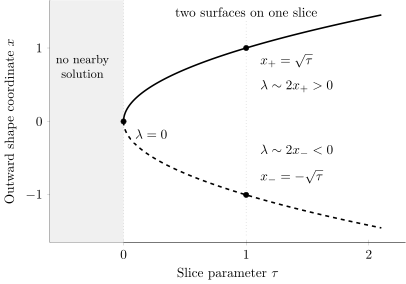
A conditional fold model : there is no nearby root for and there are two for . With directed outward and the chosen positive normalization, the leading stability signs follow . The dotted line at selects two surfaces on one slice. This is a schematic solution-space diagram, not numerical merger data; it does not exclude other, distant solutions.
Relation to individual and event horizons
Section titled “Relation to individual and event horizons”After bifurcation, a slice may contain the two individual MOTSs, an outer common MOTS, an inner common MOTS, and further distorted solutions. The outermost one defines the apparent horizon on that slice. Individual MOTSs can persist inside it; their continued presence does not mean that two causally separate black holes remain. Similarly, the inner common branch can approach and interact with individual branches without violating an area law for the outer dynamical horizon.
The event horizon is different. Its generators can join along a crease set, giving a connected global horizon before a selected slice displays a common MOTS. Event-horizon topology and MOTS branch topology answer different questions. A reliable merger narrative therefore presents the MOTS solution tree, stability eigenvalues, and the chosen foliation, then compares—without identifying—it with the global event horizon.
Check your understanding
Section titled “Check your understanding”Near a first common surface, suppose the marginality equation reduces to . Find the two branches for and explain the stability sign change.
Solution
With the sign convention written, real solutions actually exist for : . The derivative has opposite signs on the two branches and vanishes at the birth point. In the full elliptic problem this derivative is replaced by the principal stability eigenvalue. Which algebraic branch is called outer depends on the orientation of , but the paired birth and opposite leading stability are invariant features of this conditional fold model.
References
Section titled “References”- Andersson, Lars, Marc Mars, and Walter Simon. “Local Existence of Dynamical and Trapping Horizons.” Physical Review Letters 95 (2005): 111102. doi:10.1103/PhysRevLett.95.111102.
- Andersson, Lars, Marc Mars, and Walter Simon. “Stability of Marginally Outer Trapped Surfaces and Existence of Marginally Outer Trapped Tubes.” Advances in Theoretical and Mathematical Physics 12 (2008): 853–888. doi:10.4310/ATMP.2008.v12.n4.a5. Open PDF.
- Pook-Kolb, Daniel, Ofek Birnholtz, José Luis Jaramillo, Badri Krishnan, and Erik Schnetter. “Horizons in a Binary Black Hole Merger I: Geometry and Area Increase.” Physical Review D 103 (2021): 026005. doi:10.1103/PhysRevD.103.026005.