Oppenheimer–Snyder Dust Collapse
Scrollable formula. Use Left and Right arrow keys to reveal hidden content.
Scrollable table. Use Left and Right arrow keys to reveal additional columns.
Scrollable figure. Use Left and Right arrow keys to inspect hidden content.
Oppenheimer–Snyder collapse is the simplest exact spacetime in which a regular material body forms a black hole. A homogeneous, pressureless ball follows a closed Friedmann collapse internally and joins a Schwarzschild vacuum externally. The model is deliberately idealized, but it separates four notions that are often conflated: the surface crossing its Schwarzschild radius, the appearance of marginally trapped spheres, the event horizon, and the curvature singularity.
Required background. Use The Einstein Equation for the relation between the dust stress tensor and spacetime curvature.
Helpful background. Black-Hole Geometry and Mechanics supplies horizon geometry, Black-Hole Perturbation Theory supplies the contrast with linear response, Formulations of General Relativity supplies initial-value language, Relativistic Matter and Compact Objects develops material models, and Computational Relativity treats numerical evolutions beyond this exact solution.
The homogeneous dust interior
Section titled “The homogeneous dust interior”Pressureless matter has
and each dust particle follows a timelike geodesic. Choose comoving proper time and label shells by . The collapsing branch of the closed Friedmann interior is
with areal radius . Take , so the areal radius increases outward throughout the ball. Einstein’s equations reduce to
Starting momentarily at rest at maximum expansion, introduce a development angle :
Thus at and every comoving shell reaches at the finite proper time in the site’s convention; restoring SI time gives . Homogeneity makes this a simultaneous spacelike singularity. It also suppresses pressure, radiation, shell crossing, and any independent radial profile; none of those absences should be interpreted as generic.
Matching to Schwarzschild
Section titled “Matching to Schwarzschild”The stellar surface is the timelike world tube . With no surface layer, the induced metric and extrinsic curvature agree across . The exterior is Schwarzschild,
and matching identifies . It also fixes the exterior mass to the interior Misner–Sharp mass:
This equality is an independent normalization check. Directly from the spherical invariant
the Friedmann equation gives . The mass is constant along the boundary because dust neither radiates nor exerts pressure work.
The angular part of the junction condition makes the matching especially transparent. Let be the outward unit normal to the timelike surface and define its extrinsic curvature by . Since , its interior and exterior values give
The boundary therefore follows a Schwarzschild radial geodesic with energy per unit rest mass . Substituting recovers the same . This is the physical content of matching: the surface has one induced clock, one areal radius, and compatible normal geometry on both sides.
The boundary enters the Schwarzschild trapped region when . Substitution gives
so for the usual ball with the crossing occurs strictly before . A distant Schwarzschild time coordinate diverges at this crossing, but the surface’s proper time remains finite. The divergence is a coordinate effect, not a halt of collapse.
Trapped spheres and causal chronology
Section titled “Trapped spheres and causal chronology”For a round sphere, choose future outgoing and ingoing null normals and with . Their expansions may be written
The vanishing of is invariant under positive reciprocal rescaling of the null normals. In spherical symmetry it is equivalent, on the collapsing branch, to
To determine which side is trapped, choose
Then and
On the collapsing branch , so and the dust marginal tube is
It first meets the stellar surface and then moves toward smaller comoving . At a fixed interior time, the outer dust spheres, , are trapped; the regular central region is still untrapped. Thus this interior tube is the inner edge of the trapped round spheres, not the outer apparent horizon of a complete slice. The exterior Schwarzschild horizon supplies the outer edge on slices that enter that exterior region. These statements concern round spheres and the stated foliation; they are not a classification of every possible nonspherical trapped surface.
The event horizon is different. It is the boundary of the causal past of future null infinity, so its location requires knowledge of the complete future spacetime. Trace the Schwarzschild generator backward through the stellar surface. The surface crosses it at
Within the dust, the generator is an outgoing radial null geodesic satisfying . Its center-origin time is therefore
For , the event horizon leaves the regular center after the chosen maximum-expansion slice at ; for , its origin lies on that slice. If , the origin belongs to the earlier expanding extension, and the event horizon already intersects the interior at . In every case it originates before the surface crosses , and only later does the singularity form. The ordering is consequently
where the comparison uses the natural causal development, not Schwarzschild coordinate time. The event horizon grows through an initially untrapped interior; this is not acausal motion of matter, but a global boundary selected by the future.
What the model establishes
Section titled “What the model establishes”The diagram collects these curves for . Follow the event horizon from the regular center to the surface, then compare it with the later dust marginal tube. The dotted time slice makes the key distinction visible: trapped dust spheres occupy the outer part of the ball. The interior marginal tube is timelike, since gives along it. It is therefore not a spacelike dynamical horizon.
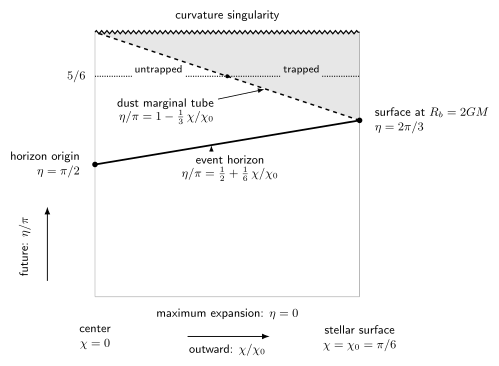
Exact coordinate loci in the Oppenheimer–Snyder dust interior for . The outgoing null event horizon begins at and meets the surface at ; the dashed timelike marginal tube then moves inward in comoving radius. The shaded wedge contains trapped round dust spheres. The axes and are normalized separately, so null rays are not drawn at 45 degrees. The Schwarzschild exterior and the event horizon’s subsequent exterior continuation are not shown.
The solution establishes an exact existence example: regular, piecewise-smooth junction data for a homogeneous dust ball can evolve to trapped surfaces and a black-hole region in finite proper time. The density has a sharp jump at the stellar surface, so the complete initial matter profile is not globally smooth, although the Darmois matching introduces no surface layer. The model makes matching, causal structure, and quasi-local trapping calculable in one spacetime. It does not establish that homogeneous dust collapse is stable under pressure, rotation, nonspherical perturbations, or arbitrary changes of the density profile. It also does not license replacing an event horizon by an apparent horizon in a dynamical calculation.
Three checks should accompany any use of the model. First, compute the same constant from both matching and the Misner–Sharp invariant. Second, verify regularity at the center before the singular time: and . Third, take ; then the ball begins weakly compact and the surface crosses late in the collapse, as physical intuition requires. The primary derivation and its causal interpretation appear in Oppenheimer and Snyder 1939, pp. 455–459, with a modern compact comparison in Harada 2004, §2.1, pp. 2–3.
For a detailed independent presentation of the matching and the two edges of the trapped region, see Baumgarte and Shapiro 2010, §1.4, Eqs. (1.88)–(1.104), pp. 18–22.
Exercises
Section titled “Exercises”For a ball released from rest at , derive the proper-time interval from maximum expansion to the singularity. Then show that the boundary reaches before that time whenever .
Solution
At the singularity , hence and . The parametric clock gives . At horizon crossing, , or . For , the solution on is . Therefore . Equality would occur only in the degenerate limit .
References
Section titled “References”- Baumgarte, Thomas W., and Stuart L. Shapiro. Numerical Relativity: Solving Einstein’s Equations on the Computer. Cambridge University Press, 2010. doi:10.1017/CBO9781139193344.
- Harada, Tomohiro. “Gravitational Collapse and Naked Singularities.” Pramana 63 (2004): 741–754. doi:10.1007/BF02705196. Open PDF.
- Oppenheimer, J. Robert, and Hartland Snyder. “On Continued Gravitational Contraction.” Physical Review 56 (1939): 455–459. doi:10.1103/PhysRev.56.455.