Bifurcation Surfaces and Extensions
Scrollable formula. Use Left and Right arrow keys to reveal hidden content.
Scrollable table. Use Left and Right arrow keys to reveal additional columns.
Scrollable figure. Use Left and Right arrow keys to inspect hidden content.
A bifurcate Killing horizon consists of two smooth null branches meeting on a spacelike codimension-two surface where the horizon Killing field vanishes. Maximally extended Schwarzschild has this structure; a collapse spacetime may contain only its future branch. A nonzero surface gravity often allows the missing branch and bifurcation surface to be supplied in an enlarged spacetime, but that statement is a theorem with substantial hypotheses, not a consequence of drawing a Kruskal diagram.
Required background. Killing Fields and Isometry Groups supplies fixed points and flows of isometries.
Helpful background. Exact Solutions of Einstein’s Equations supplies maximal extensions; Causality and Global Structure supplies global hyperbolicity and event horizons; The Einstein Equation locates the electrovacuum applications; Black-Hole Geometry and Mechanics distinguishes event and Killing horizons.
Bifurcate horizon geometry
Section titled “Bifurcate horizon geometry”Let and be smooth null hypersurfaces meeting transversely on a smooth spacelike surface of codimension two. If a nontrivial Killing field is normal to both branches and
then is a bifurcate Killing horizon and is its bifurcation surface. The flow fixes every point of but acts as a Lorentz boost in its normal two-plane. With a normalized binormal satisfying , one may choose orientation so that
Thus remains finite although the generator vanishes. The two branches are analogous to the future and past Rindler horizons, while is their fixed-point plane. In Schwarzschild, is a round two-sphere.
The bifurcation surface is not part of a single smooth branch generated by a nonzero : it is their intersection and the place where the Killing parameter becomes singular. This distinction matters when a physical collapse spacetime contains a future event horizon but no white-hole region.
Schwarzschild in Kruskal coordinates
Section titled “Schwarzschild in Kruskal coordinates”For Schwarzschild with and , define null Kruskal coordinates from retarded and advanced times and by
The stationary Killing field becomes
The future horizon is , the past horizon is , and their intersection is the bifurcation two-sphere. The metric coefficient multiplying is regular there. This construction performs two checks at once: is tangent and null on each branch, and it vanishes only at their intersection. The horizon geometry and bifurcation sphere in regular Schwarzschild coordinates are reviewed in Gourgoulhon and Jaramillo 2006, arXiv v2, Example 2.5, pp. 24–28.
The verified Schwarzschild diagram below makes the intersection structure visible. Follow either future branch toward the central point : the null generator remains nonzero until the branch reaches the fixed two-sphere, while the past branches continue into the white-hole region. The complete four-way crossing belongs to the eternal maximal extension; it is not automatically present in a one-sided collapse spacetime.
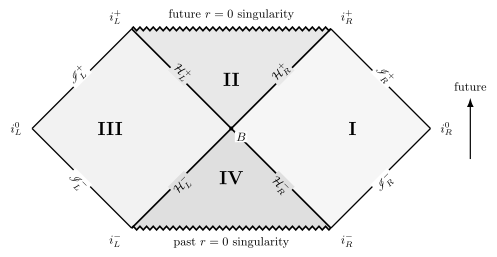
In the maximally extended eternal Schwarzschild solution, two future and two past horizon half-branches meet at the bifurcation two-sphere , where the boost-like Killing field vanishes. Away from that field is nonzero and null on each open branch. Future points upward; the two exterior regions, future black-hole interior, past white-hole interior, and jagged spacelike singularities are shown schematically and not to scale. A physical collapse spacetime need not contain the past branches or .
The exponentials work because . If one rescales , then and its Killing parameter rescale inversely so that the regular coordinates describe the same geometry.
What the extension theorem actually assumes
Section titled “What the extension theorem actually assumes”Rácz and Wald prove a global result for a specific class of stationary final states. In four dimensions, suppose a smooth spacetime is globally hyperbolic, stationary with one suitable asymptotic end, contains a black-hole region but no white-hole region, and has a connected event horizon that is a Killing horizon with compact cross-sections. If the surface gravity of its future-directed Killing generator is a nonzero constant, then there exists a larger spacetime in which the image of is a proper subset of a regular bifurcate Killing horizon. The isometry group also extends, and the enlargement can possess a reflection interchanging the two wedges. The precise statement and construction are Rácz and Wald 1996, §4, Theorem 4.2, pp. 548–550.
No Einstein equation is used in this geometric extension theorem. The asymptotic, causal, compactness, stationarity, and constancy assumptions do the work. The proof has three main stages:
- a compact cross-section is obtained by intersecting the horizon with a Cauchy surface;
- coordinates adapted to the Killing orbits and transverse null geodesics produce a local bifurcate extension;
- control of the orbit space and closed subsets allows that local extension to be attached globally without losing the Hausdorff property.
The theorem does not claim that the added white-hole wedge formed in the physical past of a collapsing star. It says that the original stationary region embeds isometrically into an enlarged geometry useful for geometric arguments. Matter fields require separate smooth-extendibility conditions; Rácz and Wald give those in their §5.
Why nonzero constant surface gravity is not enough alone
Section titled “Why nonzero constant surface gravity is not enough alone”Dropping the theorem’s global assumptions invalidates the implication. Rácz and Wald exhibit a globally hyperbolic conformal modification of a Rindler wedge whose Killing horizon has constant nonzero surface gravity and admits a local bifurcate extension, yet obstructing Killing orbits prevent the desired global extension. Their counterexample is developed in Rácz and Wald 1996, §1, pp. 540–542. It separates three statements that are often conflated:
- a neighborhood of a nondegenerate horizon may have a local bifurcate model;
- the original spacetime need not already contain a bifurcation surface;
- a global enlarged spacetime needs additional causal and orbit-space control.
Constancy of is itself an independent requirement here. For a connected Killing horizon, Rácz and Wald show that it is equivalent to the vanishing on the horizon of the exterior derivative of the generator’s twist one-form Rácz and Wald 1996, §2, Theorem 2.1, pp. 543–544. Staticity or the standard stationary-axisymmetric reflection symmetry supplies useful sufficient conditions, but these should not be silently inserted into the definition of a Killing horizon.
The extremal obstruction
Section titled “The extremal obstruction”For a degenerate Killing horizon, . The ordinary exponential Kruskal map loses its scale, and the horizon generator is already affinely parametrized. In extremal Reissner–Nordström, the proper distance down a static slice to the horizon is infinite, and the maximally extended horizon does not meet an ordinary second branch at a regular surface where the asymptotically normalized stationary Killing field vanishes. This is a geometric discontinuity: taking the extremal limit of nonextremal bifurcation spheres does not produce a bifurcation sphere of the extremal spacetime.
That failure does not mean the extremal metric is singular at its horizon. Regular ingoing coordinates cross it. What fails is the nondegenerate boost fixed-point structure, not smooth horizon crossing.
Test the scope of the theorem
Section titled “Test the scope of the theorem”A stationary collapse exterior has a connected compact Killing event horizon with constant , but the physical spacetime contains no past horizon. May one conclude that a bifurcation surface lies in the original spacetime?
Solution
No. Under the full Rácz–Wald hypotheses one may construct a larger spacetime into which the original one embeds and in which the original horizon becomes part of a bifurcate Killing horizon. The bifurcation surface belongs to the extension and need not belong to the collapse spacetime. The distinction is essential when a proof evaluates data at a bifurcation surface: one must show that the relevant geometric or matter fields extend smoothly as well.
Gaussian Null and Horizon-Adapted Coordinates next constructs a regular local chart that works without assuming a bifurcation surface.
References
Section titled “References”- Gourgoulhon, Éric, and José Luis Jaramillo. “A 3+1 Perspective on Null Hypersurfaces and Isolated Horizons.” Physics Reports 423 (2006): 159–294. DOI. Open PDF.
- Rácz, István, and Robert M. Wald. “Global Extensions of Spacetimes Describing Asymptotic Final States of Black Holes.” Classical and Quantum Gravity 13 (1996): 539–553. DOI. Open PDF.