Kerr as the Stationary Vacuum Benchmark
Scrollable formula. Use Left and Right arrow keys to reveal hidden content.
Scrollable table. Use Left and Right arrow keys to reveal additional columns.
Scrollable figure. Use Left and Right arrow keys to inspect hidden content.
Kerr is the stationary vacuum benchmark because rigidity and uniqueness turn a long list of geometric hypotheses into a two-parameter exterior. Within that domain, mass and angular momentum fix the horizon, multipoles, geodesic structure, and every other vacuum exterior observable. The benchmark is conditional: a dynamical, matter-filled, non-asymptotically-flat, singular, or higher-dimensional exterior is not covered merely because it rotates. A 2026 preprint theorem now also explains why finitely many stationary vacuum horizons cannot remain in regular axisymmetric balance; it does not remove the separate smooth global-rigidity problem.
Required background. Killing Fields and Isometry Groups supplies stationary and axial actions and their normalized generators.
Helpful background. Exact Solutions of Einstein’s Equations supplies the Kerr family; Causality and Global Structure supplies -regular exterior geometry; The Einstein Equation supplies the vacuum equations; and Mathematical Relativity supplies rigidity, topology, and harmonic-map uniqueness.
The stationary vacuum classification statement
Section titled “The stationary vacuum classification statement”Assume a four-dimensional, analytic, asymptotically flat vacuum spacetime with a complete stationary Killing field and an -regular domain of outer communications. Thus the exterior is globally hyperbolic and admits the regular acausal slice required by the classification theorem. Assume the event horizon is connected and either mean nondegenerate or rotating, with no conical defects or naked singularities in the exterior.
“Mean nondegenerate” is defined before rigidity has shown that the event horizon is Killing: a smooth compact cross-section must have nonzero averaged Gaussian-null horizon coefficient, conventionally denoted . Once the horizon is known to be a Killing horizon with constant surface gravity, this becomes the familiar nonextremality condition Chruściel, Costa, and Heusler 2012, §2.5.3, equations (2.20)–(2.21).
Under these hypotheses, the domain of outer communications is isometric to a Kerr exterior. The nonrotating case is Schwarzschild, the member. The rotating case has an axial Killing field supplied by rigidity and satisfies . The precise electrovacuum theorem, specialized by setting the Maxwell field to zero, appears in Chruściel, Costa, and Heusler 2012, §3.3.2, Theorem 3.3.
There are two logically different results inside that sentence. If axisymmetry is assumed from the outset, the axisymmetric uniqueness theorem classifies a connected regular vacuum exterior without needing analyticity in the same way. Deriving global axisymmetry from stationarity is the rigidity step for which the classical theorem uses analyticity. Merging those steps would conceal the main smoothness gap.
Why disconnected vacuum horizons cannot balance
Section titled “Why disconnected vacuum horizons cannot balance”Connectedness is an input to the classical comparison theorem above. A newer, logically separate result asks whether a regular axisymmetric stationary vacuum exterior with several horizon components can exist at all. In Weyl–Papapetrou coordinates, the boundary of the orbit half-plane is ordered into horizon and axis pieces. A nondegenerate horizon projects to a finite rod; a degenerate horizon projects to a puncture. The trace of the Weyl conformal factor on an axis rod is its logarithmic angle defect,
where is the associated interaction-force parameter. Conical regularity requires . Asymptotic normalization gives on the two external axis rods.
Han, Khuri, Weinstein, and Xiong consider any finite mixture of nondegenerate horizon rods and degenerate punctures in the standard stationary vacuum singular-harmonic-map class. For , assume only that every degenerate component has ; no angular-momentum condition is imposed on a nondegenerate rod. Their theorem proves
Thus every bounded separating axis has , interpreted as a strictly attractive interaction. It cannot simultaneously be a regular axis. This excludes a regular stationary vacuum multi-black-hole balance in the stated class Han, Khuri, Weinstein, and Xiong 2026, §1, Theorem 1.1, pp. 2–4, Open PDF.
The sign is not inferred from a weak-field analogy. The field equations give a global estimate , while a strict local argument shows that no bounded axis rod can attain . Because an external rod already has , the maximum is zero and all bounded-rod values are strictly negative. In the figure, inspect the finite dashed segment between the two horizon components: the upper panel identifies the rod data, and the lower cards display the exact sign logic.
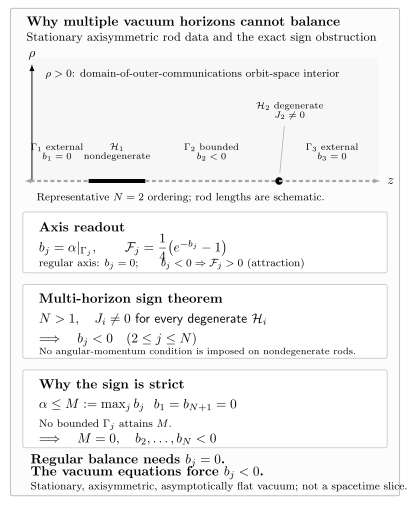
A representative orbit-space boundary contains one nondegenerate horizon rod, one degenerate horizon puncture with nonzero angular momentum, and a bounded axis rod between them. In the stationary axisymmetric asymptotically flat vacuum class of Han, Khuri, Weinstein, and Xiong, and . The external axes have zero defect, while the field equations force every bounded-axis defect to be strictly negative; its interaction force is therefore positive and attractive. Since a regular axis would require zero defect, no regular multi-horizon balance exists in this class. The rod lengths and spacing are schematic orbit-space coordinates, not proper distances or a spacetime slice; the result is a 2026 preprint theorem.
Under the standard analytic, asymptotically flat, -regular hypotheses, a rotating horizon component supplies global axisymmetry by rigidity. The new balance theorem then forces the horizon to be connected, and the classical connected-horizon theorem selects Kerr Han, Khuri, Weinstein, and Xiong 2026, discussion after Theorem 1.1, p. 4, Open PDF. This composition does not derive global axisymmetry from arbitrary smooth stationarity. It also does not cover electrovacuum, matter, nonzero , higher dimensions, or the theorem’s excluded case of a degenerate component with ; nor is the geometric quantity a time-dependent force law or a stability result.
From symmetry to an orbit-space boundary problem
Section titled “From symmetry to an orbit-space boundary problem”Rigidity first divides the problem into a static branch and a rotating stationary-axisymmetric branch. Static vacuum uniqueness selects Schwarzschild. In the rotating branch, let be the asymptotic time translation and the -periodic axial field. Vacuum circularity shows that, away from axes and horizons, the metric splits into the two Killing directions and a two-dimensional orbit space.
The vacuum Einstein equations for the norm and twist of become the Ernst harmonic-map system. Global regularity and topological censorship control the orbit space; the axis, horizon interval, and infinity supply different boundary conditions. Mass and angular momentum fix the asymptotic data, while regularity fixes how the potentials behave on axis and horizon segments.
To compare a candidate exterior with Kerr, the Robinson–Mazur method builds a nonnegative divergence identity from their harmonic maps. Integration over the orbit space gives boundary terms at the axis, horizon, and infinity. Precise asymptotics and regularity make those terms vanish, so the nonnegative bulk difference must vanish and the two maps coincide. The reconstructed metrics are therefore isometric. This reduction and comparison are organized in Chruściel, Costa, and Heusler 2012, §§3.2.3–3.2.7, especially Theorem 3.2; Robinson’s original vacuum conclusion appears in Robinson 1975, pp. 905–906.
Kerr and Electrovacuum Uniqueness gives the rigorous treatment of the orbit-space topology, Ernst map, divergence identity, boundary estimates, and theorem variants.
What Kerr then fixes
Section titled “What Kerr then fixes”For , define . The horizon quantities follow from the algebraic roots
For , these are the outer and inner horizon radii. At , is the Schwarzschild horizon while the lower root is the central curvature singularity, not an inner horizon.
These calculations verify the selected solution; they are not substitutes for the theorem. With Geroch–Hansen moments expressed in geometrized units, Kerr also satisfies
Thus , , and the mass quadrupole is . Once the hypotheses hold, a freely adjustable quadrupole would contradict the classification. Photon regions, orbital frequencies, tidal invariants, and horizon shape are likewise determined by , although extracting them may require substantial calculation.
The theorem fixes only the stationary vacuum exterior. It does not fix the matter that collapsed, guarantee nonlinear settling, or classify a realistic accretion environment. A measured departure from a Kerr multipole relation could indicate environmental matter, nonequilibrium, inference bias, or a change of gravitational theory; the uniqueness theorem alone cannot choose among them.
Hypotheses that prevent false counterexamples
Section titled “Hypotheses that prevent false counterexamples”A five-dimensional black ring can share conserved charges with a Myers–Perry black hole, but it changes dimension and horizon topology. A four-dimensional black hole with a scalar condensate changes the matter equations. Kerr–AdS changes the asymptotic boundary. A double-Kerr candidate with a strut changes exterior regularity; the multi-horizon sign theorem explains why a nonzero axis defect is unavoidable in its vacuum hypothesis class. None refutes the theorems stated above.
The analyticity issue is different: it is a limitation of the strongest general route from stationarity to global axisymmetry, not a known regular vacuum counterexample. Smooth local rigidity and near-Kerr uniqueness results cover important subsets, while the unrestricted smooth formulation remains more delicate. Likewise, extremal horizons require theorem variants because a standard bifurcation surface is absent.
Calling Kerr “the unique rotating black hole” therefore drops too many quantifiers. The correct conclusion names the theory, dimension, asymptotics, stationarity, regularity, horizon conditions, and the exterior being classified.
Test an independent quadrupole
Section titled “Test an independent quadrupole”A proposed four-dimensional metric is claimed to be analytic, stationary, asymptotically flat, vacuum, -regular, and to possess one connected nondegenerate horizon. It has ADM parameters but a Geroch–Hansen mass quadrupole different from . Can all claims be true simultaneously? What if a thin matter torus lies outside the horizon?
Solution
They cannot all be true. The hypotheses place the domain of outer communications in the Kerr classification, which fixes every multipole and in particular . A verified independent quadrupole would force at least one claimed hypothesis—vacuum, regularity, asymptotics, stationarity, connectedness, analyticity, or the invariant-moment calculation—to fail.
With a matter torus in the domain, the vacuum hypothesis fails. The exterior can then carry matter-sourced multipoles not fixed by , even if the near-horizon geometry is approximately Kerr. That is a different boundary- value problem, not a counterexample to vacuum uniqueness.
Kerr–Newman as the Electrovacuum Benchmark next adds Maxwell charge and the electromagnetic Ernst potential to the same classification architecture.
References
Section titled “References”- Chruściel, Piotr T., João Lopes Costa, and Markus Heusler. “Stationary Black Holes: Uniqueness and Beyond.” Living Reviews in Relativity 15 (2012): 7. DOI.
- Han, Qing, Marcus Khuri, Gilbert Weinstein, and Jingang Xiong. “Kerr Black Hole Uniqueness.” arXiv:2608.23325v1 [gr-qc] (24 August 2026). arXiv.
- Robinson, David C. “Uniqueness of the Kerr Black Hole.” Physical Review Letters 34 (1975): 905–906. DOI.