The Penrose Particle-Splitting Process
Scrollable formula. Use Left and Right arrow keys to reveal hidden content.
Scrollable table. Use Left and Right arrow keys to reveal additional columns.
Scrollable figure. Use Left and Right arrow keys to inspect hidden content.
The original Penrose process is a local particle decay inside the Kerr ergoregion. One daughter carries negative stationary Killing energy into the horizon; conservation then lets the other escape with more energy than the parent brought from infinity. The process extracts black-hole rotational energy because the absorbed daughter also carries sufficiently negative angular momentum. In the ideal neutral, single-decay test-background limit , the escaping energy approaches times the incident energy, a gain. That bound does not cover collisions, charge, external fields, or repeated interactions.
Required background. Spacetime Symmetries and Killing Fields supplies conserved energy and angular momentum. Helpful background. Exact Spacetimes supplies Kerr geodesics; Causality and Global Structure fixes future horizon crossing; Einstein Equations fixes the test background; Black-Hole Geometry and Mechanics supplies the area constraint; Black-Hole Perturbation Theory develops field extraction.
Set up the decay
Section titled “Set up the decay”Work in an uncharged Kerr geometry and neglect the fragments’ backreaction. An incident particle with four-momentum reaches a point inside the ergoregion and decays into two future-directed causal fragments:
Contracting with the stationary and axial Killing fields gives
where and . Arrange fragment 2 to follow an allowed negative-energy trajectory into the future horizon, . Then
Energy at infinity is conserved: the gain in the escaping fragment is exactly , the decrease of black-hole mass in the test approximation. Local four-momentum conservation also enforces rest-mass and opening-angle constraints; choosing numbers that conserve only and is insufficient.
The split must occur in the ergoregion, because negative is impossible where is future timelike. It must also give fragment 1 an outward radial trajectory that reaches infinity and fragment 2 a future-directed inward trajectory. Brito, Cardoso, and Pani give the original turning-point construction in Brito, Cardoso, and Pani 2020, §4.3.1, pp. 40–43. Penrose’s original discussion and its particle-splitting footnote are available in Penrose 1969, reprinted 2002, pp. 1160–1161.
The figure keeps three statements separate: where the split may occur, how the stationary Killing charges add, and what future horizon crossing demands. Inspect the gray ergoregion first, then follow the negative-energy daughter to the generator-energy inequality in the lower panel.
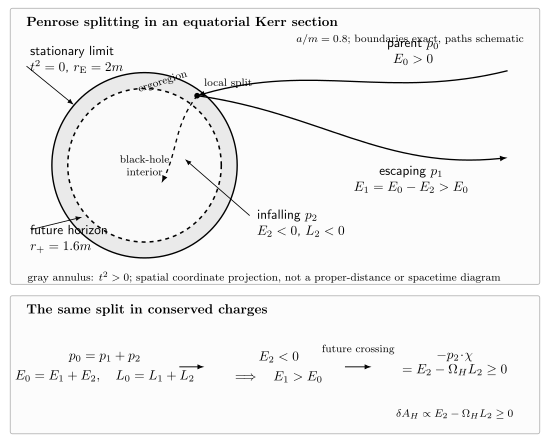
In an equatorial Kerr section, the gray band between the outer stationary limit and future horizon is the ergoregion. A local decay there may send a daughter with and through the future horizon, so conservation gives the escaping daughter . Future crossing still requires , the same combination that keeps the first-order horizon-area change nonnegative. The boundaries are exact equatorial Kerr–Schild coordinate circles for ; the paths are schematic coordinate projections, not geodesic solutions or a proper-distance diagram.
Horizon crossing and area consistency
Section titled “Horizon crossing and area consistency”The future horizon generator is . Causality for the infalling fragment requires
Since and , its angular momentum must be negative and large enough in magnitude. Absorption changes the black hole by
For a subextremal background, . In the quasi-stationary test-perturbation regime, the physical-process first law gives
Here “quasi-stationary” means that the horizon expansion and shear remain weak enough to neglect the relevant quadratic terms and that no new generators join the horizon Amsel, Marolf, and Virmani 2008, §II, pp. 4–6, Open PDF.
Thus mass extraction is compatible with area nondecrease in this regime. A reversible ideal trajectory saturates the inequality and keeps area fixed to first order, while strictly positive horizon-generator energy increases the area at this order. This differential argument is not an area proof at exact extremality: when , it degenerates, and a finite capture must instead be checked using the exact final geometry or a higher-order perturbative analysis. Exact and nearly extremal absorption instead requires separate first- and second-order variational inequalities Sorce and Wald 2017, §§III–IV, Open PDF.
This calculation also prevents a misleading energy story. The ergoregion does not radiate energy spontaneously in the stationary test problem. A specific interaction creates a negative symmetry-charge fragment, and the horizon absorbs that fragment under the causal inequality.
Ideal turning-point efficiency
Section titled “Ideal turning-point efficiency”For the standard equatorial-plane gedanken experiment, take a parent of rest mass that starts at rest at infinity, so , and decays at a radial turning point into two equal-rest-mass fragments . Solving the Kerr turning-point conditions together with four-momentum conservation gives the escaping branch
For a fixed subextremal Kerr test background, the idealized gain approaches its supremum for massless daughters, , as the split is taken toward the outer horizon. Then
Taking the test-background limit , for which , gives
If efficiency is instead defined as net gain divided by input,
The familiar value is therefore a limiting test-background result, not the efficiency of a finite backreacting decay carried out between exact stationary extremal black holes.
Stating the definition avoids calling the same result either or without explanation. The exact mass-ratio dependence and horizon limit are in Brito, Cardoso, and Pani 2020, Eqs. 4.27–4.32, pp. 42–43.
A concrete conservation example
Section titled “A concrete conservation example”Let and in arbitrary units. Suppose a locally allowed split produces an infalling daughter with and , while . Conservation gives
The horizon condition is
so the black-hole area increases at first order in the quasi-stationary test limit on a subextremal background. The escaping energy is above the input. These charge checks are necessary, but a full trajectory construction must additionally verify the mass shell and radial potential for both daughters.
If instead , the horizon combination would be , so that proposed future crossing is impossible even though energy and angular momentum could be made to add algebraically. Causal kinematics removes it.
Scope of the bound
Section titled “Scope of the bound”The limiting gain assumes a single decay of a particle falling from rest, neutral Kerr with as a test background, test bodies, ideal turning-point placement, and massless optimal daughters. Collisional Penrose processes begin with two incident particles and have different efficiencies. Charged fragments, electromagnetic fields, and multiple scattering add work reservoirs or altered initial states. Near-horizon center-of-mass energy can be large without guaranteeing that a correspondingly energetic fragment escapes to infinity.
Finite size, self-force, radiation reaction, and nonlinear backreaction also shift the trajectory and energy balance. The original calculation remains a clean existence proof and normalization benchmark; it is not a universal astrophysical conversion efficiency.
Check the efficiency convention
Section titled “Check the efficiency convention”In the limiting test-background calculation , use the ideal formula to compute the escaping energy from a parent with units. Report both outgoing/input efficiency and net-gain efficiency. What energy enters the black hole?
Solution
In this limiting calculation, the escaping energy is
Thus , or when expressed as outgoing energy per input. The net-gain efficiency is , or . Conservation requires
which is the stationary Killing energy absorbed by the black hole. A complete optimal configuration also assigns it sufficiently negative angular momentum to satisfy future horizon crossing.
Irreducible Mass and Rotational Energy turns area nondecrease into a bound on the total reversible reservoir, distinct from this one-decay gain.
References
Section titled “References”- Amsel, Aaron J., Donald Marolf, and Amitabh Virmani. “The Physical Process First Law for Bifurcate Killing Horizons.” Physical Review D 77 (2008): 024011. DOI. Open PDF.
- Brito, Richard, Vitor Cardoso, and Paolo Pani. Superradiance. 2nd ed. Lecture Notes in Physics 971. Cham: Springer, 2020. DOI.
- Penrose, Roger. “Gravitational Collapse: The Role of General Relativity.” Rivista del Nuovo Cimento, Numero Speziale I (1969): 252–276; reprinted in General Relativity and Gravitation 34 (2002): 1141–1165. DOI.
- Sorce, Jonathan, and Robert M. Wald. “Gedanken Experiments to Destroy a Black Hole II: Kerr–Newman Black Holes Cannot Be Over-Charged or Over-Spun.” Physical Review D 96 (2017): 104014. DOI. Open PDF.