Phase Diagrams, Nonuniqueness, and Stability Boundaries
Scrollable formula. Use Left and Right arrow keys to reveal hidden content.
Scrollable table. Use Left and Right arrow keys to reveal additional columns.
Scrollable figure. Use Left and Right arrow keys to inspect hidden content.
A higher-dimensional black-object phase diagram compares stationary solutions only after fixing the theory, dimension, asymptotics, conserved charges, compactification lengths, and horizon connectedness. Even then, a curve in area–spin space may represent an exact family, a perturbative bifurcation, a controlled thin-object approximation, or numerical evidence for a merger. This page separates those evidential levels and explains why neither maximal area nor a linear zero mode supplies a universal dynamical endpoint.
Helpful background. Exact Solutions of Einstein’s Equations supplies the named solution families; Global Structure supplies topology and boundary conditions; the Einstein equation fixes the theory being compared; Black-Hole Perturbation Theory supplies mode stability; and Black-Hole Geometry and Mechanics supplies the charges and first laws.
The literature assessment on this page is current through 2026-08-12. Later exact constructions, converged numerical branches, perturbative spectra, or nonlinear evolutions are outside this evidence window.
Choose the phase space before drawing it
Section titled “Choose the phase space before drawing it”For a singly rotating asymptotically flat family at fixed dimension, one often removes the mass scale and plots dimensionless horizon area against dimensionless spin. Schematically,
where the constants and are convention choices. In a Kaluza–Klein problem with circle length , natural axes instead include
Points from these two diagrams cannot be overlaid: their asymptotic boundary conditions and charge sets differ. A meaningful comparison must hold fixed all of the following:
- spacetime dimension and field theory;
- asymptotically flat, Kaluza–Klein, de Sitter, or anti-de Sitter boundary conditions;
- total charges and compactification moduli;
- connected versus disconnected horizons and the regularity class;
- perturbation data class, symmetry sector, and horizon/infinity boundary conditions.
Area at fixed conserved charges is a microcanonical thermodynamic comparison. It is not, by itself, a theorem of linear stability, nonlinear attraction, or formation from generic initial data.
Dated map of the principal branches
Section titled “Dated map of the principal branches”| Setting and branch | Construction status | What is established | What remains conditional or open |
|---|---|---|---|
| Five-dimensional asymptotically flat vacuum: Myers–Perry and singly or doubly spinning rings | Exact | Regular parameter domains, charges, mechanics, spherical or ring topology, and charge nonuniqueness | Complete stability spectra and a classification without strong symmetry assumptions |
| Five-dimensional black Saturns and multiple rings | Exact multi-horizon families | Disconnected horizons and continuous redistribution of total charges produce still greater nonuniqueness | Generic thermodynamic equilibrium, stability, and completeness of all multi-object branches |
| Six- and seven-dimensional singly spinning holes, lumpy holes, and rings | Exact Myers–Perry background; numerical stationary branches | Lumpy branches bifurcate at an ultraspinning zero mode; one numerical branch approaches a ring through a high-curvature topology-changing regime | A theorem that the branches meet, all higher harmonics, and the full diagram in arbitrary dimension |
| Thin rings and other blackfolds | Matched asymptotic or effective approximation | Controlled leading behavior when the horizon thickness is much smaller than the worldvolume curvature radius | Thick-object completion, global branch endpoints, and stability outside the expansion regime |
| Kaluza–Klein uniform strings, nonuniform strings, and localized holes | Uniform branch exact; other branches numerical or perturbative | Gregory–Laflamme thresholds and substantial evidence for nonuniform/localized branches and merger geometry | Dimension- and ensemble-dependent global completion and generic nonlinear endpoints |
| Rotating Kaluza–Klein strings and resonator strings | Perturbative plus numerical | Helically symmetric branches can bifurcate from superradiant onsets and coexist with Myers–Perry strings | Low-energy coverage, full instability spectrum, and nonlinear selection |
The exact five-dimensional constructions already prove that do not label a unique geometry. Black Saturns add a spherical central horizon surrounded by a ring; di-rings and related configurations add further components. The exact-family and balance structure is summarized in Emparan and Reall 2008, §§5.1–5.4. These families establish existence, not dynamical accessibility.
The cleanest exact charge-nonuniqueness example needs no numerical continuation. The first panel below parameterizes balanced singly spinning rings; the second compares their existence interval with the distinct Myers–Perry family at the same and . Read it as an existence diagram, not as a stability or evolution diagram.
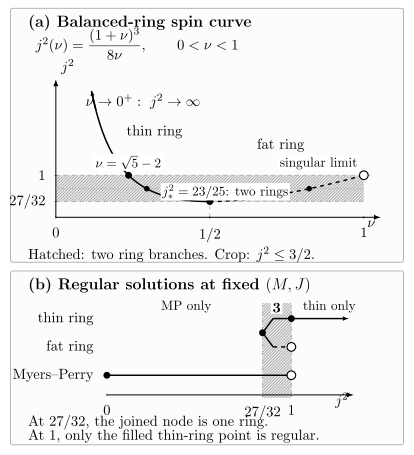
Balanced singly spinning rings obey for . The curve decreases along the thin branch, reaches the regular minimum-spin ring , and rises along the fat branch toward the excluded singular limit . Every level intersects the ring curve twice and also admits a regular singly spinning Myers–Perry black hole, giving three regular solutions with the same mass and angular momentum. At the ring branches coincide, while at the regular thin ring at remains but the fat-ring and Myers–Perry endpoints are singular. The curve is exact; its vertical display is cropped at , and the continuation arrow represents . No stability or dynamical-endpoint statement is implied.
For , the blackfold expansion bends a boosted string into a thin ring and imposes vanishing effective tension as the balance condition. Its small parameter is the ratio of horizon thickness to ring radius. The approximation and the proposed pinched-hole connections are developed in Emparan et al. 2007, §§2–8. A phase-diagram curve drawn beyond that hierarchy is an extrapolation unless an independent numerical or exact construction reaches it.
Bifurcations and merger evidence
Section titled “Bifurcations and merger evidence”A stationary zero mode of a linearized operator can mark a local bifurcation. For singly spinning Myers–Perry holes in six and seven dimensions, numerical solutions reveal two lumpy branches emerging at an ultraspinning onset. One branch approaches a numerically constructed ring while the horizon curvature grows in the expected topology-changing region. The construction satisfies convergence and Smarr checks and gives strong merger evidence in those dimensions Dias, Santos, and Way 2014, pp. 3–8 and Figs. 1–4.
That result has a precise scope. It does not prove a smooth topology change—the limiting geometry is singular—nor show that every lumpy harmonic joins a ring. The second branch found in the same calculation moves toward large curvature instead. The numerical result also cannot be promoted to every without additional continuation.
The Kaluza–Klein diagram has a parallel structure. Uniform strings meet a static threshold mode, nonuniform strings branch there, and localized holes occupy a distinct topology. In five dimensions, numerical continuations from the nonuniform and localized sides approach a common high-curvature regime; agreement of thermodynamic quantities, embeddings, and low-lying spectra gives substantial but not conclusive evidence that the branches merge Headrick, Kitchen, and Wiseman 2010, §4.5, pp. 28–36 and Figs. 5–11. The local double-cone model remains a critical-geometry proposal, not a numerically resolved smooth topology change. Which branch has greater area and whether the nonuniform direction is initially favorable depend on dimension and ensemble. “Gregory–Laflamme unstable” therefore identifies a linear boundary, not one universal final state.
Stability evidence is branch and sector dependent
Section titled “Stability evidence is branch and sector dependent”For the five-dimensional singly spinning ring, numerical perturbation theory found a nonaxisymmetric mode that continues from the fat branch into the thin branch. Combined with independent fat-ring arguments, this is strong evidence that the full balanced singly spinning family is unstable in the examined vacuum setting Santos and Way 2015, pp. 2–8 and Figs. 2–6. It remains numerical spectral evidence, not a theorem covering every matter model, second angular momentum, boundary condition, or nonlinear data class.
For a five-dimensional uniform black string, fully nonlinear simulations of several periodic lengths find a self-similar sequence of bulges and ever thinner string segments, with fits supporting pinch-off in finite asymptotic time. The revisited evolutions also report no single global timescale linking all generations Figueras et al. 2023, §§III.2–III.3 and Table III. This supports weak-cosmic-censorship violation for that vacuum Kaluza–Klein initial-data family; it does not settle other dimensions, rotating strings, altered matter, or arbitrary initial data.
Rotating strings make the landscape still less universal. Six-dimensional equal-spin Myers–Perry strings possess superradiant as well as Gregory–Laflamme channels, and helically symmetric black resonator strings have been constructed perturbatively and numerically. Their known phase space has unresolved low-energy boundaries Dias et al. 2023, §§4 and 7. This is a direct example in which changing the symmetry class reveals branches absent from a purely stationary-axisymmetric chart.
What the 2026 boundary does and does not settle
Section titled “What the 2026 boundary does and does not settle”By the evidence cutoff, exact five-dimensional rings, multiple-horizon families, several numerical lumpy/ring branches, Kaluza–Klein branches, blackfold approximations, large- expansions, and selected nonlinear instability evolutions are all established within their stated domains. The large- treatment maps nonuniform-string thermodynamics and quasinormal stability through fourth order in , but its quantitative control is an expansion in inverse dimension rather than an exact finite- classification Emparan et al. 2018, §§2–5, pp. 4–28. Modern solution-generating work continues to sharpen the exact families. For example, a 2026 monodromy construction reconstructs the known doubly rotating Myers–Perry and Pomeransky–Sen’kov ring geometries from a Riemann–Hilbert factorization Sakamoto and Tomizawa 2026, §§3–5. That is valuable structural control, but it does not by itself prove that no other branches exist.
Several questions remain unresolved rather than merely uncomputed here:
- Is there a complete classification of regular higher-dimensional stationary vacuum black objects under substantially weaker symmetry assumptions?
- Which numerical topology-changing approaches can be continued to a controlled critical geometry, and in which dimensions?
- Which linearly unstable branches have smooth nonlinear endpoints for generic admissible initial data?
- How do matter model, cosmological boundary conditions, higher-curvature terms, or additional compact directions reorganize the diagram?
A converged construction or evolution that fills a missing branch or resolves a stability boundary at fixed dimension and asymptotics must trigger a fresh review of this comparison.
A universal verdict such as “the largest-area branch is the endpoint” is not supported. The answer can change with the formulation axes—dimension, theory, asymptotics, regularity, initial-data class, symmetry sector, and boundary condition.
Check your understanding
Section titled “Check your understanding”At fixed , suppose a numerical lumpy black hole has slightly greater area than Myers–Perry, and the Myers–Perry solution has a stationary ultraspinning zero mode. Which conclusions follow: thermodynamic preference, existence of a local bifurcation, linear instability, or a unique nonlinear endpoint?
Solution
The larger area establishes microcanonical thermodynamic preference among the two constructed stationary solutions at those charges. A genuine regular zero mode, together with a continued family of solutions, identifies a local stationary bifurcation.
Neither fact alone proves a growing linear mode: the frequency must be followed through the onset with the stated perturbation boundary conditions. They also do not select a unique nonlinear endpoint. Evolution depends on the unstable mode content, allowed radiation, symmetries and initial data, and whether the candidate branch remains regular and stable away from the local bifurcation. The correct conclusion is therefore formulation-dependent, not universal.
Return to the chapter overview to compare these evidential levels across all six benchmark pages: Higher-Dimensional Black Holes and Black Objects.
References
Section titled “References”- Dias, Oscar J. C., Jorge E. Santos, and Benson Way, “Rings, Ripples, and Rotation: Connecting Black Holes to Black Rings,” Journal of High Energy Physics 2014(07), 045 (2014). DOI. Open PDF.
- Dias, Oscar J. C., Takaaki Ishii, Keiju Murata, Jorge E. Santos, and Benson Way, “Gregory–Laflamme and Superradiance Encounter Black Resonator Strings,” Journal of High Energy Physics 2023(02), 069 (2023). DOI. Open PDF.
- Emparan, Roberto, and Harvey S. Reall, “Black Holes in Higher Dimensions,” Living Reviews in Relativity 11, 6 (2008). DOI. Open PDF.
- Emparan, Roberto, Raimon Luna, Marina Martínez, Ryotaku Suzuki, and Kentaro Tanabe, “Phases and Stability of Non-Uniform Black Strings,” Journal of High Energy Physics 2018(05), 104 (2018). DOI. Open PDF.
- Emparan, Roberto, Troels Harmark, Vasilis Niarchos, Niels A. Obers, and María J. Rodríguez, “The Phase Structure of Higher-Dimensional Black Rings and Black Holes,” Journal of High Energy Physics 2007(10), 110 (2007). DOI. Open PDF.
- Figueras, Pau, Tiago França, Chenxia Gu, and Tomas Andrade, “The Endpoint of the Gregory–Laflamme Instability of Black Strings Revisited,” Physical Review D 107, 044028 (2023). DOI. Open PDF.
- Headrick, Matthew, Sam Kitchen, and Toby Wiseman, “A New Approach to Static Numerical Relativity, and Its Application to Kaluza–Klein Black Holes,” Classical and Quantum Gravity 27, 035002 (2010). DOI. Open PDF.
- Sakamoto, Jun-ichi, and Shinya Tomizawa, “Monodromy-Matrix Description of Doubly Rotating Black Rings,” Journal of High Energy Physics 2026(05), 113 (2026). DOI.
- Santos, Jorge E., and Benson Way, “The Black Ring Is Unstable,” Physical Review Letters 114, 221101 (2015). DOI. Open PDF.