Schwarzschild–de Sitter Horizon Structure
Scrollable formula. Use Left and Right arrow keys to reveal hidden content.
Scrollable table. Use Left and Right arrow keys to reveal additional columns.
Scrollable figure. Use Left and Right arrow keys to inspect hidden content.
Schwarzschild–de Sitter spacetime replaces the single asymptotically flat exterior by a finite static region. A black-hole horizon bounds that region on the inside and an observer-dependent cosmological horizon bounds it on the outside. Both arise as roots of one cubic, and their existence requires an upper bound on the mass parameter. The root ordering also fixes the signs of their surface gravities before any thermodynamic interpretation is attempted.
Helpful background. Exact Solutions of Einstein’s Equations supplies static coordinate methods; Causality and Global Structure supplies observer domains and cosmological horizons; The Einstein Equation supplies the positive- vacuum equations; and Black-Hole Geometry and Mechanics supplies Killing-horizon terminology.
The cubic horizon equation
Section titled “The cubic horizon equation”Set
with and . In the static chart,
A Killing horizon of occurs at a positive zero of . After multiplication by , the horizon equation becomes
This four-dimensional specialization is consistent with the Kerr–de Sitter radial equation and horizon analysis in Gibbons, Lü, Page, and Pope 2005, §§3–4, especially eqs. (3.6) and (4.16)–(4.18).
Introduce
For , the cubic has two positive roots and one negative root:
The subscripts denote black-hole, cosmological, and unphysical negative roots. The existence condition can be written
As , while , recovering the de Sitter static patch after the black-hole root collapses. The third root is algebraically necessary even though it is not an areal radius in the physical region.
The finite static region
Section titled “The finite static region”Factoring the lapse function gives
For , exactly one of the three numerator factors is negative, so . Hence is timelike and is spacelike only in this finite interval. At and , the static coordinates fail, but regular horizon-penetrating coordinates show that the metric itself need not be singular. For , becomes timelike; that region is not a second static exterior.
The two horizons have different causal meanings. The black-hole horizon is a future boundary for signals that fall inward from the chosen static patch. The cosmological horizon bounds what the corresponding family of observers can receive or influence. It is therefore tied to an observer domain rather than to future null infinity; the conformal infinity of de Sitter spacetime is spacelike. The global conformal extension is routed to Causality and Global Structure.
With the single generator , define signed surface gravity by
Since
one has and . The negative cosmological sign is an orientation statement for the same , not a negative local temperature. Absolute values may be used later, but discarding the sign too early obscures the two boundary orientations. The geometric definition of surface gravity and its normalization dependence are developed in Bardeen, Carter, and Hawking 1973, pp. 164–166.
The Nariai double root
Section titled “The Nariai double root”Coalescence requires both and . The second equation gives . Substitution into the first yields
Thus , , and both signed surface gravities vanish for the unrescaled . This is the Nariai boundary of the Schwarzschild–de Sitter parameter range. It does not follow that the limiting spacetime has zero size: the static radial coordinate degenerates, and a simultaneous radial and time rescaling retains a finite product geometry. That scaling is carried out on Nariai and Ultracold Limits.
For , the local maximum of lies below zero. There is no interval bounded by distinct positive black-hole and cosmological Killing horizons in this family. This is a statement about the exact vacuum solution, not a general collapse theorem.
The upper panel below now places all three positive-mass root regimes on one dimensionless lapse plot. Inspect both the zero crossings and the sign between them. The lower panel then separates the critical Kottler double root from the nondegenerate Nariai geometry obtained only after magnifying the shrinking inter-root region.
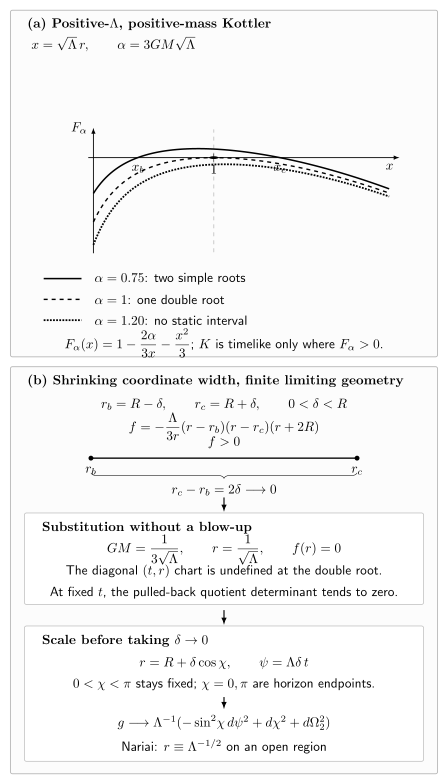
Top: the exact lapse with and . The representative subcritical curve has two positive crossings with between them, the critical curve is tangent at the double root, and the supercritical curve has no positive crossing. Bottom: although shrinks to zero, the simultaneous radial and time scaling shown retains a finite constant-radius Nariai patch. The plot is quantitative; the scaling flow is schematic. The critical Kottler metric is not simply identical to Nariai, and the figure does not by itself assign global event-horizon roles.
Root relations and independent checks
Section titled “Root relations and independent checks”Vieta’s relations turn the three roots into useful checks that do not depend on the trigonometric parametrization:
Thus any proposed pair determines both the de Sitter scale and the mass parameter. These relations are especially good at detecting a missing factor of three in the definition . They also show directly that the negative root is not optional algebraic bookkeeping: eliminating it incorrectly destroys the coefficient constraints of the cubic.
The small-mass limit supplies another independent check. Iterating the horizon equation gives
whereas expansion about the de Sitter root gives
The black-hole horizon therefore grows from the Schwarzschild value while the cosmological horizon moves inward from . Their areas, and , move in opposite directions as increases. This shared-parameter constraint will later explain the opposite signs in their separate first-law formulas.
At each simple root, regularity can be checked without constructing the whole maximal extension. Define an ingoing coordinate . The metric becomes
which is finite at a simple zero of . This demonstrates that the divergence of in static coordinates is a chart failure. It does not determine the full global role of the horizon; that still requires the chosen observer domain and conformal completion.
Two normalization cautions matter. First, no asymptotically timelike infinity exists at which to impose . A constant rescaling rescales both signed surface gravities by while leaving their ratio and root ordering unchanged. Second, is positive but replacing by its magnitude changes the oriented boundary formula. Geometry, orientation, and thermal convention should therefore be recorded separately.
Solve a root-ordering diagnostic
Section titled “Solve a root-ordering diagnostic”Suppose a Schwarzschild–de Sitter solution has . Determine , the other two roots, the static interval, and the signs of the two horizon surface gravities.
Solution
The equation gives
Writing , the cubic is . Factoring out gives
Therefore precisely between and . Because , the formula for gives and . Using magnitudes would hide this orientation difference but would not change either horizon radius.
Kerr–de Sitter Horizon Mechanics next adds rotation and makes the choice of time and azimuthal frame explicit.
References
Section titled “References”- Bardeen, James M., Brandon Carter, and Stephen W. Hawking. “The Four Laws of Black Hole Mechanics.” Communications in Mathematical Physics 31 (1973): 161–170. DOI.
- Gibbons, Gary W., Hong Lü, Don N. Page, and Christopher N. Pope. “The General Kerr–de Sitter Metrics in All Dimensions.” Journal of Geometry and Physics 53 (2005): 49–73. DOI. Open manuscript.