Hayden–Preskill Recovery
Scrollable formula. Use Left and Right arrow keys to reveal hidden content.
Scrollable table. Use Left and Right arrow keys to reveal additional columns.
Scrollable figure. Use Left and Right arrow keys to inspect hidden content.
An old black hole can act as an information mirror in a precise finite-dimensional model. If the hole is already nearly maximally entangled with early radiation, a -qubit message that is mixed into it by sufficiently scrambling dynamics becomes information-theoretically recoverable after a collector receives only new radiation qubits, with an error that falls exponentially in the overhead . The conclusion is a decoupling theorem. It assumes access to the early radiation and says that a recovery map exists; it does not say that the map can be executed before evaporation.
Required background. Quantum Information supplies purification, trace distance, Haar averaging, and recovery channels; Gauge Theory and String-Theory Preparation supplies the large-system setting used for black-hole encodings.
Helpful background. Semiclassical Gravity supplies the evaporation and backreaction clocks; Quantum Fields in Curved Spacetime supplies the radiation channel at fixed background order; and Black-Hole Information supplies the Page-time and fine-grained recovery questions.
Diary, old hole, and radiation systems
Section titled “Diary, old hole, and radiation systems”Let be a message of dimension , maximally entangled with an inaccessible reference . Let be an old black hole, already maximally entangled with collected early radiation . The phrase old black hole means past the Page-time benchmark in this model; the early radiation is large enough to purify . A unitary acts on and produces a remaining hole plus newly emitted radiation :
The decoder is allowed to act jointly on . It succeeds when the decoded system is close to maximally entangled with the message reference . This access model is essential: a collector who discarded is solving a different problem.
The diagram separates the systems that enter the scrambling unitary from those available to the decoder. Follow around the unitary: early radiation is retained by the collector, and must be combined with the new radiation .
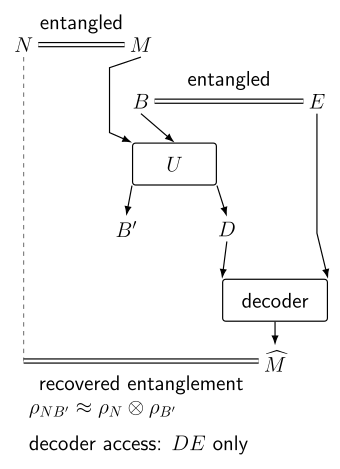
Recovery uses when the reference decouples from the remaining hole . Double lines denote initial or recovered entanglement, arrows denote quantum processing, and the dashed line follows the untouched reference. This finite-system schematic shows approximate recovery under the stated decoupling assumptions; it does not specify an efficient decoding circuit.
Decoupling statement and hypotheses
Section titled “Decoupling statement and hypotheses”Theorem in the original finite-dimensional model. Suppose is maximally entangled with , the message is maximally entangled with , and is Haar random. Then the average unhalved trace-norm decoupling error obeys
where the expectation is over . In this maximally entangled setup the remaining-hole marginal is exactly . Decoupling of from implies, by purification and continuity, that a channel on recovers the entanglement with . The recovery error depends on the chosen norm: the decoupling bound controls entanglement infidelity directly, while the trace-norm estimate below has a square root. An exact unitary -design gives the same second-moment estimate. For an approximate design, one must state the norm and accuracy of its second-moment approximation: the correction first enters that estimate, before the square roots used to bound trace-norm and recovery errors. It cannot generally be added unchanged to the final recovery norm Hayden and Preskill 2007, § 5, equation (8).
The hypotheses include maximal old-hole entanglement, Haar-random or design-like mixing, a finite-dimensional regulator, full access to and , an unhalved trace-norm error criterion, and averaging or high-probability control over . Hayden and Preskill derive the second-moment estimate and recovery statement in Hayden and Preskill 2007, § 3, equations (3)–(7). None of these assumptions follows from semiclassical Hawking radiation alone.
Proof architecture: make the remainder forget
Section titled “Proof architecture: make the remainder forget”The target is not to locate the diary directly in . Instead, show that the remaining hole has forgotten which state was inserted. Begin with the pure state on , apply to , and trace out . Haar integration of two copies of gives the average purity of . Subtracting the purity of yields a Hilbert–Schmidt fluctuation suppressed by the size of .
The rank inequality
converts that second-moment estimate to trace norm and gives the stated upper bound . If is decoupled, all correlations with the message reference lie in the complementary system . Uhlmann’s theorem then supplies an isometry on that extracts a partner of . This establishes existence of a recovery operation without constructing an efficient circuit.
More explicitly, let denote the unhalved decoupling norm for one unitary, let be the decoded diary, and define its entanglement fidelity by , where is the maximally entangled target. Purification continuity and the pure-target fidelity–distance inequality give a decoder satisfying
These are errors for recovery of the specified maximally entangled input. A dimension-independent, worst-case diamond-norm guarantee for arbitrary inputs does not follow by simply renaming this error.
As an independent limiting check, take . The bound is order one, so receiving exactly as many states as the message does not guarantee accurate recovery. Increasing by an overhead factor suppresses the bound by , as expected from decoupling.
Counting the new radiation qubits
Section titled “Counting the new radiation qubits”Write . Since ,
Thus newly emitted qubits give mean decoupling norm at most and mean entanglement infidelity at most . Jensen’s inequality gives a mean decoded-state unhalved trace norm at most ; its conventional trace distance is at most . These different error criteria must be kept separate when quoting a radiation overhead.
For a one-qubit message, twenty extra qubits give mean decoupling norm below because . The conservative bound above needs forty-two extra qubits for mean decoded-state unhalved trace norm below . Both overheads depend logarithmically on accuracy, provided the old hole is large enough to emit that many qubits in the model.
The time to emit those qubits must be added to the scrambling time. Scrambling and decoding complexity are distinct: rapid mixing may make a decoder exist after a time while the circuit that implements it remains exponentially hard. The separation between scrambling and efficiency is discussed in Hayden and Preskill 2007, §§ 4–5 and organized pedagogically in Harlow 2016, § 5.6.
Failure cases and physical qualifications
Section titled “Failure cases and physical qualifications”For a young hole, is not close to maximally entangled with accessible early radiation. Information initially remains in correlations, and the small overhead conclusion fails. A structured nonscrambling unitary can simply leave inside , also defeating decoupling. Losing part of , restricting the measurement algebra, or requiring a low-depth decoder changes the theorem.
The ensemble qualifier is equally important. The underlying second-moment bound is . Hence Markov’s inequality gives for a chosen threshold . A failure-probability target therefore costs additional overhead; an average bound is not a guarantee for every unitary. Certifying one specified Hamiltonian requires a design estimate or a direct dynamical calculation with its own error and timescale.
The random-unitary model does not derive an evaporation Hamiltonian, greybody factors, or gravitational dressing. It also does not prove a smooth horizon. Generic quantum-information theory, stable thermodynamics, and explicit string or holographic constructions are separate subjects; this page retains only the finite-model recovery theorem and the assumptions needed for its black-hole interpretation.
Exercises
Section titled “Exercises”A qubit diary is inserted into an old hole satisfying the theorem’s hypotheses. How many new radiation qubits bound the mean decoupling norm by ? What decoded-state trace-norm bound follows, and what resource has not been counted?
Solution
Set the overhead to , so the collector needs new radiation qubits in addition to access to the early radiation. The dimension ratio is . The resulting mean entanglement infidelity is at most , but the decoded-state unhalved trace-norm bound is only . This counts information-theoretic output size, not the circuit depth, memory, precision, collection apparatus, energy, or gravitational backreaction needed to implement the decoder within a specified protocol’s deadline.
References
Section titled “References”- Harlow, Daniel. 2016. “Jerusalem Lectures on Black Holes and Quantum Information.” Reviews of Modern Physics 88, 015002. arXiv:1409.1231.
- Hayden, Patrick, and John Preskill. 2007. “Black Holes as Mirrors: Quantum Information in Random Subsystems.” Journal of High Energy Physics 09, 120. arXiv:0708.4025.