The Island Formula
Scrollable formula. Use Left and Right arrow keys to reveal hidden content.
Scrollable table. Use Left and Right arrow keys to reveal additional columns.
Scrollable figure. Use Left and Right arrow keys to inspect hidden content.
In the controlled nongravitating-bath formulation developed here, the island formula computes the fine-grained von Neumann entropy of a declared radiation region by allowing a gravitating region to join its bulk entropy algebra. Replica wormholes supply the semiclassical derivation in those bath models. The prescription first extremizes generalized entropy over each admissible island boundary and then minimizes over the resulting saddles, including the empty island.
Required background. Quantum Information supplies reduced states, von Neumann entropy, purification, and joint-region entropy.
Helpful background. Semiclassical Gravity supplies generalized entropy and backreaction; Quantum Fields in Curved Spacetime supplies regulated matter entropy; Black-Hole Information supplies the Page problem and QES construction.
The radiation-plus-island functional
Section titled “The radiation-plus-island functional”Fix a semiclassical bath model with a gravitating region coupled transparently to a nongravitating QFT bath. Let be the radiation region whose normalized reduced state is sought. For an admissible gravitating island , with boundary , define
In Einstein gravity . In two-dimensional JT gravity the area analogue includes both the constant extremal/topological entropy and the dynamical dilaton contribution, for example for one connected component in a common normalization, with contributions summed when has several components. is the regulated von Neumann entropy of the joint algebra on in the prepared state. The counterterms render the sum finite in one declared scheme.
The empty island, , is included. It gives the ordinary semiclassical Hawking candidate . A nonempty candidate pays a gravitational area or dilaton cost but can sharply reduce the matter entropy because correlations between and are now internal to the retained algebra.
In the spatial sketch below, follow the matching hatching: the disconnected regions and enter one joint matter entropy. The endpoints of carry the additional gravitational cost.
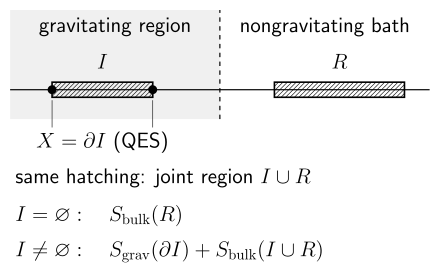
Matching hatching identifies the joint region . This is a schematic spatial slice, not a spacetime solution or a drawing to scale; it depicts no causal transfer between the regions. In the drawing, includes the boundary counterterms written separately as in the main formula. Extremize each admissible island boundary before comparing its generalized entropy with the empty-island candidate.
Derivation from the replica limit
Section titled “Derivation from the replica limit”For positive integer , cyclically glue the bath fields along and integrate over the gravitating region. A replica-wormhole saddle connects the gravitational copies. Assuming a regular replica-symmetric family, quotient by ; the quotient fixed locus has cosmic-brane tension .
Differentiating the normalized saddle action at has two contributions. The conical fixed locus gives , while the matter determinant with cyclic gluing gives the entropy of . Variation of the limiting locus gives
Thus each continued replica saddle produces a quantum extremal island boundary. This chain is exhibited explicitly for JT gravity and baths in Almheiri et al. 2020, §2.1–2.2 and §§3–5.
For a smooth normalized branch, write its effective action as
For , the smaller generalized entropy gives the larger exponential weight. In the regime where a leading semiclassical branch controls this continuation, action competition therefore becomes comparison of generalized entropies. Hence
within the declared approximation. “Extremize then minimize” is essential: minimizing over arbitrary surfaces would not follow from saddle-point equations, while keeping every extremal saddle would not perform the dominance comparison. This is a leading saddle rule. The exact derivative at requires a correctly normalized continuation of the full replica calculation; two branches that become the same one-copy geometry cannot simply be counted twice. Near a Page transition, the semiclassical limit and the replica limit require particular care.
How a late entropy decrease occurs
Section titled “How a late entropy decrease occurs”At early times, is small and the empty island usually dominates. As Hawking pairs accumulate, that candidate grows. For a nonempty island near the horizon, the radiation partners contained in purify much of , so can remain modest while the gravitational term tracks the decreasing black-hole entropy. The branches cross near a Page time, after which the island candidate is smaller.
This explanation concerns a fine-grained entropy, not a local signal emitted from the island. The formula does not say that a causal trajectory carries a copy of each interior qubit into . Reconstruction is an operator-algebra statement developed later.
Two-dimensional evaporating solutions with explicit state preparation and bath coupling are analyzed in Almheiri, Mahajan, Maldacena, and Zhao 2020, §§2–4. The radiation formula and its interpretation appear in Almheiri et al. 2021, §8, Eq. (8.2), and §9.
Independent checks and limits
Section titled “Independent checks and limits”Empty-island check. Restricting the admissible set to recovers . The formula therefore contains the Hawking branch rather than replacing it by decree.
Joint-entropy check. For a regulated pure state on , . Using instead would generally violate this purity relation and can reverse dominance.
Dimensional check. and the entropy terms are dimensionless. In JT gravity both and the normalized dilaton contribution are dimensionless; omitting the constant term gives the wrong relative weight for island topologies even though it does not move a fixed-topology extremum.
The controlled derivations used above employ specific semiclassical, often two-dimensional, nongravitating-bath models. More recent work argues that island and Page-curve observables can also be defined for selected massless-gravity settings without an external reservoir, including proper radiation algebras at null infinity and radiation inside a gravitating spacetime Antonini et al. 2025, §§ 3–4. That extension requires an explicitly chosen algebra, background-symmetry assumptions, perturbative control, and many-copy access; it is not supplied merely by replacing the bath with a gravitating region. Replica symmetry, analytic continuation, topology weights, and the integration contour remain additional assumptions. The result does not provide a microscopic radiation density matrix or prove unitary dynamics for every black hole; those remain separate questions.
Exercises
Section titled “Exercises”Suppose the no-island branch is and an already-extremized island branch is . Find the Page crossing and explain what would be wrong with selecting at all times merely because it solves the QES equation.
Solution
Equality gives , so and both branches equal . Before , the no-island entropy is smaller; afterwards the island branch is smaller. Solving the QES equation establishes only stationarity of the nonempty boundary. Choosing it at early times would skip the required minimization and return a subdominant saddle rather than the leading entropy.
References
Section titled “References”- Almheiri et al. 2020a, Ahmed Almheiri, Raghu Mahajan, Juan Maldacena, and Ying Zhao, “The Page Curve of Hawking Radiation from Semiclassical Geometry,” Journal of High Energy Physics 03 (2020) 149, DOI: 10.1007/JHEP03(2020)149.
- Almheiri et al. 2020b, Ahmed Almheiri, Thomas Hartman, Juan Maldacena, Edgar Shaghoulian, and Amirhossein Tajdini, “Replica Wormholes and the Entropy of Hawking Radiation,” Journal of High Energy Physics 05 (2020) 013, DOI: 10.1007/JHEP05(2020)013.
- Almheiri et al. 2021, Ahmed Almheiri, Thomas Hartman, Juan Maldacena, Edgar Shaghoulian, and Amirhossein Tajdini, “The Entropy of Hawking Radiation,” Reviews of Modern Physics 93 (2021) 035002.
- Antonini et al. 2025, Stefano Antonini, Chang-Han Chen, Henry Maxfield, and Geoff Penington, “An Apologia for Islands,” arXiv:2506.04311 (2025).