The Unitary Page Curve
Scrollable formula. Use Left and Right arrow keys to reveal hidden content.
Scrollable table. Use Left and Right arrow keys to reveal additional columns.
Scrollable figure. Use Left and Right arrow keys to inspect hidden content.
The usual unitary Page curve combines global purity with typical entanglement in an idealized bipartite system. Purity bounds radiation entropy by the smaller effective Hilbert-space dimension; typicality makes it approach that bound. The turnover therefore occurs when the collected radiation and remaining black-hole dimensions become comparable, not automatically at half the evaporation time or half the initial mass.
Required background. Quantum Information supplies purification, typical bipartite states, entropy, and effective dimensions used in the derivation.
Helpful background. Semiclassical Gravity supplies black-hole entropy and evaporation scales; Quantum Fields in Curved Spacetime supplies the emitted mode content; Black-Hole Information supplies the unitarity and endpoint assumptions being modeled.
Evaporation model and inputs
Section titled “Evaporation model and inputs”Let the regulated complete state be pure on
contains all radiation collected by time ; contains every remaining purifier. Assume no remnant or external bath is omitted, unitary transfer preserves a fixed total regulated dimension , and the state becomes typical enough within the allowed sector for the Haar benchmark to be informative. Energy, charge, and locality constraints are represented only through the effective dimensions, so the first omitted corrections are ensemble structure and incomplete scrambling.
For a Haar-typical state, Page’s exact formula gives the entropy of the smaller factor Page 1993, Eqs. (1)–(11). At leading exponential accuracy,
Because the global state is pure, the same entropy is obtained from . This equality supplies the descending branch.
Deriving the turnover
Section titled “Deriving the turnover”Write the dimension entropies as and . Under the fixed- transfer model,
As evaporation proceeds, increases and decreases. The two leading branches cross when
Before this Page time, radiation is the smaller factor and is almost maximally mixed. After it, the remaining black hole is the smaller factor, so purity prevents radiation entropy from exceeding the remaining factor’s entropy. Information is then increasingly carried by correlations within the radiation and between early and late radiation.
The exact mean rounds the cusp. If and ,
At equal large dimensions , the mean is , rather than the sharp maximum . A particular Hamiltonian gives a smooth time dependence whose width depends on its mixing and constraints.
Physical time is not dimension time
Section titled “Physical time is not dimension time”To convert the crossing into a retarded time, one needs the functions and . A common thermodynamic estimate identifies with the remaining Bekenstein–Hawking entropy and estimates from the coarse-grained entropy capacity of emitted radiation. These thermodynamic capacities need not have constant sum: irreversible Hawking emission produces coarse-grained entropy. They therefore replace, rather than supplement, the fixed- qubit assumption above.
For example, set for an initially pure, four-dimensional Schwarzschild black hole, and assume a constant entropy-production ratio
Then . Matching the two entropy branches gives
If with constant dimensionless , then and
Page’s photon-and-graviton model has , giving and Page 2013, Eqs. (7)–(11). Greybody factors, additional particle thresholds, rotation, charge, and changing emission rates alter this illustrative result. It is not a universal Page time.
Fine-grained and coarse-grained radiated entropy agree only on the rising typical branch to leading approximation. After the turnover, the coarse-grained radiation entropy may continue growing while the fine-grained entropy falls. The difference is stored in correlations not resolved by the coarse description.
A reference system changes the curve if the initial black hole is mixed. The complete state is then pure on , and the relevant recovery diagnostic can be mutual information with rather than alone. Likewise, a remnant leaves at the endpoint and permits nonzero .
Independent checks
Section titled “Independent checks”At the initial endpoint , the formula gives . At complete evaporation without a remnant, and purity again gives . Interchanging and leaves the curve invariant, as Schmidt-spectrum equality requires. All logarithms act on dimensionless dimensions, so the entropy has no physical units.
The model fails a discriminating test for product dynamics: a unitary that merely swaps unentangled basis states can transfer dimension without making the state typical, leaving throughout. Thus unitarity and dimension balance are not sufficient; entangling dynamics or an independently justified typicality statement is required.
Interpretation and limits
Section titled “Interpretation and limits”The finite example below separates the two dimension capacities from the actual Haar mean. Inspect the gap near the crossing: even an exactly random pure state need not make its smaller subsystem exactly maximally mixed.
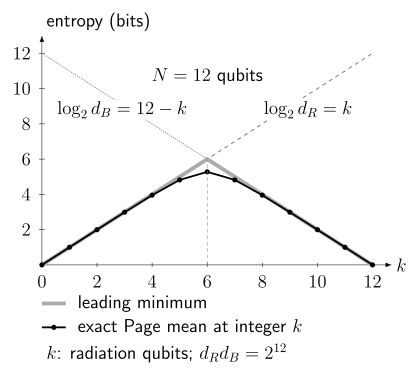
For a twelve-qubit Haar-random pure system, the exact mean radiation entropy (black points) lies below the leading minimum of and (thick gray). Entropy is in bits: the harmonic-sum formula has been divided by . The points have integer subsystem sizes; connecting segments guide the eye and do not describe physical time. At , the means are respectively , , , and bits; the second half is symmetric. No remnant or external purifier is included.
The unitary curve is a benchmark for a declared radiation factor. It does not derive the Hawking spectrum, prove black-hole scrambling, define gravitational factorization, or demonstrate operational decoding. Generic random-state results belong to Quantum Information, emission rates to Quantum Fields in Curved Spacetime, and stable thermodynamics to Semiclassical Gravity. Explicit string or holographic microphysics is separate.
Exercise
Section titled “Exercise”An -qubit pure system emits one qubit per step, but a stable -qubit remnant remains. With typical dynamics, where does the dimension crossing occur and what is the final radiation entropy benchmark?
Solution
After emitted qubits, and . The formal crossing remains if the transfer begins from all qubits, but evaporation stops at . The final smaller-factor entropy is approximately , with the Page finite-size correction. It is not forced to vanish because the remnant factor can purify the radiation. If , the process stops before the turnover.