Black-Hole Bombs and Reflecting Boundaries
Scrollable formula. Use Left and Right arrow keys to reveal hidden content.
Scrollable table. Use Left and Right arrow keys to reveal additional columns.
Scrollable figure. Use Left and Right arrow keys to inspect hidden content.
A black-hole bomb is a feedback system: a rotating horizon amplifies a wave on one encounter, while an outer reflector returns enough of that wave for another encounter. Superradiance alone is scattering, not instability. The fixed-delay model grows when its round-trip energy multiplier exceeds one. A frequency-dependent wave problem additionally requires a complex-frequency return equation; real-axis gain and phase give an approximate diagnosis. This page derives both statements for a bosonic mode and distinguishes a material mirror, an asymptotic reflecting boundary, and a leaky effective cavity.
Helpful background. Black-Hole Geometry and Mechanics supplies the horizon generator and ; PDEs and Green Functions for Gravitation supplies boundary-value and spectral methods; Formulations of General Relativity supplies conserved fluxes; Relativistic Matter and Compact Objects supplies matter boundary models; Black-Hole Perturbation Theory supplies the separated radial problem.
Energy gain in a fixed-delay cavity
Section titled “Energy gain in a fixed-delay cavity”Consider a neutral bosonic mode of positive asymptotic frequency on Kerr. We use the outward-positive radial flux convention and . If one encounter with the horizon has energy amplification , the outgoing energy is times the incident energy. Let be the fractional energy leaked through the outer boundary during one return and the fraction of the energy remaining after that leakage which is irreversibly dissipated. These are sequential, conditional fractions, not two fractions of the same incident energy. A simple one-channel round trip then multiplies cavity energy by
After trips, . For a fixed round-trip delay , the exponential rate interpolating these sampled energies and the imaginary part of a coherent fixed-delay mode are
The factor of two follows because the field amplitude varies as while its quadratic energy varies as . Therefore
is the instability criterion in this model. For small , , and , . Positive horizon gain is necessary in this passive model, but it is not sufficient: leakage can win.
For multiple channels, polarization conversion, or mode mixing, the scalar multiplier is replaced by a discrete round-trip amplitude matrix . An excited eigenvector grows under repeated application if its eigenvalue has modulus greater than one. A frequency-domain boundary problem instead requires at a complex frequency. These different uses of a return map must not be conflated, nor may incompatible flux gains be added as though they belonged to the same mode.
Horizon sign and cavity phase
Section titled “Horizon sign and cavity phase”At the future horizon the neutral superradiant condition is
equivalently . For a charged field it becomes , with defined in the gauge that vanishes at infinity. The gain factor must retain this sign; replacing by an absolute value destroys both threshold and energy balance. The flux derivation and neutral, charged, and Schwarzschild limits are given on The Superradiant Frequency Condition.
A cavity mode must satisfy more than that inequality. On the positive real-frequency axis write the round-trip amplitude as
The actual scalar mode equation is , analytically continued with the physical boundary solutions. At such a complex root the complete return factor equals one, not a number of modulus greater than one. A real-axis interval with gain can contain no suitable resonance.
To see when gain and phase give a rate, choose a real with and a local analytic logarithm of a nonzero return factor. Set
Linearizing gives
If and higher frequency derivatives are negligible over this shift, then . The delay includes reflection-phase dispersion, not just propagation time. This is a weak-envelope approximation, not a replacement for solving the full mode equation near a sharp resonance, zero or branch point. It explains why a phase-matched passive resonance above the superradiant threshold is damped in this regime even with a perfect reflector. The original rotating-black-hole bomb mechanism and its balance between horizon gain and confinement are reviewed in Brito, Cardoso, and Pani 2020, §5.2, pp. 89–96.
The feedback loop in the figure should be read clockwise. The upper arrow is the part returned for another encounter, the lower arrow is the amplified outgoing part after one encounter, and the dashed arrows are energy that does not return. In particular, no causal arrow emerges from the future horizon: the gain comes from a future-directed horizon flux whose -energy is negative in the superradiant band.
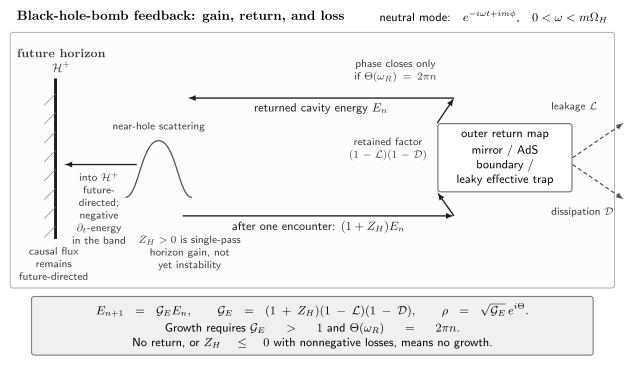
One schematic cavity cycle, not to scale. A future-directed component enters ; in the superradiant band its -energy is negative, so the reflected cavity energy is multiplied by . The outer return then removes leakage and dissipation . The energy multiplier is , whereas the amplitude multiplier has modulus ; exponential growth requires together with phase closure. Removing the return path, or taking in a passive cavity, removes the instability. The mirror, AdS boundary, and leaky trap labels denote alternative return models, not equivalent boundary problems.
Mirrors, AdS boundaries, and leaky traps
Section titled “Mirrors, AdS boundaries, and leaky traps”A literal mirror at turns the radial problem into a cavity eigenvalue problem. For a scalar, one may impose (Dirichlet), (Neumann), or a flux-conserving Robin condition, together with a future-ingoing condition at the horizon. These conditions are physically different and yield different spectra. Calling a numerical outer cutoff a “mirror” is valid only if the imposed boundary condition is part of the model, not a truncation artifact.
The asymptotically flat scalar mirror matching calculation is Cardoso, Dias, Lemos, and Yoshida 2004, §§II.A–II.B, pp. 2–5, PDF.
Asymptotically anti-de Sitter boundary conditions can also return radiation, but they define another global spacetime problem rather than a mirror placed in asymptotically flat Kerr. In rotating AdS black holes, boundary conditions, horizon size, and the angular velocity relative to the nonrotating boundary frame all enter the stability question. For a massless scalar with fast falloff, small horizon radius, slow rotation and long wavelength, Cardoso and Dias 2004, §III, pp. 3–5, PDF match small Kerr–AdS modes and identify their superradiant growth. This is a different two-author paper, not the asymptotically flat mirror calculation. Neither result establishes that every reflecting asymptotic boundary is unstable.
An environmental potential barrier is generally leaky. It supplies an outer reflection coefficient only over a frequency band and may also absorb or dephase the wave. Its complex return condition, or a justified phase-matched weak-envelope reduction, must use all losses in the same normalization. A local turning point or a visually closed effective-potential well proves neither a normalizable mode nor positive net growth.
Removing the feedback loop
Section titled “Removing the feedback loop”Three limiting checks expose incorrect bomb arguments.
First, remove the mirror in an asymptotically flat problem. Outgoing radiation then escapes to infinity, so there is no return map for a scattering packet; formally the returned fraction tends to zero and . Kerr may still amplify an individual incident wave, but repeated exponential growth has disappeared.
Second, take the Schwarzschild limit . For the horizon is absorptive, , and a passive cavity cannot satisfy . A growing Schwarzschild cavity mode would therefore require an active material boundary or another source of free energy, not rotational superradiance.
Third, tune through the threshold . Then . Any nonzero leakage or dissipation makes ; a perfectly lossless cavity is marginal at this level, not growing. The detailed black-hole-mirror spectrum and these limiting cases are discussed in Brito, Cardoso, and Pani 2020, §5.2 and §6.1, pp. 89–96, 160–165.
Energy accounting beyond a single ray
Section titled “Energy accounting beyond a single ray”The round-trip formula is not restricted to geometric optics. Choose two successive spacelike slices separated by one recurrence of the cavity field, and integrate the conserved energy current through the region between them. The change of exterior energy equals the signed boundary inflow through the horizon and outer boundary minus nonnegative material dissipation. If the field returns with the same spatial profile up to a complex multiplier, that integrated identity becomes the multiplier relation above. This makes clear which quantities must share a normalization: a Teukolsky amplitude, a scalar Klein–Gordon flux, and a material absorption coefficient cannot be multiplied until all have been converted to the same conserved energy.
For a broad wave packet, different frequencies acquire different gain and phase. Repeated reflection can narrow the packet toward a growing cavity resonance, but it can also disperse it so thoroughly that no coherent mode is formed. A time-domain pulse that becomes larger on its first return is therefore not yet evidence for an exponentially growing eigenmode. A robust diagnosis compares several returns, extracts a complex frequency independent of the observation window, and checks the integrated horizon and outer fluxes.
The stationary approximation has another limitation. As a growing field extracts angular momentum, decreases and the superradiant band shifts. A fixed-background eigenvalue describes the initial linear stage only. Similarly, a material reflector can heat, move, or change its reflectivity. Those effects are not corrections to the algebraic condition; they alter the return operator itself. The linear bomb criterion remains valuable because it identifies the energy source and the loss budget that any nonlinear evolution must reproduce.
This linear account does not predict nonlinear saturation, horizon spin-down, mirror motion, or the endpoint of a growing cloud. It diagnoses only whether the assumed stationary background and boundary model possess a linear growing mode. Mass confinement is developed next in Massive-Boson Quasi-Bound States.
Exercises
Section titled “Exercises”A coherent fixed-delay cavity mode gives the exterior a -energy gain per horizon encounter, outer leakage , conditional dissipation , and delay . Decide whether it grows and find in units of .
Solution
The exact round-trip energy multiplier is
Thus the mode grows, but only slightly: most of the horizon gain is lost. The energy rate is
so
The first-order estimate gives , which has the right sign but overestimates the exact logarithmic rate. If leakage increased to , the exact product would fall below unity and superradiant scattering would no longer imply an instability.
References
Section titled “References”- Brito, R., Cardoso, V., and Pani, P. (2020). Superradiance: New Frontiers in Black Hole Physics. Lecture Notes in Physics 971. Springer. DOI.
- Cardoso, V., and Dias, Ó. J. C. (2004). “Small Kerr–anti-de Sitter black holes are unstable.” Physical Review D 70, 084011. DOI. Open PDF.
- Cardoso, V., Dias, Ó. J. C., Lemos, J. P. S., and Yoshida, S. (2004). “The black hole bomb and superradiant instabilities.” Physical Review D 70, 044039; erratum 70, 049903. DOI. Open PDF.