The Chandrasekhar–Friedman–Schutz Instability
Scrollable formula. Use Left and Right arrow keys to reveal hidden content.
Scrollable table. Use Left and Right arrow keys to reveal additional columns.
Scrollable figure. Use Left and Right arrow keys to inspect hidden content.
Gravitational radiation usually damps an oscillation, but it drives a rotating star when the same pattern is retrograde relative to the fluid and prograde relative to infinity. That frame reversal makes the mode’s canonical energy negative while the emitted wave carries positive energy and angular momentum away. The Chandrasekhar–Friedman–Schutz criterion is therefore a sign theorem about pattern speed, not a claim that every rapidly rotating mode grows in a real star.
Helpful background. Stress–Energy and Conservation supplies conserved currents; the Einstein equation supplies the rotating background; Relativistic Matter and Compact Objects orients stellar equilibria; Black-Hole Perturbation Theory supplies mode conventions; Gravitational Radiation and Waveforms supplies flux signs; and Computational Relativity supplies spectral checks.
One pattern in two frames
Section titled “One pattern in two frames”Take a uniformly rotating star with angular velocity and a perturbation proportional to
The inertial-frame pattern speed is , while a corotating observer measures
With this convention, a prograde inertial pattern has and a retrograde corotating pattern has . The CFS sign reversal is thus
This formula is convention-sensitive. Reversing the sign in the azimuthal factor or using reverses intermediate signs, but the invariant statement remains: the pattern moves forward at infinity and backward through the fluid.
Follow the same two-crested pattern in the figure. The rotating observer turns faster than the pattern, so its apparent direction reverses even though the physical disturbance is unchanged.
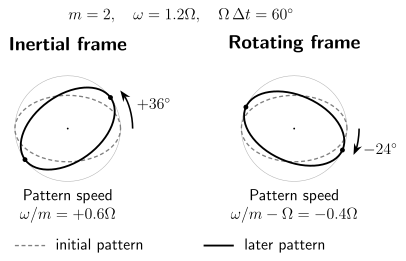
One pattern viewed in two frames, with . During , its crests advance by in the inertial frame and retreat by in the fluid frame. Dashed outlines show the initial phase and solid outlines the later phase; the deformation is schematic and the outlines are not fluid trajectories.
Canonical energy and radiation reaction
Section titled “Canonical energy and radiation reaction”For a conservative rotating-fluid perturbation, the symplectic construction defines canonical energy and canonical angular momentum . For a single real-frequency normal mode their conserved quantities obey
The rotating-frame canonical energy is
For a branch with positive rotating-frame mode energy, away from either zero frequency, this gives . The positive-norm branch assumption matters: the frame product is not a replacement for computing canonical energy in a general differentially rotating, magnetized, or already unstable system. Friedman and Schutz develop this canonical energy–angular-momentum framework and the secular instability criterion in Friedman and Schutz 1978, §III, Eq. (39a), and §IV, Eqs. (60)–(62), pp. 291–293.
Suppose . An outgoing gravitational wave has positive energy flux at infinity. Radiation reaction therefore makes the star’s perturbative canonical energy more negative:
Because the quadratic mode energy scales as amplitude squared, increasing means increasing amplitude. Radiation damps a positive-energy mode but amplifies a negative-energy mode. No local “antidamping force” is required; the rotating background supplies the free energy.
More explicitly, write and , with fixed by the conservative eigenfunction. The balance gives . The factor of two distinguishes an amplitude e-folding time from an energy e-folding time. This weak-radiation argument holds the background and mode shape fixed to leading order; a long evolution must also track the star’s changing spin.
Neutral points and onset
Section titled “Neutral points and onset”Along a rotating sequence, a mode can cross either or . The CFS-neutral point relevant to a radiating nonaxisymmetric mode occurs when its inertial pattern becomes stationary, , after which it can be prograde at infinity while remaining retrograde in the fluid. The exact crossing depends on the equilibrium sequence, equation of state, relativistic compactness, and mode family.
The axial r-mode is a striking application because its leading-order rotating-frame frequency has the opposite sign from its inertial pattern over a broad slow-rotation regime. Andersson identified the corresponding gravitational-radiation instability in Andersson 1998, §4, Eq. (15). That onset statement does not fix the growth time, viscous window, or nonlinear saturation amplitude.
Several independent checks prevent sign errors. Transform the phase directly with ; verify that wave energy and angular momentum obey for a pure harmonic; and confirm that the nonrotating limit restores the usual damping of positive-energy modes. Frequency has dimension in units, and comparisons using require when denotes physical mass.
What the criterion does not decide
Section titled “What the criterion does not decide”CFS gives a necessary energetic route to secular growth in the idealized linear problem. The realized instability also depends on the radiation growth rate compared with shear and bulk viscosity, mutual friction, crustal boundary layers, magnetic winding, accretion, cooling, and nonlinear mode coupling. Differential rotation can alter the mode spectrum and introduce corotation singularities; strong magnetic fields can change the relevant eigenfunctions. None of those effects invalidates the sign argument, but each can prevent an astrophysical amplitude from becoming large.
The criterion also assumes an isolated background with a well-defined rotational symmetry and a mode that can be continued through the neutral point. A coordinate frequency from a finite simulation is not enough: identify the inertial and material frames, extract the radiative flux, and check conservation of total energy and angular momentum.
Check the frame reversal
Section titled “Check the frame reversal”For , a mode has . Is it in the CFS sign regime?
Solution
Yes. The inertial pattern speed is , so it is prograde at infinity. Its rotating-frame frequency is , so it is retrograde relative to the fluid. Thus and the canonical energy has the unstable sign. Whether the mode actually grows requires its radiation timescale to beat all damping timescales.