Exact Interiors and Physical Admissibility
Scrollable formula. Use Left and Right arrow keys to reveal hidden content.
Scrollable table. Use Left and Right arrow keys to reveal additional columns.
Scrollable figure. Use Left and Right arrow keys to inspect hidden content.
An analytic interior metric is a solution of differential equations, not yet a model of a star. A physically admissible interior must have a regular center, positive and controlled matter variables, a meaningful equation of state, causal response, a well-defined surface, and a correct junction to its exterior. Exact solutions are most valuable as laboratories for signs, compactness bounds, and numerical benchmarks when those tests are kept separate from claims of realism.
Required background. The Einstein Equation supplies the field equations and stress–energy interpretation; Killing Fields and Isometry Groups supplies static spherical symmetry.
Helpful background. Flat-Background Hilbert Stress-Energy from Metric Variation fixes energy and pressure signs; Relativistic Matter and Compact Objects supplies material standards; Computational Relativity supplies benchmark practice.
From an ansatz to matter variables
Section titled “From an ansatz to matter variables”Assume a static spherical line element
and an isotropic perfect fluid. Choosing one metric potential, a density profile, or a generating relation can make the Einstein equations integrable. After solving, however, the functions and must be read from the same fixed Einstein convention. A sign error in curvature can turn positive density into negative density without changing the visual form of the metric.
At a regular center, , is finite with , and scalar matter variables have even expansions. Curvature invariants and orthonormal components must be finite. Coordinate regularity alone is insufficient: a finite metric coefficient can coexist with divergent pressure or curvature.
The constant-density laboratory
Section titled “The constant-density laboratory”For , the mass function is
Define . The interior Schwarzschild pressure is
For this pressure is finite, positive inside the star, and zero at . The lapse, normalized to unity at spatial infinity, is
These expressions obey , the integrated hydrostatic equation. At the surface the lapse becomes and joins Schwarzschild; its derivative also has the required junction value. This makes the solution an exact check of both TOV signs and exterior matching.
For , expansion gives
Using recovers the Newtonian uniform-density pressure . This independent limit tests the normalization, not just the vanishing surface pressure.
The model is not a causal material EOS: if constant density is imposed as an incompressible material law while pressure varies, its sound speed is unbounded. At , the central lapse tends to zero and central pressure diverges. This is a singular limiting configuration, not a regular star saturating the bound.
The figure shows how the same analytic solution changes with compactness. Compare the central values: stronger gravity requires more pressure and produces a smaller lapse, so central clocks run more slowly relative to clocks at infinity.
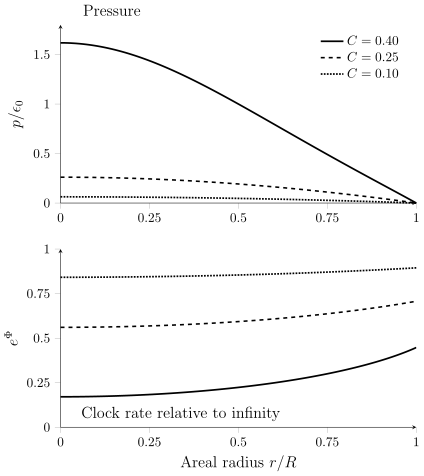
Pressure and lapse versus fractional areal radius for , , and . These quantitative curves use the constant-density exact solution with time normalized at infinity. They illustrate the growth of pressure and gravitational redshift with compactness. The incompressible fluid is a geometric benchmark, not a causal material EOS.
Buchdahl proves a broader compactness inequality under isotropic pressure, nonincreasing density, regularity, and associated geometric assumptions in Buchdahl 1959, §3(a), Eqs. (3.1)–(3.6), pp. 1028–1029. The strict bound applies to regular stars in that class. It is not universal once those hypotheses are relaxed; anisotropy or a surface layer changes the problem rather than refuting the theorem.
A physical-admissibility checklist
Section titled “A physical-admissibility checklist”A proposed interior should pass the following independent tests:
- Geometry: correct Lorentzian signature, regular center, finite curvature, and no hidden coordinate-domain change inside the star.
- Matter: , up to the surface, declared energy conditions, and finite thermodynamic variables.
- Profiles: pressure decreases outward for an ordinary isolated star; density behavior and any discontinuity are explained by the EOS.
- Response: the EOS derivative and full characteristic problem are stable and causal in the claimed domain; an algebraic ratio is not the sound speed.
- Junction: the induced metric and extrinsic curvature match the exterior, or an explicit surface stress tensor accounts for their jump.
- Stability: radial and, where relevant, nonradial perturbations are tested; equilibrium and energy conditions do not imply stability.
Delgaty and Lake apply a systematic version of these tests to many named solutions in Delgaty and Lake 1998, §1, criteria 1–6, and §§3–4. Their survey illustrates why a closed expression and even positive density are weak filters: few candidates satisfy all elementary conditions over a useful parameter interval.
Matching and model limitations
Section titled “Matching and model limitations”For a perfect-fluid surface defined by , matching to Schwarzschild requires continuity of the induced metric and extrinsic curvature. Continuity of density is not required; self-bound matter may have without a thin shell. A jump in normal pressure, by contrast, requires a distributional surface stress or a different exterior.
Exact interiors often impose a density or metric profile first and infer an EOS afterward. That inferred relation may depend on the particular star, fail thermodynamic integrability, or become multivalued. Such a solution remains a useful geometric benchmark, but it does not define a universal material model. Comparisons should therefore declare whether the EOS is input or output and which parameter domain passes every check.
Check the compactness denominator
Section titled “Check the compactness denominator”Use the constant-density central pressure to find where it diverges. Which hypothesis prevents this example from representing a realistic causal fluid?
Solution
At , the pressure denominator is . It vanishes when , hence and . The density was assumed independent of pressure, so the material is incompressible and has formally infinite . It violates causal response even below the pressure singularity. The solution can benchmark geometry and matching without being a realistic neutron-star EOS.
References
Section titled “References”- Buchdahl, H. A. “General Relativistic Fluid Spheres.” Physical Review 116 (1959): 1027–1034. DOI.
- Delgaty, M. S. R., and Kayll Lake. “Physical Acceptability of Isolated, Static, Spherically Symmetric, Perfect Fluid Solutions of Einstein’s Equations.” Computer Physics Communications 115 (1998): 395–415. DOI.