Phase Transitions and Hybrid Matter
Scrollable formula. Use Left and Right arrow keys to reveal hidden content.
Scrollable table. Use Left and Right arrow keys to reveal additional columns.
Scrollable figure. Use Left and Right arrow keys to inspect hidden content.
Dense matter may change composition continuously, cross over between useful descriptions, or undergo a genuine first-order phase transition with a density jump and latent energy. The macroscopic equation of state depends not only on the bulk phases but also on conserved charges, surface tension, Coulomb screening, and equilibrium timescales. Maxwell and Gibbs constructions encode different interface assumptions; neither is automatically correct for every compact star. Evidence and open questions here are current through 2026-08-18.
Required background. Hilbert Stress–Energy from Metric Variation supplies energy density, pressure, and phase stress.
Helpful background. The Einstein Equation supplies stellar structure and stability; Relativistic Matter and Compact Objects gives the dense-matter context; and Computational Relativity supplies equilibrium and dynamical applications.
Equilibrium between bulk phases
Section titled “Equilibrium between bulk phases”For homogeneous bulk phases H and Q, neglecting interface curvature and long-range electric-potential offsets for this first step, equilibrium requires equal temperature, pressure, and chemical potentials for each exchangeable conserved charge:
At zero temperature with only baryon number treated as an independent conserved charge, a first-order transition occurs at where
The baryon density can jump from to . At , , so the energy-density discontinuity is
This is an energy-density jump, not heat released per unit volume at fixed temperature. Thermodynamic latent heat per converted baryon is and vanishes at . Stellar conversion can still release gravitational and internal energy through the change of equilibrium.
Positive compressibility and the convex thermodynamic envelope select stable branches. Simply splicing two pressure curves at equal density violates phase equilibrium. The conserved-charge and finite-size distinctions are developed in Oertel et al. 2017, §III.D.1–III.D.2.
Maxwell, Gibbs, and finite-size matter
Section titled “Maxwell, Gibbs, and finite-size matter”A Maxwell construction imposes local charge neutrality in each bulk phase and a sharp interface. Pressure is constant through the density discontinuity for a one-component cold barotropic EOS. The ordinary charge chemical potentials can differ because an electric-potential step develops at the interface; the appropriate electrochemical potentials, including that step, satisfy equilibrium. Equality of the ordinary electron chemical potentials on both sides cannot be imposed in addition to separate local neutrality without checking compatibility.
In a spherical star the pressure decreases radially. It therefore crosses at one interface, where density jumps, rather than dwelling in a finite constant-pressure shell. In an – plot the horizontal coexistence segment labels possible bulk mixtures; it is not a radial profile.
A bulk Gibbs construction permits the phases to carry opposite charge while enforcing global neutrality. With volume fraction ,
and common baryon and charge chemical potentials determine the mixture. Pressure generally changes across the mixed-density interval because more than one conserved charge varies.
The figure separates these assumptions. Follow pressure across the two coexistence endpoints in the upper panel, and across the mixed interval in the lower panel; the horizontal axis is energy density, not radius.
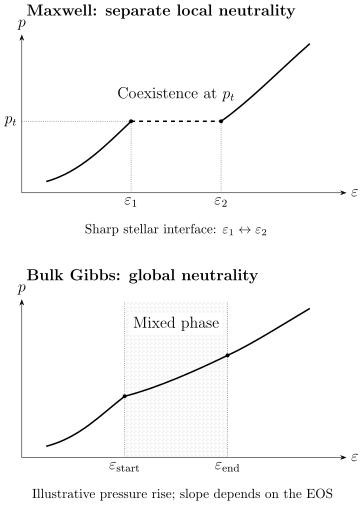
Bulk phase constructions under different charge-neutrality assumptions. The Maxwell plateau represents coexistence mixtures at one pressure; a sharp interface in a TOV star crosses between its endpoints. The ideal bulk Gibbs mixture can span a pressure interval. Curves and endpoints are schematic, with no numerical scales or universal Gibbs slope; surface, Coulomb, and screening energies are excluded.
Real matter lies between ideal bulk constructions. Surface energy penalizes interfaces; Coulomb energy penalizes charged domains; screening changes both. Low surface tension can favor structured mixed phases, while high surface tension favors a sharper locally neutral interface. The critical tension and geometry are model dependent. Pasta shapes, curvature energy, and nonequilibrium nucleation further complicate the comparison. The role of global versus local charge neutrality and of surface and Coulomb terms is explained in Oertel et al. 2017, §III.D.
Hybrid stars and third families
Section titled “Hybrid stars and third families”Adding hyperons, meson condensates, or deconfined quarks often softens pressure when new degrees of freedom first appear, but repulsive interactions or a stiff high-density phase can reverse that trend. A viable hybrid equation of state must still support observed massive stars, remain causal, and connect consistently to lower-density nuclear matter. Those conditions restrict but do not uniquely identify microscopic composition.
Consider a cold nonrotating perfect-fluid star on a stable hadronic branch, with an abrupt equilibrium transition at pressure from energy density to . When phase conversion is fast enough to maintain equilibrium during the perturbation, the small-core Seidov threshold is
Crossing it destabilizes the equilibrium sequence at the onset of an infinitesimal dense core. Equality is the marginal case and needs higher-order analysis. For example, gives a threshold : a jump of does not trigger this onset instability, while a jump of does. This test says nothing about stability at larger core size. If the high-density phase later becomes sufficiently stiff, stability can return, producing a disconnected “third family” and possible twin configurations with similar mass but different radii. The threshold and branch map are in Alford, Han, and Prakash 2013, §II.A, Eq. (2), and §III, Figure 3.
The criterion does not prove that twins exist in nature. Rotation, temperature, composition trapping, surface tension, and conversion kinetics alter equilibrium or dynamics. Nor does one measured compact radius uniquely diagnose a first-order transition; smooth hadronic equations of state can produce overlapping mass–radius regions.
Results and interpretations at the stated cutoff
Section titled “Results and interpretations at the stated cutoff”Controlled low-density theory. Chiral effective field theory constrains nucleonic matter around saturation and, for neutron-rich matter, can be propagated toward roughly twice saturation only with widening truncation, regulator, and many-body uncertainty. Its model domain is nucleonic matter below the theory’s breakdown scale; it does not settle the phase structure at several times saturation density. The current uncertainty organization and density-dependent loss of control are reviewed in Drischler, Holt, and Wellenhofer 2021, §§ 2–4.
Asymptotically high density. Perturbative QCD constrains matter only at chemical potentials well beyond most stellar cores. Interpolating across the gap permits crossovers and first-order transitions; the conclusion depends on the function class, priors, stability, and causal constraints.
Laboratory experiments. Nuclear masses, collective modes, and heavy-ion collisions constrain interactions in finite nuclei or hot, transient, often near-symmetric matter. Mapping them to cold beta-equilibrated stellar matter is model dependent. Evidence for a transition in a collision experiment would not directly fix its cold stellar location.
Astrophysical observations. Massive pulsars exclude equations of state that become too soft over too broad a density range. Radius and tidal information constrain pressure combinations, but current inference does not uniquely distinguish hyperons, quarks, a strong first-order transition, or a smooth crossover. Multiple messenger likelihoods also share crust and population systematics. Chatziioannou et al. 2025, §§ III.F and VIII reviews the competing high-density degrees of freedom and explains why the intermediate-density regime still requires comparisons among model families rather than identification of a unique phase.
These lines of evidence support possible hybrid matter but do not settle whether a strong first-order transition occurs in stable stars. Competing model classes reach different conclusions because they bridge an unconstrained density interval differently.
Open questions and possible tests
Section titled “Open questions and possible tests”The first unresolved axis is transition type: crossover, weak first order, or strong first order. The second is interface physics: local versus global neutrality after surface tension and screening. The third is conversion kinetics: rapid equilibrium versus metastable matter during oscillation, collapse, or merger. Initial temperature, lepton fraction, magnetic field, and nucleation seed can change which branch is realized.
A result that could change the interpretation would be a reproducible multimessenger analysis showing a disconnected stable branch across several equation-of-state parameterizations and prior families, with shared calibration and selection effects included. A controlled calculation that overlaps chiral and perturbative regimes, a validated surface-tension determination that fixes the Maxwell–Gibbs choice, or a new high-mass/radius combination incompatible with all smooth causal barotropes would also require revision. Retractions or substantial reanalyses of inputs trigger immediate reconsideration.
Exercises
Section titled “Exercises”A model imposes local neutrality separately in both phases but uses a pressure that varies continuously through a broad mixed-density interval. Is this a standard Maxwell construction?
Solution
No. With one independent conserved baryon charge and local neutrality in each bulk phase, Maxwell coexistence occurs at one common pressure and chemical potential, with a density jump. A varying-pressure mixed interval normally reflects a Gibbs construction with global charge neutrality, finite-size structures, or another interpolation. The model must state which additional physics produces the interval.
References
Section titled “References”- Alford, Mark G., Sophia Han, and Madappa Prakash. “Generic Conditions for Stable Hybrid Stars.” Physical Review D 88, 083013 (2013). DOI.
- Chatziioannou, Katerina, H. Thankful Cromartie, Stefano Gandolfi, Ingo Tews, David Radice, Andrew W. Steiner, and Anna L. Watts. “Neutron Stars and the Dense Matter Equation of State.” Reviews of Modern Physics 97, 045007 (2025). DOI.
- Drischler, Christian, Jeremy W. Holt, and Christian Wellenhofer. “Chiral Effective Field Theory and the High-Density Nuclear Equation of State.” Annual Review of Nuclear and Particle Science 71, 403–432 (2021). Open preprint.
- Oertel, Micaela, Matthias Hempel, Thomas Klähn, and Stefan Typel. “Equations of State for Supernovae and Compact Stars.” Reviews of Modern Physics 89 (2017): 015007. DOI. Open preprint.