Causal Continuity and Causal Simplicity
Scrollable formula. Use Left and Right arrow keys to reveal hidden content.
Scrollable table. Use Left and Right arrow keys to reveal additional columns.
Scrollable figure. Use Left and Right arrow keys to inspect hidden content.
Causal continuity asks whether chronological futures and pasts vary continuously with their base event; causal simplicity asks for the stronger closure of causal reachability itself. These are the two standard upper rungs immediately below global hyperbolicity. Their names are easy to confuse, so the decisive tests are explicit: continuity concerns the set-valued maps , while simplicity requires to be closed.
Required background. Lorentzian Metrics and Causal Cones supplies the conformal cone structure, and Smooth Manifolds and Tensors supplies compact subsets and product topology. Helpful background. Geodesics and Jacobi Fields supports the limit-curve interpretation of closed causal relations.
Continuity of chronological futures
Section titled “Continuity of chronological futures”Let be a connected, time-oriented spacetime. Because is a set rather than a number, continuity needs a set-valued definition. The map is inner continuous at if every compact set remains inside for all sufficiently near . It is outer continuous at if every compact set
remains disjoint from for all nearby . Define the past versions by replacing with .
Inner continuity always holds in a smooth spacetime. For each , openness of chronology supplies neighborhoods of and whose points remain timelike related. Finitely many of the neighborhoods of cover the compact set ; intersecting their corresponding neighborhoods of gives one allowed perturbation for all of . Outer continuity is the substantive condition: it prevents a remote chronological region from appearing discontinuously when the base point is perturbed.
One can encode the same idea with finite-volume functions. Choose an admissible measure : it has finite total volume, is positive on nonempty open sets, and assigns zero measure to every chronological boundary . A smooth positive density with finite integral provides such a measure. The zero-boundary condition matters: adding a point mass can make a volume jump when a light cone crosses that point, even in Minkowski spacetime. The precise requirements are in Minguzzi and Sánchez 2008, §3.7.1, pp. 30–31. Define
The signs make both functions nondecreasing along future causal curves. Outer continuity of is equivalent to continuity of the corresponding volume function once the automatic one-sided continuity is included. The precise compact-set and volume-function equivalences are proved in Minguzzi and Sánchez 2008, §§3.7.1–3.7.2, pp. 30–34.
Reflectivity and causal continuity
Section titled “Reflectivity and causal continuity”Full reflectivity can be expressed symmetrically as
Without reflectivity, one implication can fail because closure is taken in a single fiber: approximating by events in need not be interchangeable with approximating by events in . Future and past reflectivity retain the separate one-sided implications. Outer continuity of both chronological set maps is equivalent to full reflectivity.
A spacetime is causally continuous when it is distinguishing and reflecting. Equivalently, both maps
are injective and continuous in the compact-set sense above. Equivalently again, the two volume functions are time functions for any admissible measure. These formulations and their equivalence appear in Minguzzi and Sánchez 2008, §§3.7.3 and 3.9, pp. 34–40.
The injectivity clause cannot be dropped. A totally vicious spacetime has for every , so these set-valued maps are constant and therefore continuous, yet the spacetime has the worst possible causal loops. Causal continuity combines regular variation with point separation. It implies stable causality, but stable causality alone does not prevent a future or past set from jumping when a barrier is approached.
Closed causal reachability
Section titled “Closed causal reachability”A spacetime is causally simple when it is causal and is closed as a subset of . In the smooth setting this is equivalent to requiring every and every to be closed. It is also equivalent to closure of for every compact , together with causality.
The relation-level formulation says that whenever
then . A limiting causal connection cannot disappear through a hole or an excluded boundary. Causal simplicity therefore removes exactly the punctured-Minkowski failure studied in Chronological and Causal Futures.
Closedness also forces distinction and reflectivity. Indeed, if two distinct events had the same chronological future, closure would place them in each other’s causal futures, contradicting causality. Reflectivity follows by translating fiber closures into . Consequently,
The first implication and the equivalent closure criteria are established in Minguzzi and Sánchez 2008, §3.10, pp. 40–42. None of the displayed arrows reverses without extra assumptions.
The figure isolates the selected upper ladder. Read every solid arrow downward; each box on the right is a concrete spacetime satisfying the lower condition but not the condition immediately above it. Strong causality and lower rungs remain in the displayed formula and preceding pages but are omitted from the graphic to keep its one point legible.
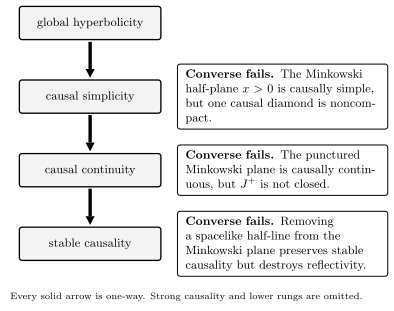
The selected upper causal ladder is directional: global hyperbolicity implies causal simplicity, which implies causal continuity, which implies stable causality. Each converse fails, as witnessed respectively by the Minkowski half-plane, the punctured Minkowski plane, and Minkowski spacetime with a spacelike half-line removed. Strong causality and lower rungs are omitted; the diagram is schematic.
Counterexamples and the remaining gap
Section titled “Counterexamples and the remaining gap”The punctured Minkowski plane is causally continuous but not causally simple. Around the missing point, a sequence of causal connections can converge to a null endpoint pair whose only possible connecting curve would pass through the puncture. Thus is not closed even though the chronological set maps satisfy the required continuity. The separation is discussed in Minguzzi 2019, Proposition 4.113, p. 145.
A removed spacelike half-line shows explicitly how reflectivity can fail. Set
Every future causal curve from would have to cross at before reaching any event with , so none can do so in . In particular, . But the points are chronologically before : their straight timelike segments cross at , on the surviving part of the line. Hence and . Reflectivity fails. The inherited coordinate is still temporal, so the spacetime is stably causal. This example separates stable causality from causal continuity by an actual pair of events, rather than by the silhouette of a slit.
Causal simplicity still does not control the size of causal diamonds. A closed set can be noncompact, so closed does not imply that
is compact. Nor does causal simplicity by itself guarantee a maximizing causal geodesic between every causally related pair or finiteness and continuity of Lorentzian distance. Compact diamonds supply the additional global control in Equivalent Criteria for Global Hyperbolicity.
| Rung | Defining addition | Principal failure still allowed |
|---|---|---|
| Stable causality | A causal widening or a time function | Discontinuous variation of chronological sets |
| Causal continuity | Distinction plus reflectivity | A nonclosed causal relation |
| Causal simplicity | Causality plus closed | Noncompact causal diamonds |
The ladder is a list of implications, not a claim that one condition is “approximately” another. Each added property supports a different theorem.
Exercise
Section titled “Exercise”Let with the induced Minkowski metric. Show that is causally simple but has a noncompact causal diamond.
Solution
The half-plane is convex. If two of its events are causally related in full Minkowski space, their straight causal segment remains in . Therefore
The right-hand side is closed in the relative topology of , and the analogous statement holds in the past. The inherited Minkowski time coordinate excludes closed causal curves, so is causally simple.
Choose and . The events lie in for , since both endpoint displacements obey the Minkowski cone inequality. Their only ambient limit is , which is not in . Thus the sequence has no convergent subsequence in the diamond, so the diamond is not compact. Causal simplicity does not imply global hyperbolicity.
Return to the chapter guide to review the complete ladder before moving to domains of dependence.
References
Section titled “References”- Minguzzi, Ettore, “Lorentzian Causality Theory”, Living Reviews in Relativity 22, article 3, §§4.1 and 4.5, pp. 104–111 and 142–149, 2019.
- Minguzzi, Ettore, and Miguel Sánchez, “The Causal Hierarchy of Spacetimes”, in Recent Developments in Pseudo-Riemannian Geometry, §§3.7 and 3.9–3.10, pp. 30–42 in the arXiv version, European Mathematical Society, 2008.