Spacelike Conformal Infinity in de Sitter Geometry
Scrollable formula. Use Left and Right arrow keys to reveal hidden content.
Scrollable table. Use Left and Right arrow keys to reveal additional columns.
Scrollable figure. Use Left and Right arrow keys to inspect hidden content.
Positive cosmological constant changes the causal character of conformal infinity. In four spacetime dimensions, a regular conformal completion of an asymptotically Einstein solution with has a timelike boundary normal, so the boundary itself is spacelike. Exact de Sitter spacetime makes the result explicit: its past and future infinities are disconnected three-spheres at finite conformal time but infinite physical affine distance. This page derives those statements and identifies the regularity, topology, and matter-decay assumptions they require.
Required background. We use The Einstein Equation with positive to determine the norm of the conformal-boundary normal.
Helpful background. Pseudo-Riemannian Metrics and Signature fixes the causal-character test, Affine and Variational Geodesics supplies the completeness check, Causality and Global Structure supplies the conformal-boundary language, Exact Solutions of Einstein’s Equations develops the de Sitter metric as a solution, and Formulations of General Relativity provides the evolution viewpoint used near a spacelike boundary.
Global de Sitter as a conformal cylinder
Section titled “Global de Sitter as a conformal cylinder”In four-dimensional vacuum de Sitter spacetime, the Einstein equation is
Global coordinates cover the complete spacetime:
where is the unit round metric on . Introduce conformal time by
Since and , the physical metric becomes
With , the unphysical metric is
It extends smoothly to . The two added components are
with the complete round metric . This is the global completion of exact de Sitter, not the planar completion of only one expanding patch. The construction and its boundary data are given in Ashtekar, Bonga, and Kesavan 2015, §III.A, pp. 10–11.
The upper panel below makes the distinction that matters for this page visible: de Sitter’s horizontal conformal ends are spacelike, while the diagonal cosmological horizons are observer-dependent null hypersurfaces inside the physical spacetime. The lower AdS panel provides the sign-reversed comparison; inspect its vertical timelike boundary rather than treating every compactified edge as the same kind of infinity.
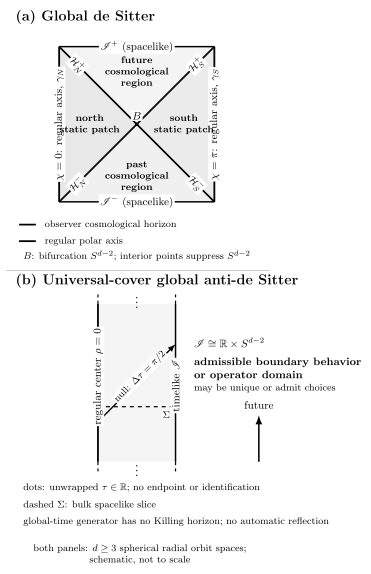
The positive and negative signs of the cosmological constant produce different global conformal boundaries. Global de Sitter has spacelike and observer-dependent null cosmological horizons inside a finite rectangle; the universal cover of global anti-de Sitter is an infinite-time radial half-strip with timelike , so a global field theory must specify admissible boundary behavior or an operator domain, which may be unique or may admit choices depending on the field and sector. Future points upward; both spherical radial diagrams are schematic and not to scale, and the anti-de Sitter continuation marks are not identifications.
The boundary normal is timelike
Section titled “The boundary normal is timelike”Let . In the exact completion,
at either component of . A hypersurface with timelike normal is spacelike. The calculation is invariant in its conclusion: under another admissible defining function , where is smooth and positive at the boundary,
Both the defining function and the unphysical metric must be transformed. Their factors cancel:
Thus the boundary value of the norm, including its magnitude, is invariant under this paired conformal change. Away from , derivatives of enter , so this equality is a boundary statement.
The labels “future” and “past” come from which end of physical causal curves the component represents. With the usual choice in the physical interior, points to the future at and to the past at . One may choose either orientation for a unit normal by writing ; this does not change its norm or the Riemannian signature of the induced three-metric. Orientation and causal character are separate pieces of data.
The same sign follows from the field equation rather than maximal symmetry. Let admit a smooth completion with , , and at . Assume
The leading part of the conformally transformed Einstein equation gives
Thus every regular boundary satisfying these four-dimensional hypotheses is spacelike. Ashtekar, Bonga, and Kesavan derive this implication, including the matter falloff, in Ashtekar, Bonga, and Kesavan 2015, §II.A–B, pp. 5–9. In spacetime dimensions the vacuum leading-order relation becomes ; the rest of this chapter uses , where the conformal field equations and radiative data have their familiar three-dimensional-boundary form.
Infinity is finite conformally, not physically
Section titled “Infinity is finite conformally, not physically”The cylinder metric places at finite values of , but conformal compactification has not made physical infinity a finite-distance surface. If is an affine parameter for an unphysical null geodesic and is affine for the same unparametrized curve in the physical metric, their parameters can be chosen so that
Near a transverse arrival at the regular boundary, has a simple zero: . Hence
Null geodesics reach the added boundary only after infinite physical affine parameter. The conformal boundary records their ideal endpoints without becoming part of the physical spacetime.
Spacelike also has no null generators. This is a decisive contrast with asymptotically flat null infinity, whose normal is both null and tangent and whose ruling helps select the BMS structure. Taking is therefore not a uniform perturbation of the boundary geometry: tends to zero and the boundary changes causal type. Statements about symmetries, charges, or radiation cannot be imported by merely setting a small positive in a formula derived at null infinity.
Topology and matter are additional inputs
Section titled “Topology and matter are additional inputs”The sign of fixes the boundary’s local causal character under the stated regularity and decay assumptions; it does not fix its topology. Global de Sitter has components. An expanding Poincaré patch naturally has future infinity, and isolated-system completions modeled on Schwarzschild–de Sitter can have . A change of conformal frame can sometimes puncture an completion, but it cannot generally repair a physical singularity or turn every completion into a smooth sphere. These alternatives are classified on Definitions of Asymptotically de Sitter Spacetimes.
The matter condition is equally substantive. The smoothness of is satisfied by important conformally regular fields and by standard late-time cosmological examples, but it is not a consequence of . Slower decay can obstruct the smooth completion or modify the leading boundary equation. Nor is conformal flatness of the induced metric assumed here. That extra condition is obeyed by exact de Sitter but excludes generic boundary geometry and severely restricts radiative data.
Finally, a spacelike conformal boundary is not a timelike wall on which boundary conditions must be imposed to make physical evolution unique. In conformal formulations it behaves more like an initial or final hypersurface. Whether smooth data there correspond to a global physical solution is a PDE theorem with topology, regularity, and matter hypotheses, not a consequence of the local sign calculation.
Common pitfalls
Section titled “Common pitfalls”Confusing a horizontal diagram edge with a coordinate choice. The edge is spacelike because its normal has negative norm in the regular unphysical metric. A drawing alone cannot establish this invariant fact.
Calling a cosmological horizon. Future infinity is a three-dimensional spacelike boundary of the global completion. A cosmological event horizon is a null boundary of one observer’s causal past inside the physical spacetime.
Assuming every positive- solution has smooth . Smooth conformal extendibility, nonvanishing , matter decay, and any completeness or topology condition must all be checked.
Exercises
Section titled “Exercises”Starting from the global de Sitter metric above, verify both the causal character of and the divergence of physical null affine parameter. Why do these conclusions not conflict?
Solution
With and , the boundary lies at and
The normal is timelike, so is spacelike. For a radial unphysical null geodesic, take near the boundary. Since ,
There is no conflict. “Spacelike” describes the causal character of the added hypersurface in the smooth unphysical metric; “infinite affine distance” describes how the physical metric diverges as . Conformal compactification deliberately places ideal endpoints at finite coordinate location while preserving their status as physical infinity.