Strong Cosmic Censorship
Scrollable formula. Use Left and Right arrow keys to reveal hidden content.
Scrollable table. Use Left and Right arrow keys to reveal additional columns.
Scrollable figure. Use Left and Right arrow keys to inspect hidden content.
Strong cosmic censorship (SCC) asks whether the maximal globally hyperbolic development of generic initial data is inextendible. The decisive missing word is how: continuous extension, locally Lipschitz extension, extension as a weak solution of the equations, extension, and smooth extension are inequivalent. A spacetime can continue as a continuous metric across a Cauchy horizon while curvature and the connection are too singular for the Einstein equations to hold weakly there.
Required background. The Einstein Equation supplies the field equations and their constraint content. Helpful background. Pseudo-Riemannian Metrics and Signature supplies metric regularity; Affine and Variational Geodesics supplies completeness language; Causality and Global Structure supplies Cauchy horizons and domains of dependence; Formulations of General Relativity separates constraints, evolution, and gauge; Exact Solutions of Einstein’s Equations supplies inner-horizon examples; PDEs and Green Functions for Gravitation supplies weak-solution and stability language.
Definition: regularity-dependent inextendibility
Section titled “Definition: regularity-dependent inextendibility”Fix an Einstein–matter system, a constraint-satisfying data space , a topology , a notion of generic subset , and an extension class . A schematic formulation is:
SCC at regularity . For every datum in , its maximal globally hyperbolic development is inextendible as an Lorentzian spacetime satisfying the stipulated matter and field-equation conditions.
An extension of is a connected spacetime together with an isometric embedding whose image is proper. The regularity of and of must be stated. If the extension is required to solve equations, the weak formulation and matter-field regularity must also be stated.
This conjecture begins where the maximal-development theorem ends. The theorem uniquely determines the largest solution region for which the original initial surface is Cauchy. SCC proposes that, generically and at its named regularity, no admissible larger spacetime exists. An extension that remains a solution in the original well-posedness class must lose the original Cauchy property. For arbitrary metric extensions or weaker solution classes, one must examine causality and equations separately: the original maximal-development theorem does not itself govern those larger categories.
The hierarchy of extension classes
Section titled “The hierarchy of extension classes”For ordinary metric regularities, the admissible extensions satisfy a nesting such as
where means locally Lipschitz. Therefore:
The converses fail in general. A continuous metric may cross a null boundary while its first derivatives blow up. Such a spacetime can be -inextendible but -extendible. This is why SCC is the strongest inextendibility claim, not the weakest.
The Christodoulou weak-solution formulation is not simply another rung identical to . Its intended threshold allows an extension only when the metric, inverse metric, and weak derivatives are regular enough that the Einstein equations make distributional sense; a common diagnostic requires Christoffel symbols to lie locally in . The exact definition depends on gauge and matter model. Locally Lipschitz metrics have essentially bounded first derivatives and are normally above this threshold, whereas a continuous extension with non- connection lies below it.
regularity makes classical curvature continuous. Divergence of a scalar curvature invariant along every approach to a boundary is therefore a sufficient obstruction to a extension. It is not an obstruction to every extension. “Curvature-inextendible” is likewise not a complete regularity class: one must say which curvature components or invariants diverge and what extension regularity that divergence excludes.
Theorem results in symmetry-reduced vacuum families
Section titled “Theorem results in symmetry-reduced vacuum families”There are rigorous SCC-type theorems in restricted families. For polarized Gowdy vacuum spacetimes, Chruściel, Isenberg, and Moncrief identify a subset open and dense in the topology whose MGHDs are smoothly inextendible Chruściel, Isenberg, and Moncrief 1990, theorem statement, p. 1673. For general Gowdy vacuum data, Ringström’s set is open in a topology and dense in the topology; its MGHDs are -inextendible, and the Kretschmann scalar is unbounded along every inextendible causal curve ending at the singular boundary Ringström 2009, Theorem 2 and Corollary 1, pp. 1190–1191.
These are nonlinear vacuum theorems with precise topologies, but they impose two spatial Killing fields and compact Cauchy topology. The Gowdy data space is a special symmetry class, not an open subset of unrestricted vacuum data. The results demonstrate how a valid model theorem must state topology and regularity; they do not prove unrestricted SCC.
Exact Taub–NUT, Reissner–Nordström, and Kerr solutions have Cauchy horizons and extensions. Their existence does not by itself refute a generic conjecture. The issue is whether horizons or sufficiently regular extensions survive perturbations in a declared data space.
The exact Reissner–Nordström family makes this logical separation visible. In the first panel below, the inner dashed null boundaries are Cauchy horizons of the analytic subextremal solution; in the last, the superextremal timelike singularity is naked because no horizon forms. Neither panel states what generic collapse produces, and the diagram encodes no perturbative stability result.
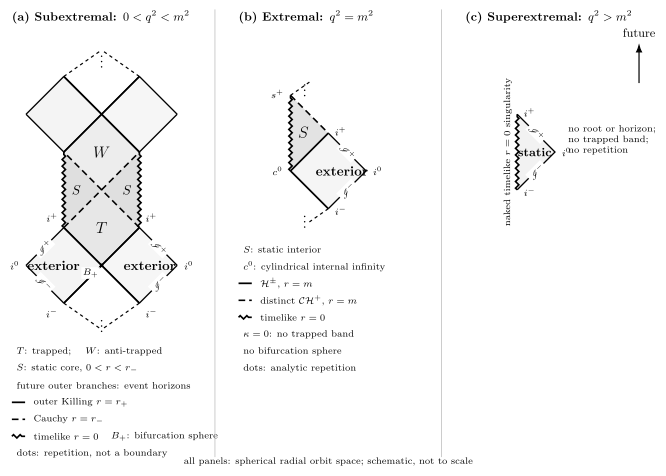
Charge separates the exact Reissner–Nordström family into three causal graphs: an infinitely repeating subextremal extension with outer and inner horizons, a distinct extremal extension with a degenerate horizon and no bifurcation sphere, and a horizonless superextremal spacetime with a naked timelike singularity. Future points upward; each spherical radial diagram is schematic and not to scale. These exact backgrounds diagnose formulation choices but do not establish generic formation or stability.
Weak null singularities and asymptotically flat interiors
Section titled “Weak null singularities and asymptotically flat interiors”Blue shift near an inner horizon can make derivatives and curvature diverge while leaving the metric continuous. In the two-ended asymptotically flat, spherically symmetric Einstein–Maxwell–real-scalar model with nonzero charge, every admissible development has a nonempty Cauchy horizon and admits a future extension, whereas a generic set—open in an appropriate weighted topology and dense in weighted smooth topologies—is -future-inextendible Luk and Oh 2019, Theorems 1.4–1.5 and 3.14, pp. 5–7 and 30–32.
The stronger weak-derivative statement has a narrower quantifier than is sometimes reported. In the particular extension constructed in the Luk–Oh interior analysis, the Christoffel symbols fail to lie in for every and . Whether the same obstruction holds for every nontrivial extension is left open Luk and Oh 2019, Remark 1.6, pp. 6–7, and Theorems 5.1 and 5.4–5.5, pp. 42–46. Their generic theorem does not assert generic Hawking-mass blowup.
This behavior, called a weak null singularity, separates verdicts:
- a continuous extension falsifies -inextendibility for that datum;
- failure of local connection in every admissible extension would support a Christodoulou-type inextendibility statement, while failure in one constructed extension does not;
- curvature blowup can support -inextendibility; and
- none of these claims automatically supplies genericity in unrestricted data.
In asymptotically flat black holes, exterior perturbations often decay by inverse powers of time. Their blue-shifted influx can then be strong enough to produce mass inflation at the Cauchy horizon. Turning this mechanism into a theorem requires the coupled nonlinear equations; a test field on a fixed metric cannot establish backreaction.
Vacuum Kerr and continuous Cauchy horizons
Section titled “Vacuum Kerr and continuous Cauchy horizons”For nonsymmetric vacuum interiors, Dafermos and Luk start with characteristic data on a hypersurface already inside a subextremal rotating black hole. Under their quantified Kerr-asymptotic assumptions, the maximal interior evolution has a nontrivial Cauchy-horizon segment across which the metric extends continuously Dafermos and Luk 2025, Theorem 4.2 and assumptions (4.2)–(4.3). By itself, this was an interior conditional theorem: it did not derive the needed event-horizon data from ordinary exterior Cauchy data.
Hintz’s 2026 preprint supplies that exterior input for a structured small-data class throughout the subextremal Kerr range. The initial data admit a finite partially polyhomogeneous expansion with a remainder of the stated decay; the resulting vacuum spacetime settles to a nearby Kerr metric with inverse-polynomial decay. Combining this with the Dafermos–Luk interior theorem yields a continuous extension across a nontrivial Cauchy horizon for that class Hintz 2026, Theorem 1.1 and consequence (1), pp. 2–3, and Theorem 13.1, pp. 318–319. This closes the exterior-to-interior conditional gap within the named topology; it is not a curvature-blowup theorem or an unrestricted stronger-regularity verdict. The 339-page preprint was revised on 3 August 2026 and relies on two companion preprints for constraint damping and tame forward estimates, so its status and dependencies remain explicit.
A Kerr–Newman–de Sitter test
Section titled “A Kerr–Newman–de Sitter test”Positive cosmological constant changes the competition. Exterior fields on stationary de Sitter black holes decay exponentially, while the Cauchy horizon blue shift is controlled by its surface gravity . For a quasinormal frequency , define
For a neutral scalar mode on a fixed Kerr–Newman–de Sitter (KNdS) background, the nonsmooth Frobenius branch near the right Cauchy horizon has radial derivative behaving as , up to oscillatory factors. It is locally square integrable exactly when
For a nonzero coefficient of this nonsmooth branch, the threshold follows from
The integral is finite precisely when ; at it diverges logarithmically. A generically excited mode with therefore supplies an obstruction. Conversely, promoting modewise to finite-energy behavior for general initial data requires a suitable spectral gap, a controlled mode expansion or decay estimate, and control of the remainder. A finite numerical scan alone cannot supply those assumptions. Stationary smooth modes, such as the constant massless scalar, do not create the nonsmooth derivative and are excluded from the decay-gap diagnostic. The local derivation and its boundary conditions are in Davey, Dias, and Sola Gil 2024, §2.3.3, pp. 13–14.
Their numerical scan uses a linear, neutral, massless scalar test field on the stationary Einstein–Maxwell KNdS family. For , it finds a roughly spherical-like transition surface around the small, near-extremal Reissner–Nordström–de Sitter corner: inside, the least-damped scalar spectrum has in their criterion; outside, including the Kerr–de Sitter limit, photon-sphere modes with provide a weak-scalar obstruction Davey, Dias, and Sola Gil 2024, §5, pp. 34–40. Their scan above the off-extremality parameter is sparser, and the quoted transition conclusion explicitly carries the qualification.
This is useful linear spectral evidence, not a universal SCC verdict. It does not evolve the nonlinear coupled Einstein–Maxwell–scalar system, compute metric backreaction, establish a generic set of collapse data, or cover gravito-electromagnetic modes throughout KNdS. The authors themselves separate their neutral scalar numerics from expectations for massive, charged, and gravito-electromagnetic perturbations and note that nonlinear studies are inconclusive Davey, Dias, and Sola Gil 2024, §§1 and 6, pp. 4–5 and 40–42. It also concerns de Sitter inner-horizon regularity, not weak-censorship visibility from asymptotically flat null infinity.
Asymptotics, matter, and boundary conditions
Section titled “Asymptotics, matter, and boundary conditions”The same SCC sentence cannot cover all asymptotics without modification.
Asymptotically flat. Polynomial exterior tails and two-ended black-hole data are central to inner-horizon blue shift. Vacuum Kerr, charged Einstein–Maxwell, and scalar-coupled systems have different perturbation sectors.
Asymptotically de Sitter. Exponential decay makes the spectral ratio relevant in linear models. A stationary KNdS parameter scan is not a theorem about arbitrary de Sitter collapse.
Asymptotically anti-de Sitter. Timelike infinity makes boundary conditions part of evolution. Reflecting boundaries can prevent decay and change the interior influx. One must formulate an initial-boundary value version and specify what counts as a development.
Matter matters twice: it changes the constraint/evolution system, and its weak regularity determines whether stress energy is defined across an extension. A scalar in has a natural finite-energy interpretation, but finite energy of a test scalar does not construct a weak metric extension. Likewise, a linear gravito-electromagnetic obstruction is not automatically a nonlinear curvature theorem.
Determinism at different thresholds
Section titled “Determinism at different thresholds”If an MGHD admits two inequivalent continuous extensions, causal curves can be continued into regions not fixed by the original data, so metric-level determinism fails in the category. If no admissible extension has locally Christoffel symbols in the stipulated weak formulation, the Einstein evolution may nevertheless terminate at that weak-solution threshold: the added continuous geometry is not an admissible weak solution. If a extension exists, classical curvature and tidal equations can cross; that is a more serious failure for classical evolution than mere continuous extendibility.
There is no reason a priori for nature or mathematics to select one threshold. A defensible SCC claim is indexed by it. The full function-space versions and proof technologies are treated on Regularity-Dependent Formulations of Strong Cosmic Censorship.
The evidence status here is fixed at 2026-08-12. New nonlinear stability or inextendibility theorems, corrections, or withdrawals can change the model-by-model matrix without changing the definitions.
Formulation diagnostic
Section titled “Formulation diagnostic”Problem. For one MGHD, suppose a proper extension exists. In every such extension the Christoffel symbols fail to lie in , and a curvature scalar diverges at the boundary. Classify , locally Lipschitz, Christodoulou weak-solution, , and smooth inextendibility for this datum.
Solution
-inextendibility is false because a continuous extension exists. A locally Lipschitz extension would have locally bounded first derivatives and hence locally square-integrable Christoffel symbols, so the stated universal failure rules it out. It also rules out the stipulated Christodoulou weak-solution class. Divergent scalar curvature rules out a extension consistent with the original curvature, and therefore rules out smooth extension. These are conclusions for one datum; SCC additionally requires that the relevant property hold on a precisely generic subset of a named data space.
Next, Genericity, Data Classes, and Matter Models supplies the quantifier needed to turn any one of these inextendibility statements into a conjecture.
References
Section titled “References”- Chruściel, Piotr T., James Isenberg, and Vincent Moncrief. “Strong Cosmic Censorship in Polarised Gowdy Spacetimes.” Classical and Quantum Gravity 7 (1990): 1671–1680. DOI.
- Dafermos, Mihalis, and Jonathan Luk. “The Interior of Dynamical Vacuum Black Holes I: The -Stability of the Kerr Cauchy Horizon.” Annals of Mathematics 202, no. 2 (2025): 309–630. DOI.
- Davey, Alex, Óscar J. C. Dias, and David Sola Gil. “Strong Cosmic Censorship in Kerr–Newman–de Sitter.” Journal of High Energy Physics 2024, no. 7 (2024): 113. https://doi.org/10.1007/JHEP07(2024)113; arXiv:2404.03724.
- Hintz, Peter. “Nonlinear Stability of Subextremal Kerr Black Holes.” arXiv:2606.28253v2 (revised 3 August 2026). arXiv.
- Luk, Jonathan, and Sung-Jin Oh. “Strong Cosmic Censorship in Spherical Symmetry for Two-Ended Asymptotically Flat Initial Data I: The Interior of the Black Hole Region.” Annals of Mathematics 190, no. 1 (2019): 1–111. DOI.
- Ringström, Hans. “Strong Cosmic Censorship in -Gowdy Spacetimes.” Annals of Mathematics 170, no. 3 (2009): 1181–1240. DOI.