Timelike Conformal Infinity in AdS
Scrollable formula. Use Left and Right arrow keys to reveal hidden content.
Scrollable table. Use Left and Right arrow keys to reveal additional columns.
Scrollable figure. Use Left and Right arrow keys to inspect hidden content.
Anti-de Sitter spacetime has a timelike conformal boundary. Light can travel from the bulk to that boundary and back in finite global coordinate time, so bulk initial data cannot determine later evolution unless boundary behavior is supplied. The boundary lies at infinite physical distance and affine parameter; conformal completion makes its causal role finite without turning it into an ordinary bulk hypersurface.
Helpful background. Lorentzian Metrics and Causal Cones supplies boundary-normal classification; Geodesics and Jacobi Fields supplies affine completeness; Causality and Global Structure supplies conformal completion; Exact Solutions of Einstein’s Equations supplies AdS coordinate systems; Formulations of General Relativity supplies evolution; Gravitational Actions and Boundary Terms supplies variational boundary data.
Global AdS and its cover
Section titled “Global AdS and its cover”In spacetime dimensions, global anti-de Sitter geometry can be written
with cosmological constant
The hyperboloid definition of AdS has periodic global time and hence closed timelike curves. Physical work normally passes to the universal covering spacetime, unwrapping so that . “Global AdS” below means this universal cover unless stated otherwise.
Spatial sections at fixed are hyperbolic balls. Their proper radial distance to diverges because . The boundary is therefore not a finite-distance reflecting wall in the physical metric. Nevertheless, the conformal structure allows causal signals to reach it in finite .
Ishibashi and Wald set out the global geometry and field dynamics on this non-globally-hyperbolic background in Ishibashi and Wald 2004, Introduction and §§2–3, pp. 2981–3014.
Conformal completion and causal character
Section titled “Conformal completion and causal character”Choose
The unphysical metric is
which extends smoothly to . There and . Its normal is proportional to , with
In signature , a spacelike normal means a timelike boundary. The induced conformal metric is
so the universal-cover boundary has topology . A different defining function rescales this metric by ; the boundary conformal class, rather than one representative, is intrinsic.
The sign contrasts with de Sitter infinity, whose normal is timelike and boundary spacelike, and asymptotically flat null infinity, whose normal is null. The limit changes causal character and cannot be treated as a small continuous adjustment of boundary conditions.
The comparison below displays that causal-character change. In the lower panel, inspect both the vertical AdS boundary and the unbounded global-time continuation: the strip is the universal cover, so the continuation marks do not identify its top and bottom. The upper de Sitter panel shows why a spacelike conformal end and an observer’s null cosmological horizon must not be conflated.
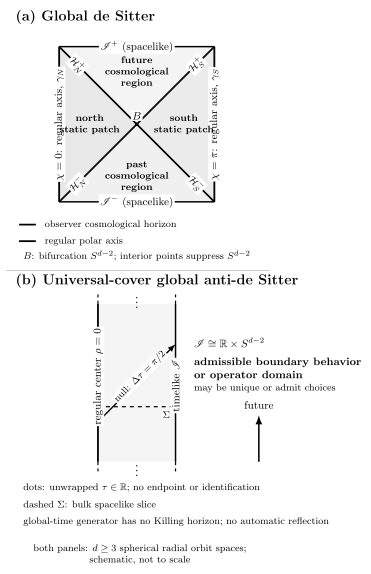
The positive and negative signs of the cosmological constant produce different global conformal boundaries. Global de Sitter has spacelike and observer-dependent null cosmological horizons inside a finite rectangle; the universal cover of global anti-de Sitter is an infinite-time radial half-strip with timelike , so a global field theory must specify admissible boundary behavior or an operator domain, which may be unique or may admit choices depending on the field and sector. Future points upward; both spherical radial diagrams are schematic and not to scale, and the anti-de Sitter continuation marks are not identifications.
Finite light-crossing time
Section titled “Finite light-crossing time”For a radial null curve, the conformal factor cancels from the null condition:
A ray emitted from the center at reaches the conformal boundary at . If a boundary condition reflects it, it returns to the center at . The coordinate is dimensionless; a clock at the center measures proper time , so the corresponding travel times are and . More generally, from radius the outward coordinate travel time is .
This finite coordinate time is conformally meaningful as causal incidence on the Einstein cylinder. It does not imply finite physical affine parameter. If is an affine parameter for the unphysical null metric, the physical affine parameter obeys
Near the boundary vanishes linearly, and the integral diverges. AdS null geodesics are not incomplete merely because the conformal diagram ends. The boundary controls evolution because causal curves can enter the physical domain from it in finite global time, not because it is a missing finite-affine endpoint.
Patches and boundary coverage
Section titled “Patches and boundary coverage”The Poincaré patch metric
has conformal boundary with a Minkowski representative. It covers only part of global AdS. Its Poincaré horizon at is a coordinate horizon of the patch, not the global conformal boundary. Statements about boundary topology, global time, or completeness must say whether they concern the patch or universal cover.
Likewise, asymptotically locally AdS spacetimes may have a boundary metric not conformal to the global Einstein cylinder, multiple boundary components, or quotients. The Fefferman–Graham form controls local behavior near each boundary component but does not determine global topology or causal connectivity.
A bulk spacetime with two timelike boundary components raises an additional causal question: can a causal curve connect them? Field equations and energy conditions constrain such connectivity in particular settings, but boundary multiplicity alone does not answer it.
Consequences and limitations
Section titled “Consequences and limitations”The timelike boundary has three immediate consequences. First, no spacelike bulk hypersurface can intercept every inextendible causal curve when curves are allowed to originate at arbitrary boundary times. Second, hyperbolic fields require boundary conditions or an equivalent self-adjoint evolution prescription. Third, conserved charges and symplectic flux depend on which boundary data are held fixed or allowed to vary.
None of these consequences selects Dirichlet boundary conditions uniquely. Admissibility depends on field type, mass, dimension, energy norm, and desired flux. Nor does the causal diagram prove stability: repeated reflection creates opportunities for nonlinear interaction, while actual evolution depends on equations and data.
Exercise
Section titled “Exercise”For a radial null ray starting at and time in global AdS, find the boundary arrival time and show that the physical affine parameter diverges if the unphysical affine parameter is proportional to near the boundary.
Solution
The outgoing null equation is , hence
Near the endpoint set . Then and . Therefore
The ray arrives at the conformal boundary in finite and finite unphysical parameter but infinite physical affine parameter. This is why the boundary is an asymptotic causal boundary, not a geodesic singularity.
Why AdS Is Not Globally Hyperbolic turns the finite causal travel time into a precise failure of Cauchy predictability.
References
Section titled “References”- Ishibashi, Akihiro, and Robert M. Wald, “Dynamics in Non-Globally-Hyperbolic Static Spacetimes III: Anti-de Sitter Spacetime”, Classical and Quantum Gravity 21, Introduction and §§2–3, pp. 2981–3014, 2004.
- Wald, Robert M., General Relativity, Chapter 8, University of Chicago Press, 1984.