Consistent Truncations and Lost Solutions
Scrollable formula. Use Left and Right arrow keys to reveal hidden content.
Scrollable table. Use Left and Right arrow keys to reveal additional columns.
Scrollable figure. Use Left and Right arrow keys to inspect hidden content.
A reduced ansatz is reliable only if its reduced equations agree with the full equations restricted to that ansatz. This commuting condition—rather than symmetry, elegance, or successful examples—is what makes a truncation consistent. Consistency guarantees that every reduced solution uplifts; it does not guarantee that every parent solution descends, and an inconsistent truncation can still possess exceptional reduced solutions that uplift after satisfying extra equations.
Required background. Use Killing fields and isometry groups for invariant sectors and the Einstein equation for the parent gravitational equations.
Helpful background. Hypersurface normals and tangential projectors gives a useful analogy between retained and projected field components.
The commuting test
Section titled “The commuting test”Let the parent fields be split as , and let a differentiable ansatz set
Write the parent Euler–Lagrange expressions as
There are two operations:
- vary to obtain every , then impose the ansatz;
- substitute the ansatz into to obtain , then vary with respect to .
The chain rule gives
up to the corresponding differential-operator adjoint when the ansatz contains derivatives. The reduced equations therefore constrain a combination of parent equations. They need not imply the discarded equations .
Consistency theorem. Assume the ansatz is differentiable, its retained variables are independent, boundary terms are controlled, and the restricted parent equations are well defined. If
for every reduced solution in the stated function class, then the truncation is consistent and substitution defines a map from the complete reduced solution set into the parent solution set. At the level of admissible solution sets, this is often summarized by saying that reduction and formation of the equations of motion commute. Pons and Talavera formulate this criterion and distinguish it from merely correct special uplifts in Pons and Talavera 2004, §1, pp. 1–5, PDF.
Here “commute” is a statement about the solution map: both routes select the same admissible reduced solutions. Literal equality of the reduced equations with every restricted parent equation is a stronger sufficient condition. If only the reduced combination vanishes, the discarded equations must still be checked separately.
The proof is direct: a reduced solution satisfies the premise, so every restricted parent Euler–Lagrange expression vanishes; inserting the ansatz reconstructs a parent solution. The force of the statement lies in verifying the implication, not in this final logical step.
The diagram starts both routes from the same parent action and ansatz. Follow the solid route to retain every parent equation, then compare it with the dashed reduced-action route. A solution on the dashed route reaches the doubled consistency box only after the discarded equation passes the diamond-shaped check; otherwise it enters the separate spurious-solution box. The two lower examples perform that check explicitly, while the dotted bottom band deliberately keeps lost parent solutions outside the obstruction branch.
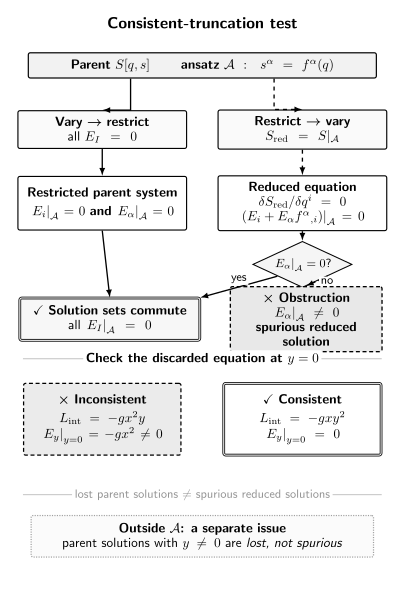
A truncation commutes only at the level of the declared admissible solution sets: every solution of the reduced-action equation must also satisfy every restricted parent equation, especially the discarded equation . For the ansatz , gives , so generic reduced oscillator solutions are spurious; instead gives , so every reduced oscillator uplifts. Valid parent solutions with are merely outside the ansatz. Schematic and not to scale.
Symmetry reductions and unimodularity
Section titled “Symmetry reductions and unimodularity”For reduction along independent Killing vectors with Lie brackets
an invariant mixed basis separates the orbit dependence from retained fields. Integration by parts along an anholonomic orbit basis produces trace terms proportional to . Consequently, under the assumptions made for the invariant Lagrangian reduction, the unimodularity condition
is a sufficient condition for the reduced Euler–Lagrange equations to equal the restricted parent equations. Abelian, compact, and semisimple groups satisfy it. The calculation, including the determinant factor in the invariant orbit measure and the precise sufficient condition, is given in Pons and Talavera 2004, §§2.1–2.4, pp. 5–12, PDF.
This theorem has hypotheses. It does not say that any ansatz described informally as “symmetric” is consistent. Singular orbits, boundary terms, noncompact orbit integration, noninvariant sources, constrained variables, and additional conditions imposed after the symmetry reduction must all be examined separately. It also does not make unimodularity necessary for every particular Lagrangian; cancellations can occur in special theories.
A discarded equation that exposes inconsistency
Section titled “A discarded equation that exposes inconsistency”Consider the finite-dimensional action
Impose the truncation . Substitution before variation gives
so every oscillator solution is allowed. The parent equation, however, is
On it requires . For , generic nonzero reduced oscillator solutions are spurious: they do not uplift. The ansatz may still admit the exceptional solution , illustrating that “some solutions uplift” is weaker than consistency.
The same diagnostic applies to fields. A retained scalar or gauge field may source a discarded metric component. One must evaluate every discarded Einstein, matter, and constraint equation, including boundary conditions. Substituting an ansatz into the action and obtaining a plausible reduced theory is not enough.
Lost parent solutions versus spurious reduced solutions
Section titled “Lost parent solutions versus spurious reduced solutions”Two logically distinct losses should be named precisely.
- A lost parent solution is a valid solution not representable by the ansatz—for example, a nonspherical gravitational wave omitted by exact spherical symmetry. This is expected and does not make the truncation inconsistent.
- A spurious reduced solution solves the reduced equations but violates a discarded parent equation. Its presence proves inconsistency.
Constraints produce an important intermediate case. Imposing a configuration-space constraint can generate secondary consistency conditions under time evolution. The resulting truncation is generally inconsistent, yet the subset of reduced solutions satisfying every secondary condition can still uplift correctly. Pons and Talavera demonstrate this mechanism for an Einstein–Hilbert reduction in Pons and Talavera 2004, §§4–5.1, pp. 19–28, PDF. Calling the entire reduced theory consistent would erase the extra condition on its solution set.
Boundary data obey the same logic. Even if bulk equations commute with reduction, a reduced boundary condition must reconstruct a permitted parent boundary condition. Fixed points and corners can impose regularity equations invisible in a regular-orbit action. Consistency is therefore a statement about the declared bulk-plus-boundary problem and function class.
Exercise
Section titled “Exercise”Modify the oscillator example to the interaction and again set . Is this truncation consistent? Which parent solutions are lost?
Solution
The parent equations are
On , the second equation vanishes identically and the first becomes , exactly the equation derived from the reduced action. Hence every reduced solution uplifts with : the truncation is consistent. Parent solutions with are excluded by the ansatz and therefore lost, but none of the retained oscillator solutions is spurious. The comparison shows that deleting a field is consistent when retained fields do not source its equation at the truncation surface.