Quasi-Local Mass and Horizon Inequalities
Scrollable formula. Use Left and Right arrow keys to reveal hidden content.
Scrollable table. Use Left and Right arrow keys to reveal additional columns.
Scrollable figure. Use Left and Right arrow keys to inspect hidden content.
A quasi-local mass assigns energy to a closed two-surface or to the bounded region it encloses. No single definition is known to satisfy every desired property in every spacetime: positivity, rigidity, monotonicity, correct small- sphere and large-sphere limits, boost behavior, computability, and horizon inequalities pull in different directions. Theorems therefore belong to a triple—definition, geometric class, and comparison principle—not to the word “mass” alone. This status comparison uses evidence checked through 2026-08-12.
Required background. Analysis for Mathematical Relativity supplies variational compactness, Hypersurfaces and Foliations supplies surface geometry, Curvature supplies Gauss identities, and Einstein Equations fixes energy conditions.
Helpful background. Causality and Global Structure clarifies horizons and null expansions, while Partial Differential Equations and Green Functions supports fill-in and extension problems.
Four different constructions
Section titled “Four different constructions”For a closed spacelike two-surface in a time-symmetric slice, the Hawking mass is
It is explicit and monotone along the connected weak inverse mean curvature flows covered by the Huisken–Ilmanen theorem, when the ambient three-manifold has nonnegative scalar curvature and the surfaces are handled through outward-minimizing hulls. Connectedness controls the Gauss–Bonnet term in the variation formula. It need not be positive or monotone for arbitrary surfaces in arbitrary slices.
The Brown–York mass compares the mean curvature of with the mean curvature of an isometric embedding into Euclidean space,
Its definition requires the reference embedding, commonly secured by positive Gauss curvature. Positivity follows under suitable fill-in and scalar- curvature hypotheses: for a compact three-manifold with nonnegative scalar curvature and boundary components of positive Gauss curvature and positive mean curvature, , with equality only for a Euclidean domain. This is Shi and Tam 2002, Theorem 4.2, pp. 117–118. The value nevertheless depends on the chosen spacelike region and reference geometry.
The Bartnik mass of compact data is instead an infimum of ADM masses over admissible asymptotically flat extensions satisfying nonnegative scalar curvature and a no-horizon or outer-minimizing condition. It is difficult to compute, but it builds positivity and nonlocal shielding into the variational problem. Horizon masses, including irreducible mass , use area and sometimes spin or charge; they are specialized to marginal or stationary surfaces rather than arbitrary regions.
Comparison on fixed axes
Section titled “Comparison on fixed axes”As of the evidence cutoff, the distinctions are these.
- Hawking: explicit for any suitable surface; monotone only along selected flows under energy and topology hypotheses; rigidity and positivity are not universal for arbitrary surfaces.
- Brown–York: boundary and reference based; positivity is a theorem for appropriate compact fill-ins; foliation and embedding dependence remain.
- Bartnik: variational and designed to represent the least total mass of an admissible extension. The original unrestricted minimizer/static-extension conjectures are false in full generality; restricted existence, regularity, uniqueness, and the relation between minimizers and static extensions remain active questions.
- Horizon: sharp for specialized black-hole cross-sections under stability, symmetry, or field-equation assumptions; not a general mass of an arbitrary finite region.
McCormick’s survey states the competing Bartnik definitions, admissible- extension choices, static minimizer conjecture, and known results in McCormick 2024, §§2–5. The Riemannian Penrose application of Hawking-mass monotonicity is proved in Huisken and Ilmanen 2001, Main Theorem and §§1–4, pp. 355–401.
Round-sphere checks
Section titled “Round-sphere checks”In Euclidean space, a round sphere of areal radius has and . Hence
so . Its Euclidean reference has , hence as well. These rigidity checks agree.
The two definitions already differ on the simplest black-hole exterior. In areal radius , a time-symmetric Schwarzschild slice has
For a centered sphere, , while its Euclidean reference sphere has . Substitution, with , gives
The last expression avoids cancellation at large . Hawking mass equals the ADM mass on every centered sphere; Brown–York mass decreases from the limiting value at to at infinity. At , for example, . These are two different well-defined functionals of the same surface, not an inconsistency in the geometry. The horizon value here is a limit from ; it does not invoke the strict mean-convex fill-in theorem at .
In the figure, compare the solid curve with the dashed constant line as the same family of spheres moves outward.
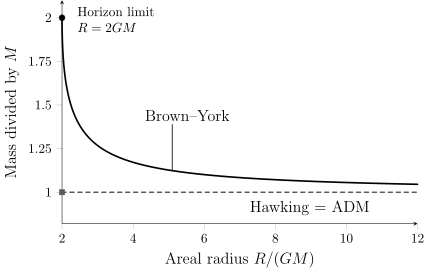
Two quasi-local masses of centered round spheres in a time-symmetric Schwarzschild exterior with physical mass . The horizontal coordinate is and the vertical coordinate is mass divided by . Brown–York mass uses the Euclidean isometric reference. The horizon point denotes the limit ; the quantitative curves approach the same ADM value only at infinity.
Distorting the surface removes the constant-Hawking-mass property. In fact, even in Euclidean space every smooth embedded surface of spherical topology satisfies , where are principal curvatures. Thus Gauss–Bonnet yields . Its Hawking mass is nonpositive, and is strictly negative for a nonround surface. This explicit example explains why flow monotonicity is a conditional theorem, not positivity for arbitrary surfaces.
Bartnik admissibility and the minimizer problem
Section titled “Bartnik admissibility and the minimizer problem”Let be compact Riemannian data with boundary. An admissible extension is a complete asymptotically flat manifold of nonnegative scalar curvature that contains the prescribed data and does not introduce a horizon screening from infinity. Boundary data may be expressed through the induced metric and mean curvature, with matching regularity depending on the version. Then
The static minimizer conjecture predicts that a mass-minimizing exterior, when it exists in a suitable class, is static vacuum and satisfies matching conditions at the boundary. Its most optimistic global form cannot be retained: for any smooth metric on whose Gauss curvature is Morse, sufficiently small positive can admit no smooth static-vacuum extension with boundary data ; see Anderson 2024, Theorem 1.1 and §3. This disproves the general static-extension conjecture, not every restricted or local version.
There is complementary positive evidence. For arbitrary Bartnik data close to those of any coordinate sphere in a Schwarzschild time-symmetric slice, including spheres with arbitrarily small positive mean curvature, the static extension problem is locally well posed in Ellithy’s geodesic gauge; see Ellithy 2026, Main Theorem and §5. Thus global existence of mass minimizers, absence of corners, boundary regularity, uniqueness in the admissible minimization class, and equivalence among definitions remain distinct questions. Local solvability near Schwarzschild neither supplies a global minimizer nor contradicts Anderson’s nonexistence data away from that neighborhood.
Horizon inequalities and tradeoffs
Section titled “Horizon inequalities and tradeoffs”Stable minimal or marginally outer trapped surfaces obey different sharp horizon inequalities. In Einstein–Maxwell theory, a stably outermost MOTS obeys without axial symmetry, where is the geometrized total electric-magnetic charge in the normalization of the theorem; see Dain, Jaramillo, and Reiris 2012, Theorem 1. Angular momentum requires axial structure: an axisymmetric, stably outermost MOTS under the dominant energy condition and nonnegative cosmological constant obeys in explicit- units; see Jaramillo, Reiris, and Dain 2011, main theorem. These can define lower bounds on an associated horizon mass. Yet a quasi-local functional that is sharp on horizons may fail a desired small- sphere matter limit, while a reference-subtraction mass may depend on a chosen embedding. A variational mass may have excellent monotonicity and positivity but no closed computational formula.
The tradeoff is therefore methodological, not a proved universal no-go theorem covering every imaginable definition. No established result says that one functional must fail exactly one named axiom. The defensible claim is narrower: the standard masses above are inequivalent outside special geometries, and their best theorems require different data, regularity, topology, symmetry, boundary, and matter assumptions.
Open questions and formulation dependence
Section titled “Open questions and formulation dependence”The position as of 2026-08-12 is that Bartnik mass remains a compelling variational candidate, but Anderson’s theorem rules out its original global static-extension conjecture without further restrictions, while Ellithy’s theorem establishes a substantial local validity regime near Schwarzschild spheres. Hawking mass is exceptionally effective along geometric flows, Brown–York mass for suitable boundary fill-ins, and horizon masses for specialized black-hole inequalities. None has a proved universal priority. Outstanding questions include existence of minimizers in suitable restricted classes and equivalence between competing definitions.
The main limitation is formulation dependence. Changing the admissible- extension class, allowing interior horizons, changing the reference embedding, dropping axisymmetry, or moving from a Riemannian slice to a spacetime surface changes the theorem. A universal verdict without those axes would be mathematically empty.
Check the comparison
Section titled “Check the comparison”Evaluate the Hawking mass on a round Euclidean sphere and on a centered round Schwarzschild sphere. Why do these calculations not prove positivity for an arbitrary surface?
Solution
For the Euclidean sphere, makes the parenthesis in vanish, so . Spherical symmetry and the Schwarzschild constraint make the same expression equal to the constant ADM mass on centered spheres. General surfaces need not share either symmetry or the flow monotonicity hypotheses; their mean-curvature integral can make negative. The examples check normalization and rigidity, not a universal positivity theorem.
References
Section titled “References”- Anderson, Michael T. “The Bartnik Quasi-Local Mass Conjectures.” Beijing Journal of Pure and Applied Mathematics 1 (2024): 405–454. DOI.
- Dain, Sergio, José Luis Jaramillo, and Martín Reiris. “Area–Charge Inequality for Black Holes.” Classical and Quantum Gravity 29 (2012): 035013. DOI.
- Ellithy, Ahmed. “Local Well-Posedness of the Bartnik Static Extension Problem near Schwarzschild Spheres.” Calculus of Variations and Partial Differential Equations 65 (2026): 7. DOI.
- Huisken, Gerhard, and Tom Ilmanen. “The Inverse Mean Curvature Flow and the Riemannian Penrose Inequality.” Journal of Differential Geometry 59 (2001): 353–437. Article.
- Jaramillo, José Luis, Martín Reiris, and Sergio Dain. “Black Hole Area–Angular-Momentum Inequality in Nonvacuum Spacetimes.” Physical Review D 84 (2011): 121503. DOI.
- McCormick, Stephen. “An Overview of Bartnik’s Quasi-Local Mass.” Beijing Journal of Pure and Applied Mathematics 1 (2024): 455–487. DOI.
- Shi, Yuguang, and Luen-Fai Tam. “Positive Mass Theorem and the Boundary Behaviors of Compact Manifolds with Nonnegative Scalar Curvature.” Journal of Differential Geometry 62 (2002): 79–125. DOI.