Scalar-Wave Boundedness and Decay
Scrollable formula. Use Left and Right arrow keys to reveal hidden content.
Scrollable table. Use Left and Right arrow keys to reveal additional columns.
Scrollable figure. Use Left and Right arrow keys to inspect hidden content.
A scalar field is the cleanest setting in which to see why black-hole decay is not an ordinary positive-energy argument. On a four-dimensional Schwarzschild or subextremal Kerr exterior, solutions of remain bounded and lose local energy, but the proof must overcome a horizon where stationary energy degenerates, a trapped null-geodesic set, and—on Kerr—an ergoregion in which stationary energy can be negative. The central mechanism is a compatible family of currents: redshift near the horizon, Morawetz control in the bulk, and weighted estimates toward null infinity.
Required background. Analysis for Mathematical Relativity supplies Sobolev and energy estimates, while Partial Differential Equations and Green Functions supplies hyperbolic propagation and multiplier identities.
Helpful background. Einstein Equations fixes the vacuum setting, Causality and Global Structure fixes the exterior domain, and Black-Hole Geometry and Mechanics together with Black-Hole Perturbation Theory supplies the horizon and perturbative geometry used below.
The scalar energy identity
Section titled “The scalar energy identity”For a real solution, define
The wave equation gives . A vector field produces the current and deformation tensor
The product rule and stress-tensor conservation give
Indices on are raised with after taking the Lie derivative: . This minus sign follows by differentiating . Stokes’ theorem on a slab therefore reads
Here is the oriented surface element; it also handles null boundaries, which have no unit normal. The positive energy on a spacelike slice with future unit normal is .
If is a future timelike Killing field, the spacelike energy density is nonnegative and . A black-hole exterior offers no single with both properties everywhere. In Schwarzschild, the stationary field becomes null on the event horizon. In rotating Kerr it is spacelike in part of the ergoregion. Thus conservation of stationary energy alone is neither nondegenerate at the horizon nor coercive throughout the exterior.
Redshift control at the future horizon
Section titled “Redshift control at the future horizon”For a nonextremal horizon, the surface gravity is positive. One constructs a future timelike multiplier , equal to sufficiently far away and tilted transversely near the horizon, for which the bulk term controls the full first derivative:
in a fixed horizon neighborhood, modulo lower-order terms absorbed by the surrounding estimate. The positive surface gravity supplies the favorable coefficient in the horizon transport equation; analytically, this is the redshift estimate. It supplies a nondegenerate flux through spacelike slices meeting the future horizon and prevents loss of the transverse derivative.
The hypothesis of subextremality is consequential. At an extremal horizon the surface gravity vanishes, the coercive redshift term disappears, and conserved or growing transverse quantities can occur. The argument here consequently does not prove uniform nondegenerate boundedness in the extremal case.
Trapping, superradiance, and integrated decay
Section titled “Trapping, superradiance, and integrated decay”A radial Morawetz multiplier gives an integrated local-energy estimate in the bulk, schematically
The weight must degenerate at trapped null geodesics—at in Schwarzschild—unless one pays a derivative or uses microlocal control. This is not a weakness of a particular multiplier: wave packets can remain near the photon region for long times, so an everywhere nondegenerate estimate with the same regularity would be false.
Kerr adds superradiance. Write for physical mass, , and , with . The horizon generator is , where . For a real-frequency separated mode with time dependence and azimuthal number , its time-averaged -energy flux into the horizon has the sign of . It can therefore be negative. By contrast, is nonnegative. Frequency localization separates the superradiant range from trapping, while redshift and a modified timelike current close the estimate. The full-subextremal scalar boundedness and decay argument is given in Dafermos, Rodnianski, and Shlapentokh-Rothman 2016, Main Theorem and §§4–11; the compatible radiation-energy formulation appears in Dafermos, Rodnianski, and Shlapentokh-Rothman 2018, Theorems 1–4 and §§4–10.
From bulk control to polynomial decay
Section titled “From bulk control to polynomial decay”The proof has four linked stages. First, redshift estimates control a nondegenerate energy at the future horizon. Second, a Morawetz estimate controls spacetime energy away from trapping. Third, an hierarchy in the far region transports weighted energy to future null infinity. Finally, a pigeonhole argument and commutation with stationary, rotational, or hidden symmetry operators convert integrated control into decay of energy on a foliation. Sobolev inequalities then yield pointwise decay after enough commutations.
Each stage protects a different boundary. Omitting redshift leaves a horizon derivative uncontrolled; omitting Morawetz permits concentration near the photon region; omitting the far-field hierarchy leaves the weighted outgoing flux and the resulting decay rates uncontrolled. On Kerr, quantitative mode stability also rules out real-axis obstructions needed by the frequency argument. None of these estimates says that a generic solution is a convergent sum of quasinormal modes.
The Schwarzschild schematic below locates the three estimates. Notice that their regions overlap: the boundary error from one estimate is controlled by its neighbor. The photon sphere marks a loss of coercivity, not a reflecting wall or a boundary of the spacetime.
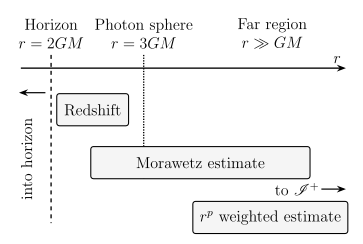
Three complementary estimates for a massless test scalar on a four-dimensional Schwarzschild exterior of physical mass . The event horizon is and the trapped photon sphere is . Spacings and overlapping estimate-support boundaries are schematic. Radiation can enter the future horizon or reach future null infinity.
| Region | Obstruction | Estimate and role |
|---|---|---|
| Future horizon | Stationary energy misses a transverse derivative | Redshift restores nondegenerate control on horizon-crossing slices. |
| Photon region and surrounding exterior | Nearly trapped waves can linger | Morawetz controls time-integrated local energy, with trapping degeneration or extra derivatives. |
| Large radius | Energy can spread toward null infinity | The hierarchy controls weighted outgoing flux and supplies decay. |
Scope and limitations
Section titled “Scope and limitations”The theorem concerns a test scalar on a fixed black-hole exterior. It is not a linearized Einstein theorem: tensor perturbations contain constraints, gauge solutions, stationary parameter variations, and reconstruction problems. Nor does an integrated decay inequality by itself give the sharp Price-law coefficient. Sharp tails require additional information about asymptotic charges and low-frequency structure. Backward evolution also reverses the horizon redshift into a blueshift; this is why the natural scattering space is based on degenerate rather than fully nondegenerate horizon energy. A further limitation is that extremal horizons provide a counterexample to any unqualified extension of the nonextremal redshift estimate.
Check the mechanism
Section titled “Check the mechanism”Suppose one tried to prove decay using only the Schwarzschild stationary Killing field . Identify the missing estimate and explain why a radial Morawetz current does not repair it by itself.
Solution
The -energy flux is nonnegative outside Schwarzschild, but becomes null on the event horizon, so that flux does not control the derivative transverse to the horizon. A radial Morawetz current controls an integrated bulk norm but degenerates at trapping and does not restore a nondegenerate horizon boundary flux. The horizon-adapted timelike multiplier supplies the missing redshift coercivity. With , Morawetz, and the far-field hierarchy combined, the energy cannot persist in a fixed exterior region; it can instead cross the horizon or escape through null infinity.
References
Section titled “References”- Dafermos, Mihalis, Igor Rodnianski, and Yakov Shlapentokh-Rothman. “A Scattering Theory for the Wave Equation on Kerr Black Hole Exteriors.” Annales Scientifiques de l’École Normale Supérieure 51 (2018): 371–486. DOI.
- Dafermos, Mihalis, Igor Rodnianski, and Yakov Shlapentokh-Rothman. “Decay for Solutions of the Wave Equation on Kerr Exterior Spacetimes III: The Full Subextremal Case .” Annals of Mathematics 183 (2016): 787–913. arXiv.