Quantum Expansion
Scrollable formula. Use Left and Right arrow keys to reveal hidden content.
Scrollable table. Use Left and Right arrow keys to reveal additional columns.
Scrollable figure. Use Left and Right arrow keys to inspect hidden content.
Quantum expansion replaces the local rate of area change of a null congruence by the rate of change of generalized entropy per unit transverse area. A cut is quantum marginal when this finite, state-dependent functional derivative vanishes—not necessarily when its geometric area expansion vanishes. The distinction is the first place where quantum matter changes the horizon criterion itself.
Required background. Quantum Information supplies the reduced-state entropy and shape dependence needed to vary the outside algebra across a cut.
Helpful background. Quantum Fields in Curved Spacetime supplies renormalized state observables; Einstein Equations fixes the mean geometry; Black-Hole Geometry and Mechanics supplies null congruences and classical marginality; and Semiclassical Gravity supplies the regime in which geometry is classical while matter entropy is quantum.
Units. This page restores in entropy and quantum-expansion formulas while keeping . Thus the Einstein entropy is ; setting recovers the site-wide convention.
Null deformations of generalized entropy
Section titled “Null deformations of generalized entropy”Let be a smooth codimension-two cut and choose one future-directed null normal . Its generators carry an affine parameter and transverse labels . A function selects a deformed cut by moving generator through affine distance . With the area density, define
This convention gives the same inverse-length dimension as the classical expansion . It also makes the classical limit transparent. Writing
and varying the area yields
Thus when tends to zero at fixed classical geometry and fixed finite matter-entropy variation. The localized deformation, its normalization, and the choice of outside must all be stated. The construction and its nonlocal state dependence are given explicitly in Bousso et al. 2016, §§ 3.1–3.3, Eqs. (3.5)–(3.10), PDF.
Quantum marginality
Section titled “Quantum marginality”For a classical outgoing light sheet, marginality means . Quantum marginality instead means
at every point of the relevant cut. If both independent future-directed null normals and are chosen, a quantum trapped cut has and with a consistent outward-side convention. A quantum marginally trapped cut has one vanishing quantum expansion and the other nonpositive. These signs are invariant under positive rescaling of a null normal, although the numerical expansion rescales.
The entropy contribution is nonlocal: correlations between a neighborhood of and distant degrees of freedom can affect . This does not allow instantaneous signaling. A unitary supported wholly on the same side of every nearby cut preserves the eigenvalues of each reduced density matrix and hence its entropy. The dependence concerns different global correlation structures and different cuts, not an arbitrary distant unitary changing the entropy. A quantum marginal cut is therefore not determined by the metric and its first derivatives alone. A classical marginal surface may have ; conversely, a nonzero can be cancelled by the entropy variation.
This also separates quantum marginality from extremality. Marginality varies the cut along one specified null direction and asks for one first derivative to vanish. A quantum extremal surface is stationary under both independent normal deformations, subject to its anchoring and homology data. Confusing the two erases the causal orientation that makes a marginal surface horizon-like.
A local shift of a marginal cut
Section titled “A local shift of a marginal cut”Consider a small bundle of generators and a one-parameter family of cuts, with affine displacement at a classical marginal cut. Fix the global state, the prescription assigning an outside algebra to each cut, and the null normalization. The region and its algebra still vary with the cut; the comparison does not switch to an unrelated entropy prescription. Write for the entropy contribution to the expansion and neglect higher-curvature terms at this order. If
then the nearby quantum-marginal location is, to first order in the small entropy correction,
The approximation requires to be small compared with the variation scale of and , with of higher order. A nearly vanishing can amplify the displacement, so a small entropy correction need not imply a small horizon shift near a degenerate zero.
For a simple focusing example, take and with . In terms of ,
The area is stationary at , whereas generalized entropy is stationary at : its positive matter contribution compensates a small area decrease. The illustrative value only separates the zeros visibly; it is not a prediction for an evaporating black hole. This local example fixes neither a global event horizon nor a preferred foliation, and it applies only within the neighborhood where the linearization is accurate.
Compare the two zeros in the diagram. The displacement is along the same chosen future null deformation, so it compares entropy and area criteria without changing the mean geometry or the quantum state.
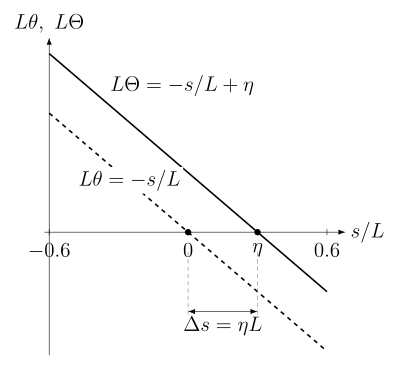
A positive entropy contribution shifts the marginal cut to in this local focusing example. The dashed line is area expansion and the solid line is generalized expansion. Here is illustrative; the global state, outside-algebra prescription and affine normalization are fixed, and higher-curvature corrections are neglected. Schematic local linearization, not a computed black-hole spacetime.
Normalization and renormalization checks
Section titled “Normalization and renormalization checks”Affine-rescaling check. Under with , take . Then and both and acquire the same factor . Their signs and zero sets are unchanged. A comparison that rescales in the area term but not in the entropy deformation is inconsistent.
Regulator check. The separate variations of and diverge, but their sum is finite after the same counterterms used for the effective action are included. Appendix A of Bousso et al. 2016, PDF explains why the generalized quantity, rather than the matter term alone, is the renormalized object. Higher-curvature terms contribute to the shape derivative and cannot be discarded when they are of the retained semiclassical order.
Quantum expansion is a semiclassical diagnostic, not a microscopic horizon observable. Its use assumes a meaningful mean metric and a state whose generalized entropy is differentiable under the chosen deformation. It does not derive fixed-background Hawking radiation, and it does not select replica saddles or establish information recovery; those fine-grained questions are treated in Black-Hole Information.
Exercise
Section titled “Exercise”At every generator of a cut suppose while the renormalized entropy contribution is . Is the cut classically marginal or quantum marginal along , or both? What happens under ? Would cancellation at only one generator suffice?
Solution
The classical expansion is nonzero, so the cut is not classically marginal. The two terms cancel at every generator, giving everywhere, so it is quantum marginal along the chosen null direction. This does not determine the other expansion or establish a marginally trapped classification. Positive rescaling multiplies both contributions by three; they become and . The cancellation, sign classification, and quantum-marginal location therefore remain unchanged. Cancellation at only one generator would establish a local zero there, not marginality of the entire cut.
References
Section titled “References”- Bousso, R., Fisher, Z., Leichenauer, S., and Wall, A. C. (2016). “A Quantum Focussing Conjecture.” Physical Review D 93, 064044. Open PDF.