Bundle Connections and Characteristic Classes
Scrollable formula. Use Left and Right arrow keys to reveal hidden content.
Scrollable table. Use Left and Right arrow keys to reveal additional columns.
Scrollable figure. Use Left and Right arrow keys to inspect hidden content.
A connection compares fibers along a path by choosing horizontal directions in a principal bundle. Its curvature measures the failure of horizontal transport to close. Chern–Weil theory then applies invariant polynomials to curvature and produces closed forms whose de Rham classes do not depend on the chosen connection. The striking result is that local differential data can represent a discrete global bundle class, although real differential forms cannot detect torsion.
Required background. Tensor Fields and Natural Operations supplies tensors and pullbacks, while Vector Fields, Flows, and Lie Brackets supplies Lie brackets. Exterior Algebra and Differential Forms supplies ordinary forms and wedge products; the Exterior Derivative and Poincaré Lemma supplies exterior differentiation, and Pullbacks and Integration over Parametrized Domains supplies integration.
Helpful background. Calculus and Linear Algebra supplies matrix Lie algebras and invariant polynomials; The Riemann Curvature Tensor supplies the tangent-bundle model of curvature.
Principal connections and horizontal transport
Section titled “Principal connections and horizontal transport”Let be a principal -bundle with Lie algebra . A principal connection can be described by a -valued one-form on such that
The first condition reproduces the generator on vertical vectors; the second makes the definition compatible with the right group action. The horizontal subspace is . A base curve and an initial point in its fiber have a unique horizontal lift under standard existence conditions, defining parallel transport.
A local section pulls the connection back to a gauge potential . If , then for matrix groups
The inhomogeneous term is why a potential is not a tensor. The global connection, rather than any one , is the invariant object. Principal connections and their local transformation law are developed in Gaiter 2024, §5.2, pp. 27–31.
Curvature and its covariance
Section titled “Curvature and its covariance”The curvature two-form is
It is horizontal and equivariant. Locally,
Unlike the potential, curvature transforms homogeneously. The covariant exterior derivative obeys the Bianchi identity . On a vector bundle associated through a representation , acts through and measures the infinitesimal holonomy of the induced connection.
These formulas pass a direct gauge check. Substitute into . The terms involving cancel by , leaving . Dropping the quadratic term would fail this test for a nonabelian group.
Chern–Weil forms
Section titled “Chern–Weil forms”Let be an -invariant symmetric polynomial of degree on . Applying it to curvature produces a -form . The Bianchi identity and invariance imply
The independence from connection has a useful explicit proof. On the same bundle, join two connections by , where is a globally defined adjoint-bundle-valued one-form on the base. The variation of curvature is . Invariance of and give
Integrating in gives the transgression formula
The primitive has degree and is global because the difference of connections transforms homogeneously. Hence the de Rham cohomology class is independent of the connection and depends only on the bundle. The assumption that both connections live on the same bundle matters: it is what makes their difference and this interpolation meaningful. Gaiter states these two properties and proves closedness in Gaiter 2024, §5.3, Proposition 5.11, pp. 32–33, PDF.
For a complex vector bundle, normalized invariant polynomials yield Chern classes; related constructions yield Pontryagin classes for real bundles. Normalization matters because the integral class has conventional factors of and, for anti-Hermitian matrix connections, powers of . Hatcher surveys these characteristic classes and their obstruction content in Hatcher 2017, §§3.1–3.2, pp. 77–97.
Integer U(1) flux on the sphere
Section titled “Integer U(1) flux on the sphere”Cover by northern and southern patches. To relate a real-valued convention to the matrix law above, write the anti-Hermitian local connection as , with and real. Choose the transition direction
Then the transformation law gives
Potentials consistent with this convention are
On the overlap, , exactly as the chosen transition direction requires. The function is single-valued exactly when . Both potentials give the same real curvature representative ,
The curvature is global even though neither potential is. The flux independently reproduces the winding of the overlap transition function. For , no global potential can exist: if globally, Stokes’ theorem on the closed sphere would force its integral to vanish.
The figure keeps the southern-to-northern transition convention, patch regularity, and sphere orientation visible at once. Inspect how the same integer appears in the overlap winding, the potential difference, and the normalized global flux.
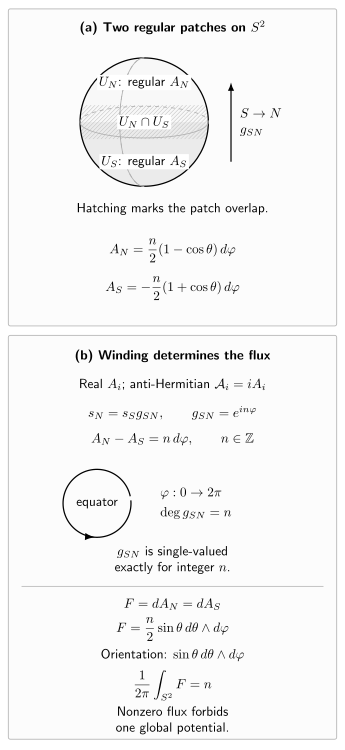
The two regular patch potentials differ on the overlap by a transition of winding . Their derivatives agree to form one global curvature, whose normalized flux equals the same integer; nonzero flux forbids one global potential. Schematic sphere with exact patch equations.
Limits of curvature representatives
Section titled “Limits of curvature representatives”Chern–Weil theory lands in real de Rham cohomology. It therefore cannot detect torsion characteristic classes, which vanish after tensoring with . Flat bundles can also have nontrivial holonomy even when . Conversely, a connection is additional geometric data; changing it changes the representative form while leaving its characteristic class fixed.
This page does not classify all bundles or identify a curvature form with a dynamical field equation. Boundary terms and secondary invariants require separate hypotheses.
Exercise: flux and patching
Section titled “Exercise: flux and patching”For the potentials above, compute , , and the normalized flux. Explain why is not allowed for an ordinary bundle with transition .
Solution
Subtraction gives . Differentiation gives on either patch. Therefore
The overlap function must agree after . For , , so it is not a single-valued map from the overlap circle to .
References
Section titled “References”- Gaiter, Jacob. Characteristic Classes, Principal Bundles, and Curvature. University of Texas at Austin notes, 2024. §§5.2–5.3, pp. 27–36.
- Hatcher, Allen. Vector Bundles and K-Theory. Version 2.2, 2017. §§3.1–3.2, pp. 77–97.