Hawking–Page Transition and Deconfinement
Scrollable formula. Use Left and Right arrow keys to reveal hidden content.
Scrollable table. Use Left and Right arrow keys to reveal additional columns.
Scrollable figure. Use Left and Right arrow keys to inspect hidden content.
The Hawking–Page transition is a clean calculation of saddle exchange at fixed boundary temperature. In global AdS, thermal AdS and AdS–Schwarzschild fill the same boundary, but their renormalized free energies cross. The boundary signature is a jump from order-one thermal excitations above the vacuum to entropy and energy of order in the large-N gauge theory. In the canonical ensemble on a compact spherical boundary this is a first-order transition; it is not a phase transition of every planar holographic plasma.
Required background. Gauge Theory and String-Theory Preparation supplies large-N counting, operator/source couplings, and string-scale control used below.
Helpful background. Quantum Gravity frames the saddle expansion, Quantum Information distinguishes ensemble entropy from fine-grained entropy, Black-Hole Geometry and Mechanics supplies horizon thermodynamics, and Quantum Fields in Curved Spacetime clarifies thermal state preparation.
Global AdS black-hole branches
Section titled “Global AdS black-hole branches”Use five-dimensional Einstein gravity with negative cosmological constant and a unit three-sphere. The Lorentzian metric function is
Regularity of the Euclidean tip gives
The temperature has a minimum at ,
Thus no smooth black-hole saddle exists below ; above it, a small and a large branch coexist. Differentiating shows that the small branch has negative heat capacity and the large branch positive heat capacity. This turning point is not yet the Hawking–Page transition, because local stability does not decide which saddle has the lower free energy.
The free-energy crossing
Section titled “The free-energy crossing”At fixed temperature, the canonical partition function weights a semiclassical saddle by . The lower free energy therefore gives the larger contribution. A positive heat capacity only says that a black hole responds stably to a small exchange of heat; it does not compare its statistical weight with a different saddle.
After matching the boundary metric and including the Gibbons–Hawking–York term and counterterms, the black-hole free energy relative to thermal AdS is
A useful independent check uses the mass above the thermal-AdS reference and the horizon entropy:
Substituting the temperature into reproduces , and differentiating with respect to verifies at fixed . The crossing is therefore at
For , the large black hole is locally stable but globally subdominant. At the entropy jumps from its low-temperature leading large-N value to
so the transition is first order. The latent heat check is immediate: the energy difference at equals . The global calculation and its gauge-theory interpretation are developed in Witten 1998, §§2–3, pp. 511–522; the AdS large-N parameter map is reviewed with explicit thermal branches in Aharony et al. 2000, §3.6.1–3.6.2, pp. 104–110.
Read the next plot vertically: at any fixed boundary temperature, compare the free energies of the available saddles. The black-hole branches first meet at , above the thermal-AdS line. The large branch wins only at the later crossing . The plotted variables follow directly from : and .
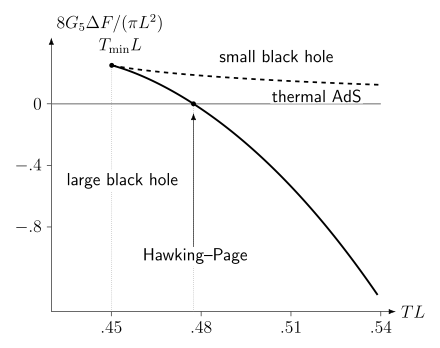
The branches meet before the large black hole crosses below thermal AdS. Positive heat capacity alone does not establish global dominance. Quantitative leading-order canonical AdS comparison with a spherical boundary; free energy is measured relative to thermal AdS.
What changes on the boundary
Section titled “What changes on the boundary”In a theory such as large-N super-Yang–Mills on , the low-temperature free energy above the Casimir term is order , while the deconfined plasma free energy and entropy are order . The parametric number of thermally active degrees of freedom is therefore the robust observable change. When center symmetry is available, the Polyakov loop supplies a more traditional confinement diagnostic, but matter content and global form of the gauge group must be specified before using it as an order parameter.
The energy density itself need not vanish below the transition because the sphere has a Casimir contribution. Likewise, the strong-coupling coefficient of the high-temperature free energy differs from the free-field coefficient. The reliable statement is the large-N scaling and saddle dominance, not equality to a weakly coupled gas.
Planar and finite-N limits
Section titled “Planar and finite-N limits”Sending the sphere radius to infinity while keeping a finite temperature focuses on the planar black brane. The constant-curvature term responsible for the competing global-AdS saddle disappears, and the planar brane dominates at every nonzero temperature in the conformal theory. Confining holographic models can still have thermal transitions, but their scale comes from additional infrared structure rather than this spherical calculation.
At finite N, a finite-volume partition function is analytic, so the sharp nonanalyticity is rounded. The width is invisible at leading saddle order and depends on subleading fluctuations and additional saddles. This is why the transition is controlled as a large-N thermodynamic statement but should not be promoted to an exact finite-N discontinuity.
Exercises
Section titled “Exercises”Compute the minimum temperature and the free-energy zero, then explain why they diagnose different notions of stability.
Solution
Differentiate and set the derivative to zero. This gives and , where the two black-hole branches meet and the heat capacity changes sign. Separately, set , which gives and . The first point concerns local response within the black-hole family; the second compares distinct saddles globally. As a check, is larger than .
References
Section titled “References”- Aharony, Ofer, Steven S. Gubser, Juan Maldacena, Hirosi Ooguri, and Yaron Oz. “Large N Field Theories, String Theory and Gravity.” Physics Reports 323 (2000): 183–386. DOI.
- Witten, Edward. “Anti-de Sitter Space, Thermal Phase Transition, and Confinement in Gauge Theories.” Advances in Theoretical and Mathematical Physics 2 (1998): 505–532. DOI.