Relativistic Precession and Circularization
Scrollable formula. Use Left and Right arrow keys to reveal hidden content.
Scrollable table. Use Left and Right arrow keys to reveal additional columns.
Scrollable figure. Use Left and Right arrow keys to inspect hidden content.
A disrupted star does not become a disk merely because its debris returns to pericenter. The stream must dissipate orbital energy while redistributing angular momentum, and relativistic precession controls where—and sometimes whether—the first strong self-intersection occurs. This page separates the robust orbital geometry from the uncertain hydrodynamics. Generic stellar dynamics and exact geodesic derivations are outside scope.
Required background. Geodesics and Jacobi Fields supplies affine geodesics, deviation, and the distinction between coordinate and invariant statements.
Helpful background. Black-Hole Geometry and Mechanics supplies Kerr horizons and spin conventions; Relativistic Matter and Compact Objects supplies stellar structure and fluid scales; Black-Hole Astrophysics supplies the observational setting.
Apsidal advance creates the intersection
Section titled “Apsidal advance creates the intersection”Let the black-hole mass be , the stellar pericenter be , and ; the dimensionless spin is . For a highly eccentric orbit around a nonspinning hole, the leading post-Newtonian apsidal advance is
Here is the semimajor axis, the eccentricity, and the semilatus rectum. The second approximation uses ; the expansion itself requires . It rotates the outgoing ellipse relative to the still-infalling stream. Approximating both pieces by ellipses with eccentricity and the same pericenter distance (their pericenter directions differ), their distant intersection has
in the outgoing stream’s angular convention. Thus weak precession makes the streams meet near apocenter, whereas strong precession moves the collision inward. This construction and its velocity-angle formula are derived in Bonnerot & Stone 2021, §3.1.2, Eqs. 11–13 and Fig. 3.
For example, set and . Equality gives two roots: near pericenter and on the distant side. At the latter, the outgoing stream’s true anomaly is . Selecting that branch is essential. As at fixed , the formal distant radius tends to , but the relative velocity also tends to zero; coincident conics are not a finite-strength shock.
If two cold streams of equal mass flux and equal speed merge inelastically at angle , momentum conservation gives a final speed . The kinetic energy thermalized per unit total colliding mass is therefore
Only when can the binding-energy term be dropped, giving
For initially parabolic debris, conservation of the original specific angular momentum gives a circularization radius and an energy requirement . An apocenter collision can therefore be violent locally yet remove only a small fraction of the energy needed for a compact disk. Thermalization also does not imply prompt radiation: trapped heat can support or re-expand the gas. “A self-crossing shock occurred” and “the gas circularized promptly” are not equivalent claims (Bonnerot & Stone 2021, §3, Eq. 9; §3.1.2, Eq. 15).
Spin can make the streams miss
Section titled “Spin can make the streams miss”Misaligned Kerr spin adds nodal precession. Distinguish the rotation of the ascending node about the spin axis, , from the small angle between successive orbital planes. For inclination ,
where the last expression uses . At the nominal apsidal intersection, the stream-centre separation has scale ; its actual value also depends on the intersection’s direction relative to the line where the planes meet. A prompt collision requires
with and the two stream widths. This condition is more informative than the precession angle alone: nozzle-shock expansion, self-gravity, cooling, and repeated pericenter passages all change . If the first winding misses, later windings can still intersect after the stream thickens. The estimate, its assumptions, and delayed-intersection examples are given in Bonnerot & Stone 2021, §3.1.2, Eq. 14 and Fig. 4.
The sign and size of Kerr corrections also depend on orientation. A prograde equatorial orbit generally has less apsidal advance than the corresponding retrograde orbit at fixed encounter parameters, while nodal precession vanishes for exact alignment. A scalar “spin measurement” inferred from a circularization delay is therefore conditional on inclination and stream thermodynamics.
Reproducible ballistic benchmark
Section titled “Reproducible ballistic benchmark”The following calculation checks only the two-ellipse geometry. It represents neither hydrodynamics nor exact Kerr transport. Use Python 3.12.7 and NumPy 2.1.3, binary64 arithmetic, , , and the leading-order . The algorithm brackets the distant root of the difference between an unrotated conic and a copy rotated by , applies bisection, and compares with the analytic radius above.
import mathimport numpy as np
ecc = 0.98rp_rg = 10.0p_rg = rp_rg * (1.0 + ecc)dphi = 3.0 * math.pi / rp_rg
def radius(theta, offset):    return p_rg / (1.0 + ecc * math.cos(theta - offset))
def difference(theta):    return radius(theta, 0.0) - radius(theta, dphi)
def intersect(iterations):    centre = math.pi + dphi / 2.0    lo, hi = centre - 0.4, centre + 0.4    flo = difference(lo)    for _ in range(iterations):        mid = 0.5 * (lo + hi)        if flo * difference(mid) <= 0.0:            hi = mid        else:            lo, flo = mid, difference(mid)    theta = 0.5 * (lo + hi)    rnum = 0.5 * (radius(theta, 0.0) + radius(theta, dphi))    return rnum
rexact = p_rg / (1.0 - ecc * math.cos(dphi / 2.0))for n in np.array([8, 12, 16], dtype=int):    rnum = intersect(int(n))    print(n, f"{rnum:.12f}", f"{abs(rnum - rexact):.3e}")
Save the program as tde_stream_intersection.py. The program must write the iteration count, intersection radius in , and absolute radius error. Run it in an isolated environment with exactly these commands:
python3 -m venv .venv-tde.venv-tde/bin/python -m pip install numpy==2.1.3.venv-tde/bin/python tde_stream_intersection.pyThe reproduced convergence table is:
| Bisection iterations | Absolute radius error | |
|---|---|---|
| 8 | 156.138045129279 | 3.380e-3 |
| 12 | 156.134678703281 | 1.320e-5 |
| 16 | 156.134665553296 | 5.157e-8 |
The error falls by roughly for each four extra bisections because the average of the two radii used by the program is stationary to first order at this symmetric intersection. Neither individual conic has zero radial slope there, and the angular bracket itself still converges linearly. As an independent check, the limiting value agrees with the analytic result . Changing the bracket to include the near-pericenter root is a failure, not an alternative answer; production calculations must identify winding and branch explicitly. At , omitted higher-order relativistic terms are much larger than the displayed root-finding errors. Those digits test this declared conic model, not the accuracy of a physical TDE prediction.
The plot places the same two conics in a frame whose negative axis passes through the distant crossing. Follow the arrows: one branch is moving inward while the other is moving outward. The distant lobes are outside the cropped view; the full conics share a focus and pericenter distance, not a pericenter position.
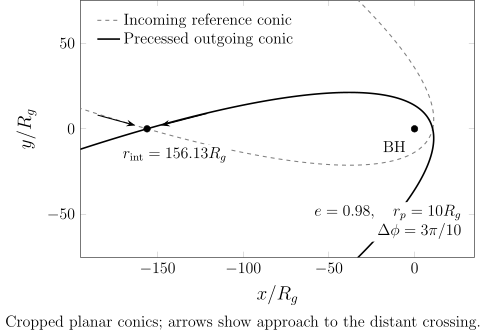
For the declared , two-ellipse benchmark and imposed advance , the distant intersection lies at . Axes have equal scales and the view is cropped. The curves are quantitative within this approximate planar model; arrow lengths are illustrative. Stream width, spin-induced vertical displacement, shocks, and a formed disk are not represented.
What a hydrodynamic calculation must establish
Section titled “What a hydrodynamic calculation must establish”A credible global calculation must state , , inclination, stellar model, penetration factor , energy width, spacetime treatment, stream-width prescription, cooling or radiation closure, self-gravity, grid or particles, atmosphere, and capture rule. Before evolving gas, it should recover geodesic apsidal precession and the ballistic intersection above. Resolution must then be increased across the stream cross-section, nozzle shock, pericenter, and self-crossing shock while monitoring intersection location, dissipated energy, bound mass, and angular momentum.
Known failure modes include artificial stream broadening, an unresolved nozzle shock, loss into a numerical atmosphere, omitted self-gravity, coordinate rather than physical intersection tests, and cooling prescriptions that force either an adiabatic torus or a thin disk. Existing calculations span local collisions, pseudo-relativistic global models, and relativistic simulations; the studies compared in Bonnerot & Stone 2021, §§3.2–3.4 and Table 1 do not establish a universal circularization time. For the earlier disruption and energy-freezing step, see Rossi et al. 2021, §2.2.
Diagnostic: intersection is not circularization
Section titled “Diagnostic: intersection is not circularization”For , , and an almost head-on collision, estimate the fraction of the circularization energy removed in one idealized shock.
Solution
Using and gives
Even the maximal equal-flux shock removes only about one quarter of the required energy. The result is an upper bound: oblique impact, unequal mass fluxes, a partial vertical miss, or re-expansion lowers the thermalized fraction. The correct formulation is therefore repeated energy and angular-momentum evolution, not a binary collision/no-collision label.
For the actual finite- benchmark, the two conics have opposite radial velocities and identical tangential velocities at the distant root. With , their radial speeds have magnitude . Removing this radial motion gives . The energy needed to reach a circular orbit at the same is . Their ratio is therefore , about one fifth. This is the consistent cold, inelastic estimate for those two ellipses; is the looser parabolic, head-on estimate.
References
Section titled “References”- Bonnerot, Clément, and Nicholas C. Stone. 2021. “Formation of an Accretion Flow.” Space Science Reviews 217, 16. https://doi.org/10.1007/s11214-020-00789-1.
- Rossi, Elena M., Nicholas C. Stone, Jamie A. P. Law-Smith, Morgan Macleod, Giuseppe Lodato, Jane L. Dai, and Ilya Mandel. 2021. “The Process of Stellar Tidal Disruption by Supermassive Black Holes: The First Pericenter Passage.” Space Science Reviews 217, 40. https://doi.org/10.1007/s11214-021-00818-7.