Intrinsic Geometry of Horizon Cross-Sections
Scrollable formula. Use Left and Right arrow keys to reveal hidden content.
Scrollable table. Use Left and Right arrow keys to reveal additional columns.
Scrollable figure. Use Left and Right arrow keys to inspect hidden content.
A horizon cross-section is a spacelike two-surface cut through a null horizon. Its induced metric determines area, distances, Gaussian curvature, and intrinsic multipolar distortion without referring to a picture in an external Euclidean space. Schwarzschild sections are round, whereas rotating Kerr sections are axisymmetric and generally not round. Their total area alone cannot distinguish those shapes, and a failed Euclidean embedding does not signal a spacetime singularity.
Helpful background. Exact Solutions of Einstein’s Equations supplies the stationary metrics used as input; Causality and Global Structure supplies null horizons and cross-sections; The Einstein Equation fixes the vacuum examples; Killing Fields and Isometry Groups supplies axial symmetry; and Black-Hole Geometry and Mechanics orients the horizon data.
The induced two-geometry
Section titled “The induced two-geometry”Let be a smooth spacelike cross-section of a null horizon, with tangent basis vectors . The intrinsic metric is the pullback
It is positive definite and determines the area form , the area
and the intrinsic scalar curvature , where is Gaussian curvature. All of these are invariant under reparametrizing coordinates on . They do not require embedding in another manifold.
For a stationary Killing horizon, translating a cross-section along the generators preserves its intrinsic metric. In a dynamical horizon, different cross-sections need not be isometric and their area and curvature can evolve. The present calculation concerns equilibrium sections only.
For Schwarzschild, every standard horizon section is a round sphere of radius :
Constant positive is the intrinsic meaning of roundness; a circular appearance in a coordinate plot would not establish it.
Pullback to a Kerr horizon section
Section titled “Pullback to a Kerr horizon section”Now take a Kerr outer horizon at , including its smooth extremal limit, and define
Pulling the spacetime metric back to a section transverse to the horizon generators gives
The determinant simplifies dramatically:
Therefore
This recovers the area obtained from the four-dimensional horizon data. It also checks regularity at the axis: near either pole the circumference-to- radius ratio tends to when has its standard period.
For any axisymmetric metric , its Gaussian curvature can be calculated without an embedding:
Substituting the Kerr functions yields
The Schwarzschild limit gives everywhere. For nonzero spin, varies with latitude: it is always positive at the equator but can become negative in polar caps near extremality. The horizon remains a smooth spacelike two-sphere; negative intrinsic curvature is not divergent four-dimensional curvature. Visser derives the Kerr horizon and its intrinsic shape in Visser 2009, §§9–10.
Area, topology, and shape carry different information
Section titled “Area, topology, and shape carry different information”Define the area radius . A round sphere of radius has the same area as the Kerr section, but its curvature is the constant . Unless , that is not the Kerr curvature above. Thus equal area does not imply equal intrinsic metric.
Nor does total curvature fix the shape. Because a regular horizon section has topology , Gauss–Bonnet gives
Schwarzschild and Kerr share this integral even though their curvature distributions differ. Area is a monopole-like size measure; latitude-dependent curvature contains higher shape information. In more general isolated-horizon settings, geometric and rotational multipoles organize such departures from roundness. For an axisymmetric isolated horizon, the resulting mass and angular-momentum multipoles give a diffeomorphism-invariant characterization of its horizon geometry Ashtekar, Engle, Pawlowski, and Van Den Broeck 2004, §III, pp. 8–16. Their definition requires that axial structure or another preferred basis, so an arbitrary distorted surface does not come with unique numbers called “the multipoles.”
This distinction matters physically. Stationary mechanics needs the total area, angular momentum, and charge. Questions about tidal distortion or near-horizon shape need more of than its integral. Conversely, knowing the intrinsic metric does not determine the entire exterior spacetime without field equations and boundary data.
The equator and poles provide a compact diagnostic. Kerr’s equatorial curvature is positive for every allowed spin, whereas the polar value decreases with rotation and can cross zero. This is intrinsic evidence of an oblate, increasingly distorted section, independent of how a coordinate artist draws it. A curvature measurement at only one latitude is still insufficient to reconstruct the full metric: an axisymmetric function carries infinitely many shape modes. Reflection symmetry and the Kerr field equations reduce that freedom for this exact family, but a generic distorted horizon requires the complete curvature profile or an equivalent set of multipoles.
Euclidean embedding is an optional representation
Section titled “Euclidean embedding is an optional representation”One may try to represent the axisymmetric metric as a surface of revolution in Euclidean three-space. Such a representation can be intuitive, but it adds an embedding problem that is not part of the definition of . For the Kerr section, the polar curvature is
It changes sign when , equivalent in Kerr to . Above this spin, the familiar smooth global embedding as an axisymmetric surface of revolution in Euclidean three-space fails near the poles. The intrinsic horizon metric remains regular. Other ambient signatures or higher-dimensional embeddings may still represent it.
An embedding failure is therefore not evidence for a horizon pathology. The intrinsic calculation is primary; the embedding is one visualization whose existence has additional conditions. Visser derives the horizon metric and polar-curvature obstruction in Visser 2009, §9, eqs. (116)–(124), pp. 27–28 and illustrates the resulting partial Euclidean embedding in Visser 2009, §10, Fig. 2, pp. 32–33.
For a surface of revolution , matching the azimuthal circumference fixes . Matching the meridional line element then requires
A real Euclidean profile needs this radicand to be nonnegative. The two panels below hold the area radius fixed and vary only the dimensionless spin . Compare the redistribution of intrinsic curvature in the upper panel with the separate embedding test in the lower panel.
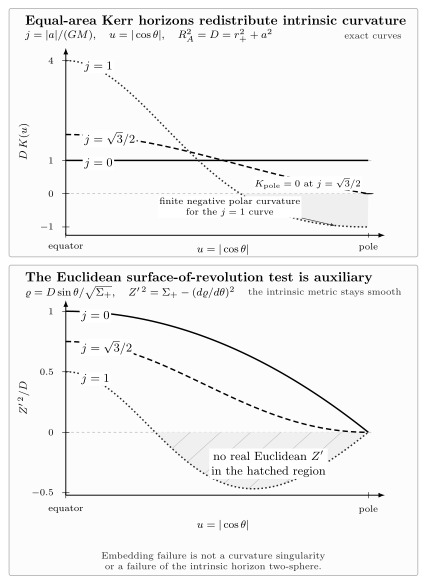
At fixed , the upper panel gives the exact dimensionless curvature against for . Each section has area and total curvature , but spin moves curvature toward the equator: the threshold curve reaches , while extremal Kerr has at the equator and at the pole. The lower panel gives the exact required by an axisymmetric surface-of-revolution embedding in Euclidean three-space. Its hatched negative region admits no real , so the extremal section cannot be embedded globally by that ansatz even though its intrinsic metric and finite curvature remain regular. These quantitative plots compare equal-area sections; they are not spacetime diagrams or proper-distance embeddings.
Diagnose roundness at fixed area
Section titled “Diagnose roundness at fixed area”Show directly that a Kerr section and a round sphere can have the same area but different curvature. Then determine the sign of the polar curvature for and for extremal Kerr.
Solution
Choose the round sphere to have radius . Its area is , equal to the Kerr area, and its Gaussian curvature is the constant . The Kerr value depends on whenever , so the metrics are not isometric despite equal areas.
At , one has and , hence . For extremal Kerr, , so
while the equatorial curvature remains positive. Finite, sign-changing Gaussian curvature describes a smooth but nonround horizon section.
Domains of Outer Communications and Interior Boundaries next places these horizon sections on the boundary of the exterior region used by stationary theorems.
References
Section titled “References”- Ashtekar, Abhay, Jonathan Engle, Tomasz Pawlowski, and Chris Van Den Broeck. “Multipole Moments of Isolated Horizons.” Classical and Quantum Gravity 21 (2004): 2549–2570. DOI. Open manuscript.
- Visser, Matt. “The Kerr Spacetime: A Brief Introduction.” In The Kerr Spacetime, edited by David L. Wiltshire, Matt Visser, and Susan M. Scott. Cambridge: Cambridge University Press, 2009. arXiv:0706.0622v3.