Third Law and Unattainability of Extremality
Scrollable formula. Use Left and Right arrow keys to reveal hidden content.
Scrollable table. Use Left and Right arrow keys to reveal additional columns.
Scrollable figure. Use Left and Right arrow keys to inspect hidden content.
The third law is the least universal of the classical black-hole mechanics laws. Israel’s unrestricted finite-time claim has regular counterexamples; what survives is a narrower unattainability result with a connected-horizon hypothesis. Neither statement is the algebraic Kerr–Newman extremality bound or the Nernst theorem of ordinary thermodynamics. Keeping these claims separate is essential because rigorous solutions now show both extremal critical collapse and a subextremal apparent-horizon region followed by an extremal event horizon in finite advanced time.
Required background. The Einstein Equation supplies the evolution equations and energy-condition coupling.
Helpful background. Exact Solutions of Einstein’s Equations supplies the Kerr–Newman extremal limit; Causality and Global Structure supplies event and apparent horizons; Flat-Background Hilbert Stress-Energy from Metric Variation supplies the matter inequalities; and Black-Hole Geometry and Mechanics supplies surface gravity and trapped surfaces.
Three inequivalent statements
Section titled “Three inequivalent statements”The original mechanics analogy proposed an operational statement: no finite sequence of physical operations can reduce the surface gravity to zero. Bardeen, Carter, and Hawking state this form and explain its relation to the loss of the trapped region at extremality in Bardeen, Carter, and Hawking 1973, pp. 168–170, Open PDF. It is a claim about an evolving horizon and therefore needs a specified class of admissible processes.
The geometric statement is much simpler. Define
For a stationary Kerr–Newman solution,
An event horizon exists within this family when , and it is extremal when . These equations classify exact stationary solutions. They do not say whether a dynamical spacetime can reach the boundary , nor whether the exterior remains Kerr–Newman while it does so. A test-particle calculation that makes a final-parameter estimate is therefore not yet a theorem about horizon destruction; it must control self-force, radiation, nonlinear backreaction, and the global horizon.
The Nernst heat theorem is different again: in one common formulation, entropy approaches a parameter-independent constant as temperature approaches zero. Classical black-hole mechanics contains no statistical entropy and no temperature. Even if one later imports the semiclassical identifications and , extremal Kerr–Newman horizons have finite areas that depend on their charges. Thus a Nernst-like statement neither follows from, nor proves, dynamical unattainability.
Israel’s claim and the surviving connected-horizon result
Section titled “Israel’s claim and the surviving connected-horizon result”Evidence cutoff: 2026-09-04. Israel formulated the third law as the claim that no continuous process whose accreted stress-energy remains bounded and satisfies the weak energy condition near the apparent horizon can reduce a black hole’s surface gravity to zero at finite advanced time Israel 1986, pp. 397–399. In the dynamical argument, “becoming extremal” is represented by losing the trapped region, not by substituting time-dependent parameters into a stationary surface-gravity formula.
The proof invokes Israel’s earlier confinement construction: a trapped two-surface is continued to a regular, locally area-preserving—often called semirigid—spacelike three-cylinder, provided the continuation encounters no singularity Israel 1986, pp. 789–791. Semirigidity is an input to that proof architecture; it is not supplied by the weak energy condition alone. A later analysis of this gap is given in Düztaş 2018, §2, pp. 330–333.
A narrower statement does survive in spherical symmetry. If the weak energy condition holds, the trapped region is nonempty, and the outermost apparent horizon is connected, then that connected horizon cannot become extremal in finite time in Israel’s trapped-surface sense Kehle and Unger 2025, §1.4.3, Proposition 1.1, pp. 11–12, Open PDF. Raychaudhuri evolution preserves the older trapped region, but it does not require the outermost marginal tube to remain one connected branch. Connectedness is therefore a genuine global restriction, not a consequence of the energy condition.
A peer-reviewed finite-time counterexample
Section titled “A peer-reviewed finite-time counterexample”Kehle and Unger construct, for any prescribed finite regularity index , spherically symmetric, one-ended asymptotically flat Cauchy data with a regular center for the Einstein–Maxwell–charged-scalar system. Their evolution contains a portion of an exactly Schwarzschild apparent horizon and later becomes exactly extremal Reissner–Nordström along the event horizon after finite advanced time Kehle and Unger 2025, Theorem 1, p. 3, and §1.4.4, pp. 12–13, Open PDF. The construction has arbitrarily high prescribed finite regularity, and the matter model satisfies the dominant energy condition, hence also the weak energy condition.
The outermost apparent horizon is disconnected. Its early component contains the Schwarzschild horizon portion; a later component agrees with the extremal event horizon. Trapped surfaces persist at arbitrarily late advanced times in the interior even though a neighborhood of the late event horizon contains no strictly trapped surfaces Kehle and Unger 2025, §5.3, pp. 39–41, Open PDF. The result therefore directly disproves the unrestricted Israel third-law claim. It does not contradict the narrower connected-horizon proposition, because the outermost apparent horizon changes branch.
The branch plot below separates the four geometric facts that do the work. In particular, inspect the missing connector within between the early and late outermost components: the trapped region persists, but the outermost apparent horizon need not form one connected world tube. This says nothing about the existence of additional, non-outermost marginal tubes.
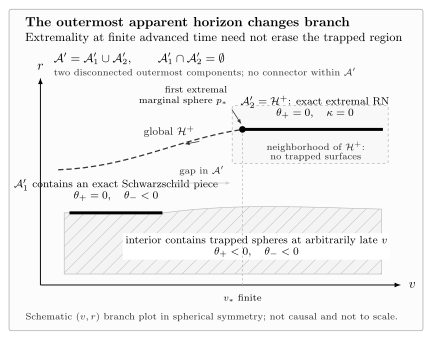
In the spherically symmetric Einstein–Maxwell–charged-scalar counterexample, the early component contains an exact Schwarzschild apparent-horizon portion. The disjoint late component begins at the first extremal marginal sphere after finite advanced time and then agrees with the exactly extremal Reissner–Nordström event horizon . Strictly trapped spheres persist deeper inside at arbitrarily late times even though a neighborhood of the late event horizon contains no trapped surfaces. This is a schematic branch plot for arbitrarily high prescribed finite regularity and dominant-energy matter; it is not a causal diagram, is not to scale, and makes no claim of genericity, stability, slicing invariance, or nonspherical validity.
Two distinct Vlasov results
Section titled “Two distinct Vlasov results”Theorem 1 of the later preprint is a critical-collapse theorem. For fixed black-hole mass, nonzero fundamental charge, and sufficiently small nonnegative particle mass, it constructs a smooth one-parameter family of smooth, spherically symmetric, one-ended asymptotically flat Einstein–Maxwell–Vlasov data. Below the critical parameter the matter disperses without a black hole or naked singularity; at the critical parameter the late exterior and event horizon are exactly extremal Reissner–Nordström and there are no trapped surfaces; above it the late exterior is subextremal Reissner–Nordström and an open trapped region exists Kehle and Unger 2024, Theorem 1, pp. 4–5, preprint PDF. This establishes extremal critical collapse. It is a tuned possibility result, not a genericity or stability theorem, and it is not itself the subextremal-to-extremal process in Israel’s formulation.
Theorem 2 is separate. It constructs smooth, spherically symmetric, one-ended asymptotically flat Einstein–Maxwell–Vlasov solutions, for either massive or massless particles, containing an early subextremal Reissner–Nordström apparent-horizon portion and trapped surfaces but a late domain of outer communication and event horizon that are exactly extremal Reissner–Nordström. The outermost apparent horizon has at least two connected components Kehle and Unger 2024, Theorem 2, pp. 13–14, preprint PDF. This is the direct Vlasov third-law counterexample. Its proof is presented as a sketch in Kehle and Unger 2024, §6.1, pp. 79–80, preprint PDF, so this result retains preprint status rather than being merged with the peer-reviewed charged-scalar theorem.
Near-extremal rate diagnostic
Section titled “Near-extremal rate diagnostic”For Reissner–Nordström, set
Suppose a controlled near-extremal model yields with constant while remains finite. Then
so approaches zero but never reaches it at finite . This behavior is consistent with unattainability. By contrast, postulating would predict a finite hitting time , but that extrapolation is not a counterexample until the associated stress tensor, apparent horizon, energy condition, and near-extremal approximation are shown to remain regular through the endpoint.
This diagnostic follows one prescribed Reissner–Nordström-like branch. It cannot exclude a disconnected outermost apparent horizon or a finite-time change of outermost branch, which is the mechanism in the rigorous counterexamples above.
Check your understanding
Section titled “Check your understanding”A smooth, spherically symmetric Einstein–Maxwell–Vlasov evolution contains an early causal diamond isometric to part of a subextremal Reissner–Nordström black hole, including an apparent-horizon portion and trapped spheres. At late advanced time its domain of outer communication and event horizon are exactly extremal Reissner–Nordström. Its outermost apparent horizon has two connected components.
Which Kehle–Unger preprint theorem describes this spacetime? Why does it not contradict the surviving connected-horizon proposition? Does it establish that generic collapse is extremal?
Solution
This is Theorem 2, the direct Vlasov third-law counterexample, not Theorem 1, which concerns a one-parameter family crossing the dispersion–collapse threshold. The example evades the connected-horizon proposition because the outermost apparent horizon is disconnected: an early subextremal component is not continuously deformed into the late extremal component. The older trapped region can persist in the interior while the outermost marginal branch jumps outward.
The theorem proves existence, not genericity. It supplies a smooth regular counterexample to the unrestricted third-law claim, while making no assertion that an open set of initial data evolves to the same extremal endpoint.
Next, Validity Beyond Einstein Vacuum Gravity compares which parts of the four laws survive additional matter and higher-curvature dynamics.
References
Section titled “References”- Bardeen, J. M., B. Carter, and S. W. Hawking. “The Four Laws of Black Hole Mechanics.” Communications in Mathematical Physics 31 (1973): 161–170. DOI.
- Düztaş, Koray. “Cosmic Censorship and the Third Law of Black Hole Dynamics.” Turkish Journal of Physics 42 (2018): 329–334. DOI.
- Israel, Werner. “Must Nonspherical Collapse Produce Black Holes? A Gravitational Confinement Theorem.” Physical Review Letters 56 (1986): 789–791. DOI.
- Israel, Werner. “Third Law of Black-Hole Dynamics: A Formulation and Proof.” Physical Review Letters 57 (1986): 397–399. DOI.
- Kehle, Christoph, and Ryan Unger. “Extremal Black Hole Formation as a Critical Phenomenon.” arXiv:2402.10190v1 [gr-qc] (2024), preprint. arXiv.
- Kehle, Christoph, and Ryan Unger. “Gravitational Collapse to Extremal Black Holes and the Third Law of Black Hole Thermodynamics.” Journal of the European Mathematical Society (2025), published online first. DOI. Open PDF, arXiv:2211.15742v2.