Ultracompact Objects and Light Rings
Scrollable formula. Use Left and Right arrow keys to reveal hidden content.
Scrollable table. Use Left and Right arrow keys to reveal additional columns.
Scrollable figure. Use Left and Right arrow keys to inspect hidden content.
An ultracompact horizonless object can possess circular null orbits, including stable trapping unavailable outside a Schwarzschild black hole. Stable trapping supports very long-lived linear waves and motivates concern about nonlinear or ergoregion instabilities. It does not, by itself, prove growth on an astrophysically relevant timescale, and it does not guarantee observable echoes. Geometry, perturbing field, boundary response, rotation, dissipation, and formation history must be specified. Evidence here is current through 2026-08-18.
Required background. The Einstein equations supply the compact-object geometry and perturbation equations.
Helpful background. Stress–Energy and Conservation supplies canonical energy; Relativistic Matter and Compact Objects supplies horizonless equilibria; Black-Hole Geometry supplies photon orbits and horizons; and Computational Relativity supplies spectral and long-time evolution checks.
Null effective potential
Section titled “Null effective potential”For a static spherical metric
equatorial null geodesics with energy and angular momentum have a radial potential governed by
Here in the static horizonless region, and is areal radius. Writing a dot for an affine-parameter derivative, the null constraint is
A circular null orbit has and satisfies , with . Linearizing the radial geodesic equation gives
Thus a local maximum is radially unstable and a local minimum is stable. A minimum restores a slightly displaced ray; a maximum pushes it farther away. The orbital frequency and Lyapunov exponent depend on , , and their derivatives at the light ring; compactness alone does not determine them.
In stationary axisymmetry, prograde and retrograde rings and off-equatorial structures require the full Hamiltonian or impact-parameter potentials. A spherical one-dimensional picture cannot be transferred unchanged to a rapidly rotating object.
An exact example with both kinds of orbit
Section titled “An exact example with both kinds of orbit”The constant-density interior makes the distinction explicit. Let and . Its time component, matched to Schwarzschild at the surface, is
For , differentiating gives an interior minimum at and an exterior maximum at . Their values are and . The lapse remains positive, so neither orbit is a horizon. In the figure, compare the bottom of the well with the top of the outer barrier.
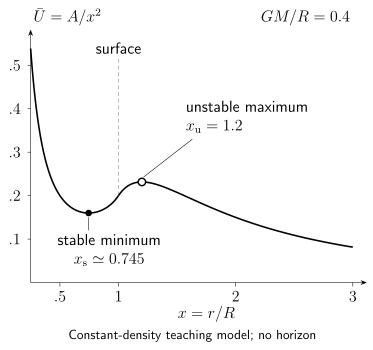
The dimensionless null potential at has a stable interior light ring at and an unstable exterior light ring at . The dashed line marks the surface ; the curve is quantitative. This incompressible, noncausal teaching model is horizonless. Radial geodesic stability does not establish nonlinear stability of the spacetime or matter.
The density jumps at the surface: and its first derivative match there, while its second derivative jumps. The example can therefore be checked directly from the piecewise metric; it should not be presented as an application of a theorem requiring a smooth material geometry.
Pairing result and its assumptions
Section titled “Pairing result and its assumptions”Cunha, Berti, and Herdeiro use a topological argument for smooth, stationary, axisymmetric, circular, topologically trivial, horizonless ultracompact objects continuously connected to a regular configuration without light rings. The deformation must preserve the degree’s boundary conditions: a critical point cannot enter or leave through the boundary of the chosen domain, including infinity. Two steps must be distinguished. Conservation of topological degree makes nondegenerate critical points occur in pairs of opposite degree: a saddle and an extremum of the impact-parameter potential. This geometric statement alone does not determine whether the extremum is stable. In general relativity, the null energy condition excludes an extremum unstable in both transverse directions, establishing a stable companion under the paper’s hypotheses. See Cunha, Berti, and Herdeiro 2017, preprint pp. 2–4, Eqs. (9) and (13)–(23), PDF.
The key physical step is that the null stress contraction at the light ring is proportional to the trace of the transverse effective-potential Hessian. A negative-definite Hessian would make that contraction negative. The topological pairing and the energy-condition argument therefore do different jobs; omitting the latter overstates the stability conclusion in axisymmetry.
This is a geodesic result. It does not state that every nonspherical, time-dependent, nonsmooth, topologically nontrivial, or noncircular spacetime has the same pair. Nor does the existence of a stable null orbit specify the perturbation boundary conditions, matter response, or nonlinear fate. A degenerate light ring needs separate analysis because a quadratic stability test can vanish.
Trapped waves, ergoregions, and echoes
Section titled “Trapped waves, ergoregions, and echoes”At large angular index, wave propagation is related to null geodesics by WKB theory. A stable potential well separated from infinity by a barrier supports quasibound modes whose leakage can be exponentially small in angular momentum. Slow decay is not exponential growth. Keir proves slow-decay obstructions for waves on classes of spherically symmetric ultracompact spacetimes and discusses the nonlinear-stability concern in Keir 2016, § 3.3 and Theorem 4.7; Theorem 5.3, PDF. The lower bound concerns a linear scalar wave on a fixed static spherical background with a stably trapped potential well. It obstructs a uniform faster-than-logarithmic local-energy decay estimate with the stated loss of derivatives. The matching upper bound imposes additional asymptotic and regularity assumptions. Neither result is a theorem of nonlinear Einstein–matter instability, and a finite collection of decaying modes cannot test a bound uniform over arbitrarily high angular frequencies.
Rotation can add an ergoregion. For a horizonless sufficiently reflective object, negative-energy modes in the ergoregion can combine with positive outgoing flux to produce an ergoregion instability. Absorption, viscosity, magnetic fields, a material surface, and rotation profile can alter or quench the cycle. This mechanism is distinct from stable trapping in a nonrotating spacetime.
Echoes require partial reflection and a propagation cavity with an identifiable delay, not merely a light ring. The signal depends on surface or interior response, barrier transmission, initial excitation, rotation, and dissipation. Cardoso and Pani review light rings, trapped modes, ergoregions, echoes, and their model dependence in Cardoso and Pani 2019, §§4–6 and model-comparison figures.
Comparison of methods and results
Section titled “Comparison of methods and results”The following distinctions summarize evidence through 2026-08-18.
| Claim | Evidence type | Supported conclusion | Limitation or contrary consideration |
|---|---|---|---|
| Light-ring pairing | Topological degree for smooth stationary circular horizonless objects; Einstein equation and NEC for stability | Nondegenerate rings pair with opposite degree; the energy condition establishes a stable companion. | Degeneracy, topology, lack of circularity, time dependence, or nonsmooth matching can leave the theorem’s data class. |
| Stable trapping | WKB and direct spectral calculations | Some fields have modes with parametrically slow leakage. | Long lifetime is not a positive growth rate; field spin, coupling to matter, and boundary conditions change the spectrum. |
| Nonlinear instability | Heuristic energy accumulation, slow-decay theorems, and limited evolutions | Stable trapping is a serious obstruction to uniform decay and motivates nonlinear tests. | A generic nonlinear outcome and astrophysical growth time are not settled for all model classes. |
| Ergoregion growth | Canonical-energy and mode analyses of rotating horizonless objects | Rotation plus negative-energy modes and insufficient absorption can drive growth. | No ergoregion means this mechanism is absent; absorption and dissipation can change the sign or timescale. |
| Echoes | Transfer functions and searches for delayed waveform structure | Reflective compact models can produce echo-like responses. | Look-elsewhere effects, waveform residuals, environmental scattering, and unknown reflectivity prevent a generic light-ring-to-echo implication. |
Competing positions differ mainly in what “unstable” means. A spectral mode with positive growth, a nonlinear energy cascade, secular backreaction over a very long time, and an astrophysically excluded lifetime are four different claims. Any timescale must be compared with formation, accretion, dissipation, merger, and observation times.
What would settle the frontier
Section titled “What would settle the frontier”The unresolved question is whether stable trapping generically produces a nonlinear failure before a realistic object is formed, altered, or observed. The strongest check computes both light-ring stabilities, compares a WKB tunneling time with direct spectral eigenvalues, and evolves generic perturbations long enough to resolve the predicted timescale while monitoring constraints and energy.
A result that could change the interpretation is a rigorous nonlinear theorem, a converged long-time evolution, a counterexample with stable trapping and an acceptable lifetime, or an observational echo or ringdown analysis with controlled look-elsewhere effects and waveform systematics. Until then, “stable light ring implies immediate exclusion” and “long-lived linear mode proves stability” are both stronger than the evidence.
Check the Schwarzschild exterior ring
Section titled “Check the Schwarzschild exterior ring”For , find the circular null orbit from and determine its radial stability.
Solution
Setting gives . The second derivative is
so the exterior ring is unstable. A regular horizonless object with a black-hole-like exterior may have an additional interior ring under the pairing theorem’s assumptions; this exterior calculation alone does not locate or classify it.
References
Section titled “References”- Cardoso, Vitor, and Paolo Pani. “Testing the Nature of Dark Compact Objects: A Status Report.” Living Reviews in Relativity 22 (2019): 4. DOI.
- Cunha, Pedro V. P., Emanuele Berti, and Carlos A. R. Herdeiro. “Light-Ring Stability for Ultracompact Objects.” Physical Review Letters 119 (2017): 251102. arXiv.
- Keir, Joe. “Slowly Decaying Waves on Spherically Symmetric Spacetimes and an Instability of Ultracompact Neutron Stars.” Classical and Quantum Gravity 33 (2016): 135009. DOI.