Cauchy–Characteristic Extraction
Scrollable formula. Use Left and Right arrow keys to reveal hidden content.
Scrollable table. Use Left and Right arrow keys to reveal additional columns.
Scrollable figure. Use Left and Right arrow keys to inspect hidden content.
Cauchy–characteristic extraction takes metric data on a timelike worldtube, evolves them along outgoing null hypersurfaces, and evaluates radiation in an inertial conformal frame at future null infinity. It removes polynomial finite-radius extrapolation from the workflow, but it introduces a different set of numerical questions: worldtube reconstruction, null initial data, characteristic evolution, compactification, and asymptotic gauge transformation.
Helpful background. Formulations of General Relativity supplies Cauchy and characteristic decompositions; Differential Equations for Relativity supplies interpolation and evolution methods; Black-Hole Geometry and Mechanics supplies the inner strong-field setting; Gravitational Radiation and Waveforms defines null-infinity observables; and Computational Relativity supplies the common evidence framework.
The worldtube-to-null-infinity problem
Section titled “The worldtube-to-null-infinity problem”Choose a timelike worldtube inside the resolved Cauchy domain, with an exterior covered by a regular outgoing null foliation. Placing it outside the strongest near-zone dynamics is often convenient, but CCE does not assume weak radiation at the worldtube. The relevant geometric restriction is avoiding caustics or crossings of the outgoing generators in the computational exterior. On each Cauchy slice, record enough metric data and derivatives on to reconstruct characteristic boundary variables and their coordinate Jacobian. Outgoing null hypersurfaces labeled by then foliate the exterior.
In one common Bondi–Sachs form compatible with signature ,
The angular metric contains the radiative degrees of freedom. Radial hypersurface equations determine variables such as , , and from the worldtube outward, while an evolution equation advances the shear data. A compactified radial coordinate places conformal null infinity at a finite grid location. There one must transform to an asymptotically inertial Bondi frame before interpreting news, strain, or Weyl data.
This hierarchy explains why CCE is not merely “evaluate the Cauchy waveform farther away.” It solves a second initial-boundary problem. Barkett and collaborators specify a spectral implementation and its tests in Barkett et al. 2020, §§II–V and §VI.A–D.
What is supplied, and what is solved?
Section titled “What is supplied, and what is solved?”The determinant condition , with the unit sphere metric, makes an areal radial coordinate. The hypersurface still needs its own initial shear profile: knowing boundary values on does not specify the whole outgoing cone.
A concrete compactification is for constant . Then , the worldtube at lies at , and future null infinity lies at . The chain rule gives
A finite coordinate endpoint therefore represents infinite physical radius. Regularity is a property of the rescaled fields and equations, not permission to insert into unregularized expressions.
For Schwarzschild, , , , and . Substitution recovers the outgoing Eddington–Finkelstein metric and zero news. This elementary check tests the signs of both and before a dynamical calculation.
The computational grid below shows why two kinds of input are required: worldtube history enters along one boundary, while the first null hypersurface needs data across the exterior. The radial endpoint is null infinity, but the final frame conversion remains a separate operation.
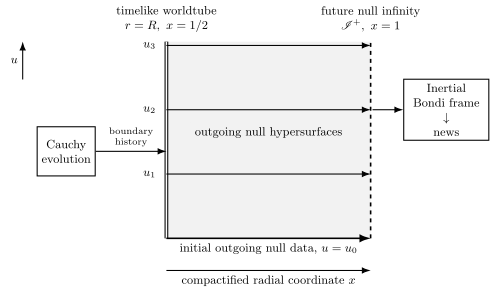
Outgoing characteristic computational coordinates with : a fixed worldtube at maps to , and future null infinity to . Each horizontal line represents an outgoing null hypersurface. This is a schematic grid, not a conformal spacetime diagram; the drawn slopes do not represent causal angles or light speeds. It assumes a regular outgoing foliation and does not establish that a numerical waveform has converged.
CCE passes data outward only. It cannot repair reflections that have already propagated from the Cauchy outer boundary into its worldtube data. Two-way Cauchy–characteristic matching addresses a different coupled boundary problem.
Errors that replace extrapolation error
Section titled “Errors that replace extrapolation error”Worldtube error begins with interpolation from the three-dimensional Cauchy grid to a moving spherical surface. Metric derivatives and coordinate transformations can converge at a different rate from the evolved fields. Store the full worldtube data and transformation rather than only already-combined waveform modes; otherwise a sign or Jacobian error cannot be revisited.
Characteristic initial data on the first outgoing null hypersurface are generally not supplied by the Cauchy evolution. A convenient choice can launch transient radiation that decays but contaminates the early waveform. Vary that choice or discard a demonstrably settled interval. Moving outward can reduce near-zone mismatch but worsens Cauchy resolution and radial lever arm; moving it inward has the opposite tradeoff. Worldtube radius is therefore a systematic-control parameter.
Characteristic discretization contributes angular, radial, and temporal truncation error. Compactification and regularity at null infinity require carefully regularized variables. The transformation to an inertial asymptotic frame can introduce additional derivatives and mode mixing. The Bondi–Sachs and affine-null free-evolution systems analyzed by Giannakopoulos, Hilditch, and Zilhão are only weakly hyperbolic in standard -type norms, and their smooth-data tests show why apparently favorable convergence can miss the high-frequency pathology; see Giannakopoulos et al. 2020, §§II, IV–V. This does not by itself establish failure of a particular CCE implementation, but it prevents empirical convergence on smooth benchmarks from being generalized without checking the formulation, norm, and data regularity.
Moxon and collaborators develop a modern CCE system and separate its numerical tests in Moxon et al. 2023, §§II–V, Figs. 7–13, and §VI, Figs. 14–16. Their structure motivates four independent variations: Cauchy resolution, characteristic resolution, worldtube location, and initial null data.
Analytic and gauge benchmarks
Section titled “Analytic and gauge benchmarks”A linear Teukolsky wave of amplitude supplies analytic characteristic data and radiation. Because the numerical characteristic equations are nonlinear while the reference solution is linearized, after truncation error is reduced the remaining analytic mismatch should scale as . Vary both and resolution: resolution convergence alone cannot distinguish a coding error from neglected nonlinear terms, while amplitude scaling can.
A gauge-transformed Schwarzschild spacetime supplies a complementary null test. Coordinates and worldtube data may be time dependent, but the Bondi news in an inertial frame must vanish. This test probes the coordinate transformation and asymptotic frame more sharply than a wave-amplitude comparison. Report an absolute news norm, not a relative error divided by zero.
For a binary or nonlinear-wave dataset, run at several worldtube radii and characteristic resolutions. Compare news or strain mode by mode with finite-radius extrapolation, while keeping Cauchy data and frame alignment fixed. Balance of radiated energy and angular momentum against initial and remnant quantities is an independent physical check. Agreement between two CCE resolutions that share a faulty worldtube transform is not independent evidence.
A rerunnable extraction record
Section titled “A rerunnable extraction record”The environment record should pin the Cauchy dataset and checksums, Cauchy-to-worldtube interpolator, worldtube coordinate map, characteristic equations and gauge, radial compactification, angular representation, time integrator, floating-point precision, and software revision. Inputs include every worldtube radius, null initial-data prescription, mode convention, conformal factor, inertial-frame construction, and discarded transient interval.
Outputs should preserve worldtube data, characteristic constraints, regularity residuals at null infinity, news or strain modes, convergence comparisons, and frame metadata. A clean future rerun would process a gauge Schwarzschild test and a Teukolsky family at , , and , refine both grids, and repeat over multiple worldtubes. This page defines that executable sequence but does not claim that it has been run.
The characteristic grid is only one possible failure mode. Reject the finite result if gauge Schwarzschild produces unresolved news, Teukolsky error fails both resolution and scaling tests, characteristic constraints plateau, different worldtubes disagree beyond their estimated Cauchy error, early results depend materially on null initial data, or the inertial-frame transformation is undocumented. A CCE waveform lives at null infinity, but that location alone does not make it exact.
Check your understanding
Section titled “Check your understanding”Two characteristic resolutions give indistinguishable waveforms from one worldtube. Moving the worldtube from to shifts the dominant-mode phase by more than the claimed uncertainty, and the shift does not decrease when only the characteristic grid is refined. What has been established?
Solution
Only characteristic-grid convergence at fixed boundary data has been established. The persistent worldtube dependence points to Cauchy interpolation, coordinate reconstruction, near-zone mismatch, or null initial data. Refine the Cauchy evolution and worldtube sampling, inspect transformation residuals, vary the initial null prescription, and include the remaining radius spread as a systematic. It cannot be erased by quoting the finer characteristic resolution.
Continue with Fluxes, Memory, and Consistency Checks.
References
Section titled “References”- Barkett, Kevin, Jordan Moxon, Mark A. Scheel, and Béla Szilágyi. 2020. “Spectral Cauchy–Characteristic Extraction of the Gravitational Wave News Function.” Physical Review D 102, 024004. arXiv.
- Giannakopoulos, Thanasis, David Hilditch, and Miguel Zilhão. 2020. “Hyperbolicity of General Relativity in Bondi-like Gauges.” Physical Review D 102, 064035. DOI.
- Moxon, Jordan, Mark A. Scheel, Saul A. Teukolsky, Nils Deppe, Nils Fischer, François Hébert, Lawrence E. Kidder, and William Throwe. 2023. “Cauchy–Characteristic Evolution and Waveform Extraction with SpECTRE.” Physical Review D 107, 064013. arXiv.