Particle Horizons and Event Horizons
Scrollable formula. Use Left and Right arrow keys to reveal hidden content.
Scrollable table. Use Left and Right arrow keys to reveal additional columns.
Scrollable figure. Use Left and Right arrow keys to inspect hidden content.
The particle horizon asks how far away matter could have sent us a signal by now. The event horizon asks how far away a signal emitted now can ever reach us. The first depends on the past endpoint of conformal time and the second on its future endpoint. In FLRW geometry the same future-distance limit also applies to a signal we send to a comoving receiver. Neither limit follows from the instantaneous Hubble parameter alone.
Helpful background. Einstein Equations fix the background dynamics, Relativistic Matter and Compact Objects supplies the stress–energy interpretation, Causality and Global Structure supplies causal-past and causal-future language, Relativistic Cosmology supplies the FLRW setting, and Mathematical Relativity clarifies endpoint and extension questions used below.
Two endpoint integrals
Section titled “Two endpoint integrals”Write an FLRW line element in cosmic time as
Here is dimensionless, and have dimensions of length, and is the constant spatial-curvature parameter with dimensions . The function equals , , or for positive, zero, or negative , respectively. This is the convention of FLRW Geometry. For radial light, setting gives : in a diagram with equally scaled and axes, light travels on lines at 45 degrees.
Fix a comoving observer at . If the cosmological patch begins at and ends at , the comoving radii relevant at time are therefore
A finite bounds the comoving worldlines from which a signal could have arrived by . A finite bounds the events on the slice whose signals can arrive at any later time. The event horizon is the boundary of the causal past of the observer’s entire future worldline; a source exactly on it reaches only the limiting future boundary, not the observer at any finite later time.
The proper radial distance on a fixed-time slice is , whereas the areal radius, defined by a sphere’s area , is . These agree for . Keeping them separate matters in curved space. The integral definitions and their conformal diagrams are developed in Tong 2019, § 1.1.4, pp. 15–19 (PDF).
The comparison axes are consequently different: past versus future endpoint, received versus ever-sendable signals, and already specified versus model-dependent cosmic history. An event horizon is teleological because deciding that converges requires the entire future geometry. In a spatially compact universe, topology can cap the greatest independent separation, so one must combine the conformal-time test with the spatial identification; the integral by itself describes radial causal reach in the covering geometry.
Power laws expose the distinction
Section titled “Power laws expose the distinction”Let for , with . If this law is extrapolated to , then
only for . An antiderivative exists for , but it gives a finite improper integral only if its lower-end contribution converges. For the past integral diverges, logarithmically at . Matter domination () and radiation domination () therefore possess particle horizons when idealized back to .
If the same power law continues to , then
is finite only for . Thus decelerating matter expansion has a particle horizon but no event horizon, whereas an eternally accelerating power law has an event horizon but, if extended unchanged all the way to , no particle horizon. Realistic histories are piecewise: a finite-duration accelerated era changes the integral by a finite amount, and the pre- and post-acceleration epochs decide the endpoints.
For the flat de Sitter patch with and ,
while the past integral from diverges. If exponential expansion instead starts at a finite time, its particle horizon is finite and remembers that beginning. This endpoint sensitivity is why the same instantaneous does not determine both horizons.
The Hubble radius is not a causal horizon
Section titled “The Hubble radius is not a causal horizon”For an expanding model, , the comoving Hubble radius is a local expansion scale. Its derivative is
so it shrinks during accelerated expansion and grows during deceleration. That behavior is useful for tracking perturbation wavelengths, but is not defined by a causal boundary. A photon can cross the Hubble radius, and a time-dependent Hubble radius need not coincide with either endpoint integral. “Horizon crossing” in perturbation theory often means ; it should not be read as crossing a global event horizon.
For a flat FLRW model, the proper radial distance of an inward photon obeys
The term increases the distance because the background expands; the term is the photon’s inward motion relative to local comoving observers. An inward photon outside initially becomes more distant even though every nearby observer measures its speed as unity. If the Hubble radius subsequently grows past it, its distance begins to decrease and it may reach us. No local light-speed limit has been violated.
For example, in a matter-only flat model an inward ray arriving at has
It crosses at , its point of maximum distance. It still arrives at . This explicit trajectory is stronger evidence of the Hubble radius’s nonbarrier character than a comparison of radius values at one time.
Likewise, an event horizon is observer-dependent in cosmology. Different comoving observers have translated causal diamonds even in a homogeneous geometry. A particle horizon limits what is observable now, not what exists, and opacity can impose a practical visibility surface inside the causal domain without changing the geometric horizon.
The conformal diagram makes this comparison visible. The same observer is at throughout each panel; incoming light crosses the dotted Hubble scale in both models. The gray curves are the horizon radii selected by the finite conformal endpoint.
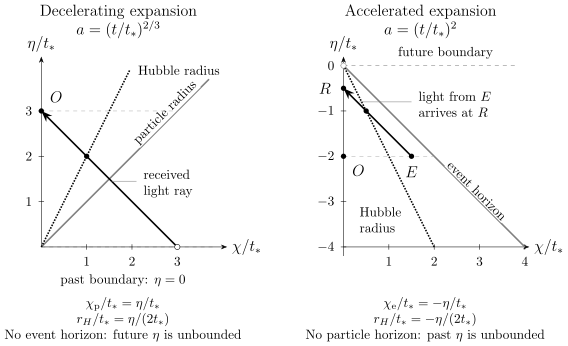
Two flat, noncompact power-law models on . Matter expansion has and ; accelerated expansion has and . Here . Both received light rays cross that dotted Hubble scale. The left ray is extrapolated to the excluded big-bang boundary, marked by an open endpoint. In the right panel, emission at lies inside the event horizon at the time marked , and reception at occurs before . Equal conformal-coordinate scales are used; proper distances are not represented.
The earlier causal-scales comparison tabulates these coordinate choices and both endpoints.
Checks and limitations
Section titled “Checks and limitations”Both integrals have dimensions of comoving length in units with , while multiplication by gives a physical length at time . Differentiating gives and : past causal reach accumulates, whereas the remaining comoving reach decreases. These signs provide a quick normalization check.
The calculation assumes an FLRW geometry and a specified endpoint within that model or extension. It does not settle whether the endpoint is a curvature singularity, a removable coordinate boundary, or a transition to different dynamics. Those are questions of geodesic completeness and global extension, treated on the next page; proof-level causal definitions remain with the linked Global Structure treatment.
The exact observer-domain and causal-boundary distinctions are developed in Observer, Acceleration, and Cosmological Horizons.
Exercises
Section titled “Exercises”For on noncompact flat spatial slices, determine which horizons exist for (i) and (ii) , assuming the model holds for all . Give the physical event-horizon radius in case (ii).
Solution
For , the past integral behaves as and is finite, so there is a particle horizon; the future integral diverges, so there is no event horizon. For , the past integral diverges but the future integral is , so there is an event horizon. Its physical radius is .
Differentiate the matter-era photon trajectory above and verify that its maximum occurs at . Was the photon moving outward relative to a nearby comoving observer before that maximum?
Solution
Differentiation gives . It vanishes at , or , changing from positive to negative there. Nevertheless throughout: the photon always moves inward locally. Proper separation on an extended cosmic-time slice and locally measured velocity answer different questions.
References
Section titled “References”- Tong, David. Cosmology. University of Cambridge Part II Mathematical Tripos lecture notes, Michaelmas 2019. Official PDF.