Five-Dimensional Black Rings
Scrollable formula. Use Left and Right arrow keys to reveal hidden content.
Scrollable table. Use Left and Right arrow keys to reveal additional columns.
Scrollable figure. Use Left and Right arrow keys to inspect hidden content.
The five-dimensional black ring is an asymptotically flat vacuum black hole whose horizon has topology . Rotation along the balances the ring against collapse when the metric parameters satisfy a definite conical-regularity condition. Its coexistence with spherical Myers–Perry black holes at the same conserved mass and angular momentum is an explicit failure of four-dimensional-style uniqueness.
Required background. The Einstein Equation supplies the five-dimensional vacuum equation.
Helpful background. The Riemann Curvature Tensor supplies singularity tests; Exact Solutions of Einstein’s Equations places the family; Global Structure develops horizon topology; and Killing Fields and Isometry Groups supplies the two rotational symmetries.
Ring coordinates and exact metric
Section titled “Ring coordinates and exact metric”Use coordinates
and define
with . A singly spinning neutral black ring is
where
The scale has dimensions of length. Spatial infinity is the corner . The circle collapses at , while the circle is the ring direction and also degenerates on an exterior axis. The event horizon lies at
a zero of behind the ergosurface , or . Horizon-regular coordinates show that the horizon cross-section contains the noncontractible circle and a two-sphere built from .
Emparan and Reall discovered this exact family and its nonuniqueness in Emparan and Reall 2002, pp. 101101-1–101101-4. Their later review gives this parameterization, the balance condition, and the reduced phase curve in Emparan and Reall 2008, §5.1.1, Eqs. (50)–(56), printed pp. 22–24. The charge normalization and the branch analysis used below are developed together in Emparan and Reall 2006, §3.2, Eqs. (35)–(41), printed pp. 12–14.
Balance from conical regularity
Section titled “Balance from conical regularity”Local regularity at an axis fixes an angular period from the derivative of . Choosing common periods
regularizes the asymptotic axes and . The remaining inner axis at is regular only if
This is the balance condition. If it is not imposed, a conical disk supplies an additional stress that holds the ring. Thus a vacuum metric away from the axis is not yet a balanced vacuum black hole globally.
The condition has a mechanical interpretation. The ring’s self-attraction tends to shrink the , while angular momentum along provides centrifugal support. The exact equality above includes the fully relativistic relation between those effects. It is not obtained by setting a Newtonian centripetal force equal to gravity.
Charges and nonuniqueness
Section titled “Charges and nonuniqueness”With the asymptotic periods normalized to by a corresponding angular rescaling, the mass and ring angular momentum can be written
If a different angular period is retained in the displayed coordinates, the charge formulas acquire the corresponding normalization factors. Metric and charge conventions must therefore be kept together.
A convenient scale-free spin is
On the balanced branch,
Its derivative is
Thus the thin branch decreases from infinite spin, while the fat branch rises from their common minimum . This is a smooth minimum of ; the familiar cusp appears only after the two branches are plotted against another observable such as reduced horizon area.
The first panel below follows the exact ring curve. The second deliberately uses , rather than , as its horizontal variable so that the separate Myers–Perry family can be compared at the same conserved charges without pretending that it is parameterized by ring thickness.
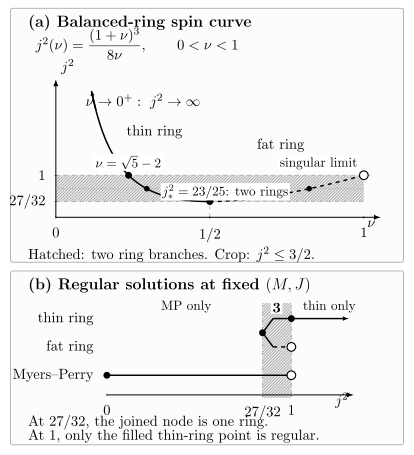
Balanced singly spinning rings obey for . The curve decreases along the thin branch, reaches the regular minimum-spin ring , and rises along the fat branch toward the excluded singular limit . Every level intersects the ring curve twice and also admits a regular singly spinning Myers–Perry black hole, giving three regular solutions with the same mass and angular momentum. At the ring branches coincide, while at the regular thin ring at remains but the fat-ring and Myers–Perry endpoints are singular. The curve is exact; the vertical display is cropped at , and the continuation arrow represents . No stability statement is implied.
For every , two regular balanced rings share the same . A regular singly spinning Myers–Perry black hole also exists throughout this open interval, because its regularity range is . Thus three distinct regular vacuum black holes have the same conserved charges there. At the lower endpoint the thin and fat descriptions denote one minimum-spin ring, not two. At the upper endpoint the equation factors as
so the interior root is a regular thin ring even though the fat-ring limit and the singly spinning Myers–Perry limit are singular. Stationarity, asymptotic flatness, vacuum Einstein equations, and conserved charges therefore do not uniquely select the geometry in five dimensions.
This comparison concerns exact stationary solutions. It does not say that every branch is dynamically stable. Nor does horizon topology alone distinguish all solutions; additional interval structure, multipole data, or horizon geometry is needed.
Limits and geometric checks
Section titled “Limits and geometric checks”As along the balanced branch, and the ring becomes thin, with large dimensionless spin. A local segment approaches a boosted black string, providing a powerful check on the horizon and charge scaling. The fat branch approaches a singular endpoint as . Neither limit is captured by setting a parameter to its endpoint without rescaling coordinates near the ring.
Curvature invariants remain finite at the regular horizon and diverge at the true singular set beyond it. Axis regularity must be checked separately because a conical defect is distributional and may not appear in invariants evaluated off the axis.
Exercises
Section titled “Exercises”Find the minimum of the balanced-ring spin function for .
Solution
Differentiate its logarithm:
The only interior critical point is . The derivative changes from negative to positive there, so it is a minimum. Substitution gives
Hence two ring branches coexist for , until the fat branch reaches its singular endpoint at and . For , only the thin ring branch remains.
At , identify every real root of the balanced-ring equation and decide which roots represent regular black rings. Then include the Myers–Perry family and count the regular solutions at this endpoint.
Solution
Setting gives
The three real roots are
Only lies strictly inside the regular interval , so it is one regular thin ring. The root is the singular fat-ring endpoint, and the negative root is outside the ring parameter range. The singly spinning Myers–Perry endpoint at is also singular. Therefore exactly one regular solution from these families remains at .
References
Section titled “References”- Roberto Emparan and Harvey S. Reall, “A Rotating Black Ring Solution in Five Dimensions,” Physical Review Letters 88, 101101 (2002). DOI.
- Roberto Emparan and Harvey S. Reall, “Black Holes in Higher Dimensions,” Living Reviews in Relativity 11, 6 (2008). DOI; Open PDF.
- Roberto Emparan and Harvey S. Reall, “Black Rings,” Classical and Quantum Gravity 23, R169–R197 (2006). DOI; Open PDF.