Kerr Domains, Horizons, and Extensions
Scrollable formula. Use Left and Right arrow keys to reveal hidden content.
Scrollable table. Use Left and Right arrow keys to reveal additional columns.
Scrollable figure. Use Left and Right arrow keys to inspect hidden content.
Kerr has two distinct nullity conditions. Roots of are candidate Killing horizons, while locates stationary-limit surfaces where the asymptotically normalized time translation becomes null. For nonzero spin the outer surfaces meet only on the rotation axis; at the Schwarzschild endpoint they coincide everywhere. Horizon-regular coordinates show that the rotating roots of are chart boundaries, whereas is the invariant ring singularity only when and .
Required background. Frames, Coframes, and Anholonomy supplies regular tetrads across the Boyer–Lindquist coordinate poles.
Helpful background. The Einstein Equation supplies Ricci flatness; The Riemann Curvature Tensor distinguishes ring blowup from horizon regularity; Exact Solutions of Einstein’s Equations supplies chart-domain checks; Causality and Global Structure supplies global horizon language; Killing Fields and Isometry Groups supplies Killing generators.
Radial roots and spin regimes
Section titled “Radial roots and spin regimes”Choose the positive-mass asymptotic end, and , before defining . Set and
The algebraic roots are
Their geometric meaning depends on the spin regime:
| Regime | Root and horizon structure |
|---|---|
| is the Schwarzschild event and Killing horizon; the formal root is the central curvature singularity, not a null hypersurface | |
| are simple; in the eternal extension, is the outer event and Killing horizon and is an inner Cauchy and Killing horizon | |
| the roots merge into the degenerate horizon | |
| there is no real root and hence no Kerr horizon |
This endpoint distinction is explicit in Boyer and Lindquist 1967, §II, p. 270, Eqs. (2.11)–(2.14): when , their is “not a null surface” but the essential Schwarzschild singularity. Carter gives the same classification in Carter 1968, §1B, p. 1562, Eqs. (12)–(13).
At a genuine root away from , Boyer–Lindquist components diverge because , while the inverse norm of a constant- normal is . Ingoing or outgoing Kerr coordinates remove the component pole on the corresponding oriented branch.
At , the two roots merge at and . The usual nonextremal Kruskal exponentials degenerate, although ingoing coordinates remain regular. For , has no real root; no horizon separates the positive- asymptotic end from the ring singularity. These are exact-family classifications, not claims about stability or formation.
Horizon generator versus stationary limit
Section titled “Horizon generator versus stationary limit”The null generator of the outer Killing horizon is
Here is normalized at infinity and has period . Direct substitution shows at for every , and in a horizon-regular chart is normal to the null hypersurface. The angular velocity is included to identify the metric domain; its mechanics and thermodynamic consequences are treated elsewhere.
The stationary field itself obeys
Its outer stationary-limit surface is
For a rotating Kerr black hole, , , with equality only at . In the subextremal case, the region is the outer ergoregion: is spacelike there, but suitable combinations remain timelike. The stationary-limit surface is not a Killing horizon. At , instead,
for every , , and there is no ergoregion. The distinction between the null horizon and the surface , together with its Schwarzschild exception, is already noted in Boyer and Lindquist 1967, note added in proof, p. 281; the defining metric and roots appear in Carter 1968, §1A–B, pp. 1560–1562, Eqs. (1), (3)–(4), and (12)–(13).
The figure puts the two tests side by side. In the upper panel, inspect how the radial roots merge and then disappear as crosses one. In the lower panel, compare the outer horizon with the stationary-limit surface and locate the ring separately; the gray region is the ergoregion, not the black-hole interior.
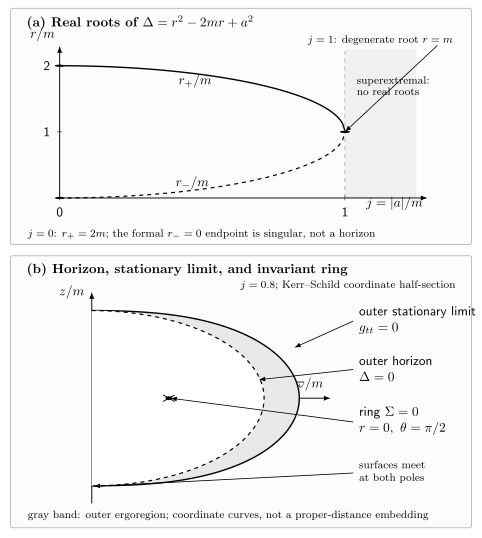
For positive-mass Kerr, are real only for ; the endpoint is the Schwarzschild singularity, not a horizon. The lower panel gives exact Kerr–Schild coordinate curves at : the outer stationary-limit surface bounds the gray ergoregion outside the outer horizon and meets that horizon only at the poles, while is the ring at . These are coordinate curves, not a proper-distance embedding.
Horizon branches and analytic blocks
Section titled “Horizon branches and analytic blocks”For , the Boyer–Lindquist intervals , , and are separate chart blocks. Ingoing Kerr coordinates cross the future outer-horizon branch reached by ingoing principal rays; outgoing Kerr coordinates cross the time-reversed outer branch. The same differential metrics are regular at the corresponding oriented branches of the inner root. Neither chart alone supplies the bifurcation two-surfaces of a simple horizon, so further Kruskal-like overlaps are required for the standard eternal analytic extension. The two principal charts and their overlaps are constructed in Boyer and Lindquist 1967, §II–III, pp. 271–275, Eqs. (2.16)–(3.11) and Carter 1968, §1C, pp. 1562–1565, Eqs. (14)–(25).
The negative- continuation is a specifically rotating construction. For , the oblate coordinate is not an areal radius, and the surface maps to the equatorial disk , . Away from the boundary of that disk, the metric can be continued to a second sheet with . Boyer and Lindquist describe the disk aperture and signed- sheet in Boyer and Lindquist 1967, §II, p. 270; Carter warns that one Cartesian Kerr–Schild triple corresponds to two signed- points in the extended construction in Carter 1968, §1A, p. 1560, Eqs. (6)–(8).
At , there is no oblate disk through which to continue: is the Schwarzschild curvature singularity. Thus the Schwarzschild extension terminates there and must not be obtained by retaining the rotating negative- narrative.
Ring, disk, and the massless exception
Section titled “Ring, disk, and the massless exception”For and , the obstruction to the rotating disk continuation is
In Kerr–Schild Cartesian coordinates this is the boundary ring , . Curvature invariants diverge there along generic approaches. The open disk inside the ring participates in the multi-sheeted analytic coordinate construction, and regions on the negative- side can contain closed timelike curves. Carter analyzes the ring, signed- asymptotic ends, and causal pathology in Carter 1968, §§1A and 2, pp. 1560–1561 and 1566–1569; Bičák gives a modern secondary synthesis in Bičák 2000, arXiv:gr-qc/0004016v1, §4, pp. 42–51, Open PDF.
The formal limit at fixed is different again. Since the Kerr–Schild profile is , the metric becomes exactly Minkowski space in Cartesian coordinates. The oblate disk and ring then mark a coordinate branch choice, not a horizon or curvature singularity. Because was defined only for , this limit has and is not a massless rotating black hole. The flatness follows directly from Kerr 1963, p. 238, Eq. (5) or Carter 1968, §1A, p. 1560, Eqs. (6)–(8).
Calling this an analytic extension does not prove a preferred maximal extension in weaker differentiability classes. Nor does the ideal inner horizon survive generic perturbations unchanged. Those global and dynamical questions require more than the exact background geometry developed here.
Exercise
Section titled “Exercise”For , show that the outer stationary-limit surface lies outside or on the outer horizon and find where the two meet. Then evaluate the result at .
Solution
Because , one has . Taking nonnegative square roots gives . For , equality requires , hence or . At the equator , strictly outside . At , the two square roots are identical for every angle, so the stationary-limit surface and horizon coincide everywhere at .
References
Section titled “References”- Bičák, Jiří. “Selected Solutions of Einstein’s Field Equations: Their Role in General Relativity and Astrophysics.” In Einstein’s Field Equations and Their Physical Implications, Lecture Notes in Physics 540, 1–126. Springer, 2000. arXiv:gr-qc/0004016v1.
- Boyer, Robert H., and Richard W. Lindquist. “Maximal Analytic Extension of the Kerr Metric.” Journal of Mathematical Physics 8, no. 2 (1967): 265–281. DOI: 10.1063/1.1705193.
- Carter, Brandon. “Global Structure of the Kerr Family of Gravitational Fields.” Physical Review 174, no. 5 (1968): 1559–1571. DOI: 10.1103/PhysRev.174.1559.
- Kerr, Roy P. “Gravitational Field of a Spinning Mass as an Example of Algebraically Special Metrics.” Physical Review Letters 11, no. 5 (1963): 237–238. DOI: 10.1103/PhysRevLett.11.237.