Null Focusing and Trapped-Surface Kinematics
Scrollable formula. Use Left and Right arrow keys to reveal hidden content.
Scrollable table. Use Left and Right arrow keys to reveal additional columns.
Scrollable figure. Use Left and Right arrow keys to inspect hidden content.
Null focusing is controlled by the two-dimensional screen transverse to a lightlike congruence in four spacetime dimensions. For affine, twist-free generators with nonnegative null Ricci contraction, negative expansion diverges within affine parameter at most . A compact spacelike two-surface is future trapped when both independent future null expansions are negative. This is local kinematics, not yet a statement about an event horizon or geodesic incompleteness.
Required background. We use congruences and optical scalars, Einstein’s equation, and the Hilbert stress tensor.
Helpful background. Null normalization uses special relativity and smooth tensor geometry. Penrose-type conclusions require separate global causal structure.
Null focusing statement and proof
Section titled “Null focusing statement and proof”Let be a smooth spacelike codimension-two cross-section, and let be the affinely parametrized tangent to one smooth null congruence orthogonal to in dimensions. Assume, up to the first focal point to ,
Surface orthogonality makes screen twist vanish. The affine null Raychaudhuri equation gives
Since the screen metric is positive definite, . Integrating the reciprocal inequality exactly as in the timelike case gives
Put . While the null Jacobi determinant remains positive, and the reciprocal comparison implies
Provided the null geodesic extends to through a regular spacetime, its Jacobi fields also extend there. If a focal point has not occurred earlier, the area determinant therefore vanishes as . A focal point to then occurs no later than
In four dimensions the coefficient and bound are and . Kontou and Sanders display the full affine null Raychaudhuri identity Kontou and Sanders 2020, § 2, p. 8, Eq. (17), PDF; MIT constructs the screen equation and derives the comparison inequality Guth–Turner 2017, Lecture 14, pp. 60–61, Eqs. (14.19)–(14.25), PDF.
Affine normalization matters. Replacing by a constant positive multiple rescales both and , leaving the geometric focal event unchanged but changing its numerical parameter value. A nonconstant rescaling introduces nonaffinity and a term.
The proof assumes a smooth congruence only before the focal event. Its Jacobi fields and spacetime curvature may remain regular at that event while the expansion and shear cease to be finite; the optical description is what breaks down. The generators are hypersurface orthogonal, so their screen twist vanishes. An arbitrary null congruence with twist is not covered by deleting the positive twist term from Raychaudhuri’s equation.
Two future null expansions of a surface
Section titled “Two future null expansions of a surface”Let now be a smooth compact spacelike codimension-two surface without boundary—a closed surface. Its normal plane is Lorentzian and contains two independent future-directed null directions, represented by and . With induced screen metric , define
Equivalently, is the fractional rate of change of the area element when is deformed along the corresponding null normal:
is future trapped when and everywhere. It is future marginal in one direction when one expansion vanishes and the other is nonpositive under an appropriate convention. These are properties of the chosen surface and null orientations, not of an entire spacetime region by definition.
Under positive rescaling on ,
because the projector annihilates the normal. The values depend on normalization, but their signs do not. Negative rescaling would reverse time orientation and is not allowed when comparing future normals.
The pair of future directions is invariant even though individual labels “outgoing” and “ingoing” may cease to have a global meaning. On a general compact surface there need not be a preferred exterior. The definition uses both independent future null normals and their expansion signs, not a coordinate radial direction.
Kontou and Sanders state trapped-surface and focusing hypotheses in the context of the Penrose theorem Kontou and Sanders 2020, § 5.1, pp. 38–40, Definition 5.3 and Theorem 5.4, PDF. The global theorem contains hypotheses beyond the local definitions retained here.
Round spheres as an independent check
Section titled “Round spheres as an independent check”In four-dimensional Minkowski spacetime, take a round sphere of radius at fixed inertial time. Choose future null normals
These normals satisfy , have positive inertial-time components, and obey . Thus the comparison fixes both future orientation and cross-normalization rather than relying on the drawing’s left–right placement.
The area is . Along the outgoing deformation , while along the ingoing deformation . Hence
One future expansion is positive and one negative, so ordinary spheres in flat spacetime are not future trapped. The ingoing congruence focuses at the center after affine interval , exactly saturating . Curvature is unnecessary for this geometrical focusing; negative initial expansion is enough.
For a trapped spherical surface in a black-hole interior, both future null deformations decrease its areal radius and hence its area. The invariant test is the pair of expansion signs. A coordinate drawing of tilted light cones, or a coordinate called “radius,” is insufficient by itself.
The figure contrasts these two sign patterns. Inspect the size of each displaced surface relative to the hatched starting surface: the arrow’s left–right direction only separates the two future null normals and does not define an exterior.
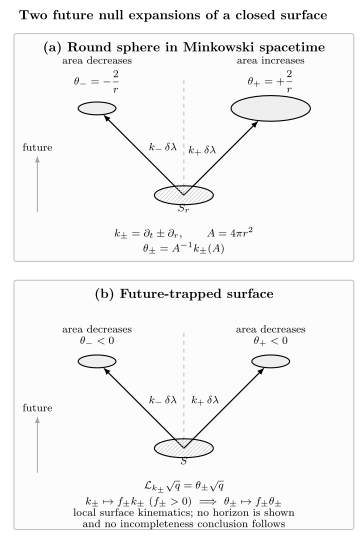
Two future null deformations of a closed spacelike two-surface need not change its area in opposite ways. For a round sphere in Minkowski spacetime with , the exact expansions are and . For a future trapped surface both are negative, so both infinitesimal future deformations reduce area. The lower panel states local kinematics only: it neither identifies an event horizon nor implies geodesic incompleteness. Normal-plane projection; surface sizes are schematic and not to scale.
The mean-curvature vector of packages the same information invariantly. Its causal orientation is determined by the two null expansions once their cross-normalization is fixed. The null-expansion definition remains more direct for focusing because each sign is propagated along its corresponding null hypersurface.
From trapped kinematics to global theorems
Section titled “From trapped kinematics to global theorems”If NEC and Einstein’s equation give null convergence, each negative future expansion is driven toward a focal point. A global incompleteness theorem then uses additional assumptions: a suitable causal condition, a noncompact Cauchy surface or alternative global hypothesis, completeness assumed for contradiction, and properties of achronal null generators. It is this global argument—not the Raychaudhuri inequality alone—that reaches geodesic incompleteness.
A trapped surface is not an event horizon. Event horizons are globally defined as boundaries of causal pasts of infinity, while trapped surfaces are quasi-local. Nor does focusing itself imply curvature divergence: the Minkowski ingoing sphere already supplies a zero-curvature focal point.
Exercises
Section titled “Exercises”Show that positive rescaling of a null normal preserves the sign of its expansion on .
Solution
For ,
The second term vanishes because . Therefore . If , future orientation and the sign of expansion are preserved.