Events, Intervals, and Minkowski Geometry
Scrollable formula. Use Left and Right arrow keys to reveal hidden content.
Scrollable table. Use Left and Right arrow keys to reveal additional columns.
Scrollable figure. Use Left and Right arrow keys to inspect hidden content.
All inertial observers agree on the Minkowski interval between two events, its timelike/null/spacelike causal class, and—after choosing the same time orientation—the order of causally related events. They do not generally agree on coordinate differences, simultaneity, or the temporal order of spacelike-separated events.
Required background. Calculus and Linear Algebra provides quadratic forms, linear maps, and basis changes; Variational Mechanics and Symmetries supplies the distinction between a physical trajectory and its coordinate description.
Events before coordinates
Section titled “Events before coordinates”An event is something localized in both place and time: for example, a flash at a detector or the meeting of two clocks. A worldline is the sequence of events along one object’s history. Two observers who meet agree that the meeting happened even when they assign it different coordinates.
Minkowski spacetime is affine: subtracting two events and produces a displacement vector , but no event is intrinsically the origin. An inertial Cartesian chart assigns four numbers to each event. Physically, its time labels can be supplied by a lattice of clocks at rest relative to one another and synchronized by light signals. A different inertial lattice changes the labels without changing the events.
The invariant quadratic form is
Restoring units gives . A Lorentz transformation satisfies
so has the same . A translation changes both event coordinates by the same constant and cancels from their difference. Tong derives the invariant interval and Lorentz-group condition in Tong 2013, §§7.3.1–7.3.2, printed pp. 125–130 (PDF).
For two distinct events, the sign classifies their separation:
- is timelike; a slower-than-light worldline can join the events.
- is null; a light signal can join them.
- is spacelike; no causal signal limited by the light cone can join them.
The cone also has future and past halves. Proper orthochronous Lorentz transformations preserve those halves, so if lies in the future causal cone of , every such inertial observer agrees that precedes ; see Tong 2013, §7.2.2, printed pp. 117–118 (PDF).
Here proper excludes a spatial reflection and orthochronous excludes reversal of the chosen future direction. The latter is what matters for causal ordering. Coincident events have zero displacement and , but the zero vector is not a light-ray direction. Also, a timelike separation says that a causal influence is possible; it does not establish that one event actually caused the other.
The causal-cone diagram makes this partition visible. Inspect the null boundary first, then the timelike interiors and spacelike exterior. Its second panel also isolates a low-dimensional topological fact: in dimensions the spacelike exterior has separate left and right components, although the same sign test still classifies every displacement.
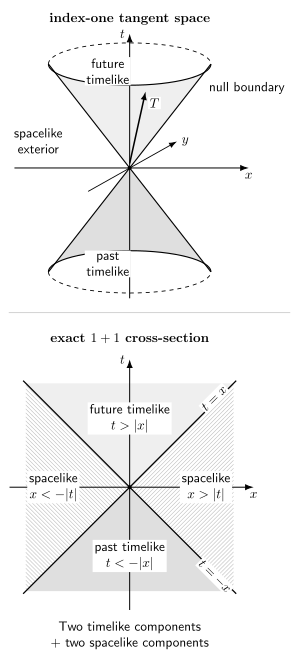
An index-one tangent metric has two timelike components bounded by the null cone. The 1+1 cross-section makes the low-dimensional exception explicit: the spacelike set has separate left and right components, so the cone complement has four pieces. Schematic and not to scale.
Canonical frames for each class
Section titled “Canonical frames for each class”For a displacement in dimensions with , first rotate the spatial axes so that
If , a timelike displacement is already in canonical rest-frame form. Otherwise the remaining calculation lies in the plane. Take a boost with :
If the separation is timelike, . Choosing gives : there is an inertial frame in which both events occur at the same place, and
If the separation is spacelike, put , so . Choosing gives : there is a frame in which the events are simultaneous, separated by . More precisely,
so allowed boosts with and assign opposite signs to . Null separation admits neither rest nor simultaneity frame; the cone remains the cone. The boost and interval ingredients appear in Tong 2013, §7.1, printed pp. 108–114, and §7.3.1, printed pp. 125–127 (PDF); Hughes 2024, Lecture 4, §4.3, printed pp. 31–33 (PDF) applies them to the canonical frames.
Transfer check: classify three displacements
Section titled “Transfer check: classify three displacements”In units with , let event and consider , , and in coordinates. Classify each separation and find a useful canonical frame.
Solution
For ,
so the separation is timelike. The boost is allowed and gives . Since ,
For ,
so it is spacelike. Choosing makes . Choosing instead gives , explicitly reversing the coordinate time order without threatening causality.
Finally, , so is null-separated from . Substitution into the boost shows for every finite ; its null class is unchanged.
The sign test is a useful diagnostic: with , a stationary clock has . If a calculation labels that displacement spacelike, its signature has been mixed. The canonical-frame construction assumes global inertial charts and flat spacetime. In curved spacetime the causal class of each tangent vector is still exact, but separated events generally do not define one affine displacement measured by a single constant matrix .
Lorentz Transformations, Rapidity, and Velocity Addition now derives the boost used above and explains exactly when its rapidity parameter adds.
References
Section titled “References”- Hughes, Scott A. Introduction to Relativity and Spacetime Physics. MIT 8.033 Lecture 4, especially §4.3, printed pp. 31–33 (PDF), Fall 2024.
- Tong, David. Dynamics and Relativity. §7.1, printed pp. 108–114; §7.2.2, printed pp. 117–118; §§7.3.1–7.3.2, printed pp. 125–130 (PDF), University of Cambridge, Lent Term 2013. Signature translated from to .