Cauchy Surfaces
Scrollable formula. Use Left and Right arrow keys to reveal hidden content.
Scrollable table. Use Left and Right arrow keys to reveal additional columns.
Scrollable figure. Use Left and Right arrow keys to inspect hidden content.
A Cauchy surface is a slice that every inextendible timelike curve crosses exactly once: no such curve can miss the data surface or return to it. This single geometric object encodes both coverage and non-recurrence. It need not be compact, smooth, or a level set of a preferred coordinate, but stronger regularity is normally chosen when differential equations require normal derivatives and Sobolev data.
Required background. Geodesics and Jacobi Fields supplies inextendibility and the distinction between causal curves and geodesics. Helpful background. Lorentzian Metrics and Causal Cones supplies causal character; Causality and Global Structure provides the global context; Partial Differential Equations and Green Functions explains why smooth spacelike slices are used for field data.
Equivalent geometric definitions
Section titled “Equivalent geometric definitions”Let be a connected, smooth, time-oriented spacetime without boundary. A Cauchy hypersurface may be defined as a nonempty subset that every inextendible timelike curve intersects exactly once. For nonempty , equivalent formulations are:
- is achronal and ;
- is achronal and .
The first version speaks directly about histories. The second says that data on have a domain of dependence equal to the whole spacetime. The third says that there is no boundary beyond which prediction from fails. Their equivalence in the smooth causal theory is summarized in Minguzzi and Sánchez 2008, Definitions 3.73–3.74, pp. 43–44.
Why does “exactly once” contain two ideas? Existence of an intersection excludes causal gaps: an observer cannot remain forever in a region causally disconnected from the slice. Uniqueness excludes timelike return: if one timelike curve met twice, the two intersection points would be timelike related and would not be achronal. Conversely, an inextendible timelike curve that misses witnesses a failure of .
The causal version requires care. Every inextendible causal curve meets a Cauchy hypersurface, but a merely achronal may contain a null segment. A null curve can then meet along that entire segment. If is acausal—no two of its points are causally related—every inextendible causal curve meets it exactly once. Smooth spacelike Cauchy hypersurfaces are acausal and are the usual data surfaces in analysis.
Structure forced by the Cauchy property
Section titled “Structure forced by the Cauchy property”A Cauchy hypersurface is necessarily closed and edgeless, and it is an embedded topological hypersurface even if no differentiability was assumed at the outset. It divides spacetime into the disjoint union
Thus each event is unambiguously before the slice, on it, or after it. This is stronger than saying that is achronal. A finite spacelike disk is achronal but has an edge around which causal curves can pass; it is only a local data patch. A partial Cauchy hypersurface is commonly taken to be an acausal edgeless hypersurface, but its domain of dependence may still be a proper subset of .
The adjective “surface” is not a claim about compactness. The plane in Minkowski spacetime is a noncompact Cauchy hypersurface. In the Einstein static universe, constant-time slices have compact topology . More generally, the existence of one Cauchy surface rigidly constrains the global topology: the spacetime is homeomorphic to , and all its Cauchy hypersurfaces are homeomorphic. The smooth metric form of this statement is developed on Cauchy Time Functions and Metric Splitting.
There is also a compactness consequence that is easy to miss. If is compact and is Cauchy, then
are compact subsets of . Thus a compact source cannot influence an unbounded portion of a single Cauchy slice “instantaneously.” This statement is geometric; it does not require a field equation. It is one of the inputs that later makes support estimates for wave equations global rather than merely local.
Do not reverse the implication without the rest of the theorem. A particular slice might have compact intersections with the causal future of many chosen sets and still fail to meet some inextendible history. The Cauchy condition retains its universal quantifier over curves. Likewise, compact topology of does not make the spacetime itself compact: the product direction is time, and a globally hyperbolic spacetime cannot be compact as a spacetime without violating its causal properties.
Minkowski slices and a null near-miss
Section titled “Minkowski slices and a null near-miss”In -dimensional Minkowski spacetime, is Cauchy. Along a future-directed timelike curve, increases strictly. If an inextendible timelike curve had bounded above, the speed bound would keep bounded over every finite time interval; the curve would approach a spacetime point and could be extended. Hence ranges from to , and the curve crosses exactly once.
Any Lorentz boost maps to a tilted spacelike line and preserves the Cauchy property. By contrast, the null line is not Cauchy, despite being achronal and edgeless as a subset. Introduce null coordinates
The curve
is future-directed, timelike, and inextendible: , , and . It remains in and never meets the null line . A picture that looks like a complete diagonal slice can therefore fail the actual curve test.
A spacelike surface can still miss light rays
Section titled “A spacelike surface can still miss light rays”Requiring spacelike tangents does not solve the coverage problem. In the same Minkowski spacetime, take the complete graph
The induced metric is
so the graph is everywhere spacelike. Its slope has magnitude strictly below one; comparing endpoint differences shows it is also acausal. It is closed and edgeless, yet the inextendible null line misses it: that line has , whereas has . Thus is a partial Cauchy hypersurface, not a Cauchy surface of all Minkowski spacetime.
In the figure, follow the dashed light ray. It crosses at the origin but remains below , even as the two approach the same null direction. The missing intersection is a global failure; there is no singularity, edge, or locally timelike piece of .
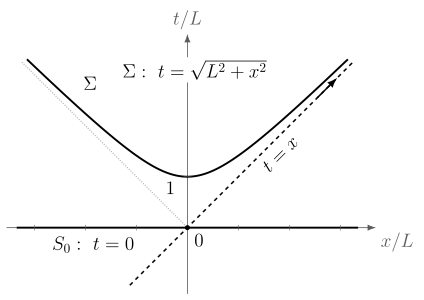
Spacelike tangents do not guarantee a Cauchy surface. In flat Minkowski spacetime, is Cauchy but misses the inextendible null line . The axes are and with equal scales and ; the curves are evaluated from the displayed equations. The dotted line is the other null asymptote, . Only a finite coordinate window is shown, and every curve continues beyond it.
Deleting one point from Minkowski spacetime supplies another counterexample. A constant-time surface below the deletion no longer controls all of the future, because a causal curve can be past-inextendible by approaching the missing point without ever reaching the surface. Local flatness and an apparently global coordinate slice are not sufficient.
Cauchy surfaces and global hyperbolicity
Section titled “Cauchy surfaces and global hyperbolicity”The fundamental equivalence is that a spacetime admits a Cauchy hypersurface if and only if it is globally hyperbolic. One direction says that a universal data slice rules out causal loops and runaway sequences in causal diamonds. The other constructs a global time function from compact-diamond control and takes a level set. The precise causal and compactness hypotheses, and why neither may simply be dropped, are the subject of Equivalent Criteria for Global Hyperbolicity; the classical theorem appears in Minguzzi and Sánchez 2008, Theorem 3.75, pp. 44–46.
For field theory one normally chooses a smooth spacelike Cauchy hypersurface with future unit normal . A second-order normally hyperbolic equation then accepts a field value and normal derivative on . This analytic use is more structured than the topological definition: a rough Cauchy hypersurface proves global causal control, but it may not be the convenient carrier for classical differential data.
Spacetimes with timelike conformal boundaries fall outside the ordinary theorem. Curves can arrive from or escape to the boundary without crossing a proposed slice, so an initial surface alone is insufficient. One must specify boundary conditions and prove an initial–boundary-value result. Calling a constant global-time section of anti-de Sitter spacetime “Cauchy” without this qualification conceals the missing boundary data.
Exercise
Section titled “Exercise”In two-dimensional Minkowski spacetime, show that the line is a smooth spacelike Cauchy hypersurface for . Explain which step fails at .
Solution
For , a Lorentz boost with velocity has time coordinate
so is exactly . Isometries preserve causal character and inextendibility. Since every inextendible timelike curve crosses exactly once, every such curve crosses exactly once. Its tangent has norm , confirming that the line is spacelike.
At the boost factor diverges and the line becomes null. It is no longer the image of a constant-time plane under a Lorentz isometry. The explicit timelike curve , above avoids the null line , so the existence part of the Cauchy condition fails.
References
Section titled “References”- Bernal, Antonio N., and Miguel Sánchez, “Smoothness of Time Functions and the Metric Splitting of Globally Hyperbolic Spacetimes”, Communications in Mathematical Physics 257, Theorem 1.1, pp. 44–49, 2005.
- Minguzzi, Ettore, “Lorentzian Causality Theory”, Living Reviews in Relativity 22, article 3, §§3–4, 2019.
- Minguzzi, Ettore, and Miguel Sánchez, “The Causal Hierarchy of Spacetimes”, in Recent Developments in Pseudo-Riemannian Geometry, §3.11.2, pp. 43–46 in the arXiv version, European Mathematical Society, 2008.