Black-Hole Initial Data
Scrollable formula. Use Left and Right arrow keys to reveal hidden content.
Scrollable table. Use Left and Right arrow keys to reveal additional columns.
Scrollable figure. Use Left and Right arrow keys to inspect hidden content.
Black-hole initial data solve the Einstein constraints on a slice whose topology or inner boundary represents one or more holes. The familiar choices— isometry throats, punctures, excision, conformal flatness, and analytic spin/boost tensors—answer different mathematical questions. No single choice determines a unique astrophysical binary. Nonphysical initial radiation arises whenever the chosen free data fail to match the geometry and time derivatives of the intended quasiequilibrium spacetime.
Required background. Hypersurface Normals and Tangential Projectors supplies spatial and horizon geometry, while PDEs and Green Functions for Gravitation supplies elliptic domains, inner boundary conditions, and singular-source methods.
Helpful background. The Einstein Equation supplies the constraints; Formulations of General Relativity locates the construction within this volume; and Presymplectic Potentials and Currents prepares the distinction between prescribed canonical data and physical charges.
Three ways to represent a hole
Section titled “Three ways to represent a hole”For time-symmetric conformally flat Schwarzschild data,
Here is the physical mass, is an isotropic coordinate radius, and the cosmological constant vanishes. The convention is for the future unit normal . Time symmetry means that the entire vanishes; maximal slicing below requires only its trace .
The sphere is a minimal surface and an inversion isometry exchanges the two asymptotically flat ends. This leads to three related but operationally different descriptions:
| Representation | Elliptic domain | Inner prescription | Main tradeoff |
|---|---|---|---|
| Isometry throat | One exterior copied across a minimal surface | Inversion or throat condition | Geometrically transparent but restrictive |
| Puncture | Euclidean space with isolated points removed | Analytic singular part plus regular correction | No inner numerical boundary, but another end is compressed to a point |
| Excision | Exterior of one or more compact regions | Horizon or quasiequilibrium boundary data | Flexible geometry, but boundary conditions must be mutually compatible |
Gourgoulhon derives the minimal-surface condition and the two-ended Schwarzschild bridge in Gourgoulhon 2007, §8.2.5, eqs. (8.52)–(8.66), pp. 132–136, PDF. For moving holes, the distinction is no longer merely a choice of coordinates: different free data and inner conditions generally produce different physical initial slices.
Why the puncture is a second infinity
Section titled “Why the puncture is a second infinity”The area of an isotropic coordinate sphere is , where
Thus decreasing does not indefinitely decrease physical area. The derivative vanishes at , where . The same areal radius grows without bound both as and as . With , this becomes the useful symmetric expression
The radius plot makes the two ends visible: follow the curve toward either large positive or large negative , and compare each limit with the minimum at the throat.
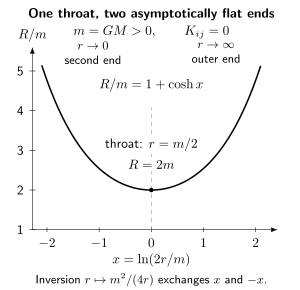
For the time-symmetric Schwarzschild slice, and , where . The minimum is the throat; and are separate asymptotically flat ends. This is a quantitative radius plot, not an embedding diagram.
The inversion sends and leaves the complete three-metric unchanged. In the chart the limit is another ordinary asymptotically flat region . It also lies at infinite proper distance: along a radial line, . The divergence of at the puncture is therefore a coordinate description of an end, not a material delta source on the physical three-manifold.
The throat condition can be checked directly rather than inferred from a coordinate picture. Its outward spatial unit normal is , and its mean curvature within the initial slice is
For time-symmetric data the outgoing null expansion equals this mean curvature, so a minimal sphere is marginally outer trapped. Setting the last factor to zero gives at the throat: this is the Robin boundary condition used if only one exterior is retained. In this exact Schwarzschild example the sphere is the bifurcation sphere; identifying an event horizon in general initial data additionally requires the spacetime development.
Bowen–York momentum and spin
Section titled “Bowen–York momentum and spin”On a flat conformal background with maximal slicing , the Bowen–York trace-free tensor solves the momentum constraint analytically. Keep explicit in the interpretation of its parameters: the and used below are geometrized, so the corresponding physical ADM charges are and . The barred tensor is conformal data, related to the physical extrinsic curvature by in this sector, as derived in Conformal Decomposition of the Einstein Constraints. With the Euclidean radial unit vector (distinct from the spacetime normal), the linear-momentum part is
and its spin part is
Both are trace free and divergence free away from the puncture. Surface integrals recover the geometrized parameters and ; restoring physical units therefore introduces the factors of stated above. Bowen and York give the original construction and its surface charges in Bowen and York 1980, §§II–III, pp. 2049–2053. The Hamiltonian constraint remains nonlinear:
For puncture data one separates the known singular behavior, for example , where the geometrized mass parameter has dimensions of length (and equals for a single Schwarzschild puncture in these units), and solves for a regular correction . Gourgoulhon gives the Bowen–York solution and verifies its charges in Gourgoulhon 2007, §8.2.6, eqs. (8.67)–(8.84), pp. 136–139, PDF.
Where nonphysical radiation enters
Section titled “Where nonphysical radiation enters”Conformal flatness is exact for the standard time-symmetric Schwarzschild slice, but not for the analogous stationary rotating Kerr geometry. A spinning Bowen–York hole therefore cannot be exactly a stationary Kerr slice under the usual smoothness and symmetry assumptions. Its evolution must rearrange both the hole and the exterior gravitational field, producing a burst commonly called junk radiation.
For a binary, additional mismatches arise from superposing single-hole fields, choosing approximate orbital parameters, setting the wrong radial velocity, or imposing time symmetry where an inspiral has nonzero time derivatives. These effects should be separated conceptually:
- constraint violation is a failure to solve the elliptic system;
- junk radiation can remain even when the constraints are solved accurately;
- eccentricity reflects an orbital mismatch and need not coincide with the radiative mismatch;
- gauge transients can alter coordinate diagnostics without changing the physical radiation content.
The conformal transverse-traceless construction prescribes a TT curvature seed. Conformal thin-sandwich and extended thin-sandwich constructions instead prescribe conformal metric velocity and lapse-related data, making approximate quasiequilibrium conditions more direct. This advantage is not a theorem of uniqueness: the extended system can possess multiple solution branches.
Excision and horizon data
Section titled “Excision and horizon data”An excision surface intended to represent a quasiequilibrium black hole is often required to have vanishing outgoing null expansion. Conditions on its shear, tangential shift, lapse, or normal motion then encode additional physical choices. The expansion condition alone does not fix the entire elliptic boundary-value problem, and an apparent horizon is slice dependent.
Puncture data avoid an explicit inner boundary, but they do not remove the need to choose topology and regularity. Conversely, excision does not remove the interior from the spacetime solution; it restricts the initial-data domain to the exterior and supplies boundary information there. Neither representation is intrinsically more physical without reference to the free data and target spacetime.
Independent checks
Section titled “Independent checks”The Bowen–York expressions pass three immediate tests. Contracting either with gives zero. The momentum part scales as and can contribute to ADM linear momentum, whereas the spin part scales as and combines with a rotational generator of order to give finite angular momentum. Setting returns the time-symmetric Schwarzschild puncture equation.
Common pitfalls
Section titled “Common pitfalls”A puncture is not a curvature singularity on the initial slice. It usually represents a compactified asymptotic end; regularity is judged in a chart adapted to that end.
Constraint satisfaction does not imply astrophysical fidelity. The elliptic equations constrain the data but do not select the correct inspiral state.
Conformal flatness is a physical restriction. It is not merely a harmless coordinate gauge for spinning black holes.
Exercise: charge-sensitive falloff
Section titled “Exercise: charge-sensitive falloff”Explain from radial scaling why the and terms can encode different ADM charges even though both solve the same momentum constraint.
Solution
The linear-momentum surface integral contracts with an asymptotic translation, which is , and an area element . Thus the momentum term has a finite nonzero limit. The spin term vanishes in that integral. Angular momentum instead uses a rotational generator , so the spin contribution scales as . Its tensor parity makes the corresponding momentum-term contribution cancel under the standard asymptotic conditions. The distinction is encoded jointly by falloff, angular structure, and the asymptotic generator.