Inspiral Phase and Amplitude Structure
Scrollable formula. Use Left and Right arrow keys to reveal hidden content.
Scrollable table. Use Left and Right arrow keys to reveal additional columns.
Scrollable figure. Use Left and Right arrow keys to inspect hidden content.
A quasi-circular inspiral waveform is organized by a slowly evolving orbital scale, a rapidly accumulated carrier phase, and a hierarchy of angular modes and amplitude corrections. The total mass fixes the time and length scale; the symmetric mass ratio fixes the leading chirp; mass asymmetry and dimensionless spins control further structure. This page derives the leading waveform scalings while treating higher-order orbital dynamics as an accepted input.
Helpful background. Einstein Equations supplies the field dynamics behind energy balance; Waves, Green Functions, and Geometric Optics supplies outgoing-wave phase conventions; Relativistic Two-Body Dynamics supplies the binding energy and orbital evolution used here; Gravitational Radiation and Waveforms supplies radiative moments and flux; and Computational Relativity explains how the late waveform is obtained when the inspiral expansion fails.
Quasi-circular source invariants
Section titled “Quasi-circular source invariants”Let source-frame component masses satisfy , and define
The symmetric mass ratio obeys , with equality for equal masses, while . For quasi-circular orbital angular frequency , the invariant velocity parameter is
The dimensionless spins are . In a nonprecessing system their projections along the orbital angular momentum are constant on the orbital timescale; in a precessing system the full vectors and a rotating frame are required.
This page assumes an adiabatic hierarchy
where radiation reaction changes little during one orbit. The derivation of the binary equations of motion is not treated here, and observational parameter estimation is a separate downstream problem.
Carrier phase and mode amplitudes
Section titled “Carrier phase and mode amplitudes”At large source-frame areal radius , define the distance-rescaled complex strain
with unit-normalized spin-weight harmonics:
The global time convention is . For a nonprecessing quasi-circular source, a mode can be organized as
where at leading order and tail propagation produces higher-order logarithmic shifts between and a coordinate orbital phase. The notation collects the relative amplitude series; it is not assumed to be the same for every .
In the stated harmonic convention, the dominant Newtonian mode is
Here the mode formula uses the source-frame mass . For a cosmological source, propagation converts it to the detector-facing scale
where is redshift invariant. Thus has dimensions of length and is dimensionless; nearby sources recover the scale . The wave angular frequency is approximately , so its cyclic frequency is in the same frame as .
Blanchet 2024, §3.4.5, pp. 212–219 gives the convention-explicit mode construction and higher-order amplitude organization.
Leading chirp from balance
Section titled “Leading chirp from balance”The Newtonian circular binding energy and quadrupole luminosity are accepted dynamical and radiative inputs:
Energy balance, , gives
Since ,
is the chirp mass. In terms of the dominant cyclic frequency,
The sign is positive: a bound circular inspiral loses energy, grows, and the carrier chirps upward. The balance construction and high-order separation between energy, flux, phase, and modes are developed in Blanchet 2024, §§3.4.3–3.4.5, pp. 206–219.
Why does energy loss make the wave faster? The binding energy is negative: losing energy makes the binary more tightly bound, decreases its separation, and increases its orbital speed. At fixed distance the leading strain amplitude grows as , while the time between successive wave cycles shrinks. These two trends produce the characteristic chirp.
Integrating the leading frequency equation from to a higher frequency gives the elapsed source-frame time
The formal limit defines the Newtonian integration constant . It is a useful early-inspiral timescale, not a claim that this approximation predicts the merger. Equivalently, and while the approximation remains controlled. For observed frequencies, replace by the redshifted chirp mass and use detector time; the source/detector dictionary derives that replacement.
What controls the hierarchy
Section titled “What controls the hierarchy”The figure shows the two parts of the chirp together: shrinking cycle spacing and a growing amplitude envelope. It integrates the displayed Newtonian equations for , starting at with and , and stopping at . The upper curve is the normalized real mode
while the lower curve is the dimensionless angular wave frequency . Read both against the same source-frame time axis; neither curve continues into merger.
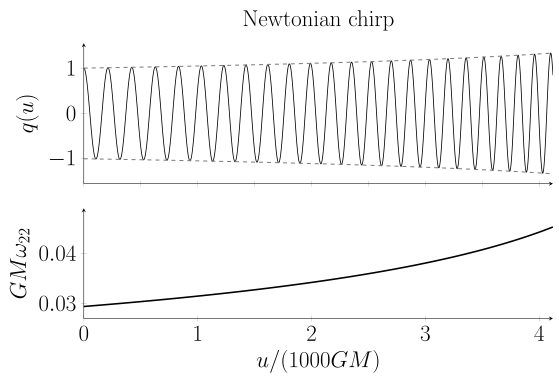
Quantitative leading-order Newtonian chirp for an equal-mass, nonspinning circular binary, with and . Dashed lines mark the upper panel’s envelopes ; the lower panel gives and the shared time coordinate is . The interval ends at . These are solutions of the leading inspiral equations, not numerical-relativity data or a merger prediction; the diagram supplies no estimate of neglected PN corrections.
Different invariant combinations enter different parts of the waveform:
- sets the overall time scale and, together with distance, the amplitude scale.
- controls the leading secular phase acceleration.
- controls finite-mass-ratio corrections and the overall leading amplitude.
- changes sign under exchange and therefore multiplies exchange-antisymmetric contributions, including leading odd- structure in the nonspinning circular limit.
- spin projections enter phase and amplitude corrections; in-plane spins additionally drive precessional rotations.
- orders the slow-motion series. Amplitude and phase series must state their truncation separately.
Phase is especially demanding because a small fractional error in accumulates over many cycles. A “restricted” waveform may retain a high-order phase while keeping only the leading amplitude; a full amplitude model retains the harmonics and corrections required at the declared order. These are different approximations, even when their carrier phase is identical.
The hierarchy requires both and slow radiation reaction; neither condition supplies a universal numerical cutoff. A truncated PN waveform may lose the accuracy required for a particular application well before reaches unity. Compare successive orders, independent approximants, and numerical or perturbative waveforms in their overlap. Merger structure requires controlled strong-field input rather than extrapolating the displayed power series without an error estimate.
Common pitfalls
Section titled “Common pitfalls”Calling the detector phase without a frame declaration. is a source waveform phase. Detector arrival time, sky position, polarization basis, and cosmological redshift are separate mappings.
Using total mass where chirp mass belongs. sets the time unit, but the leading frequency derivative depends on .
Assuming every harmonic has frequency . A quasi-circular mode has leading phase and angular frequency approximately . Eccentricity and precession add further frequencies.
Exercise
Section titled “Exercise”Starting only from , , and , derive and show that its mass dependence can be written entirely through .
Solution
. Balance therefore gives , or . Differentiating yields . Replacing by gives . Because , this is the stated chirp-mass formula. Every factor is positive, so the frequency increases monotonically within the adiabatic regime.