Ordinary Displacement Memory
Scrollable formula. Use Left and Right arrow keys to reveal hidden content.
Scrollable table. Use Left and Right arrow keys to reveal additional columns.
Scrollable figure. Use Left and Right arrow keys to inspect hidden content.
Ordinary displacement memory is a permanent change in the asymptotic strain produced when the nonradiative state of an isolated system changes between early and late times. The archetypal source is scattering, ejection, or capture that changes the asymptotic velocities of massive bodies. After the burst and its local curvature have passed, freely falling separations need not return to their original values. This page derives that endpoint observable; it does not assess a present detector or event claim.
Helpful background. Einstein Equations supplies the constraints that relate asymptotic fields to matter and radiative flux. Waves, Green Functions, and Geometric Optics supplies retarded propagation and the zero-frequency endpoint limit. Gravitational Radiation and Waveforms supplies TT strain and curvature response. Causality and Global Structure supplies future null infinity, stationary asymptotic eras, and the distinction between null and timelike asymptotic data.
Memory as an endpoint of the Bondi shear
Section titled “Memory as an endpoint of the Bondi shear”Use the volume’s Bondi convention
with . For a unit-sphere dyad , define
Suppose news is negligible in stationary or uniformly moving eras before and after . The displacement-memory tensor is
and the complex memory is
At large but finite Bondi areal radius , . This is an asymptotically flat relation; replacing by a cosmological luminosity distance requires the propagation and redshift map. A time-independent supertranslation adds the same electric-parity vacuum shear to both stationary endpoints, so the inhomogeneous shift cancels from their difference when corresponding physical cuts are compared. The Bondi frame and cut matching must still be stated: comparing unrelated cuts can manufacture an apparent offset.
Favata fixes a compatible and spin-weight convention before separating ordinary and nonlinear memory in Favata 2010, §§2–3, pp. 3–5, PDF.
The unbound-particle formula
Section titled “The unbound-particle formula”In linearized gravity, let asymptotic bodies be labeled by , with rest mass , velocity , Lorentz factor , and observation direction . The leading ordinary memory is
The symbol means the late outgoing state minus the early incoming state, with every body and asymptotic momentum accounted for. The TT projection is relative to . The denominator is a retarded-time Jacobian; it becomes important for relativistic motion. Its smallness alone does not imply divergent on-axis strain, because the transverse projection of also vanishes along the velocity. The full endpoint formula is Favata 2010, pp. 4–5, eq. (11), PDF.
This formula is not obtained by differentiating a bound-orbit quadrupole forever. It follows from the retarded field of asymptotically inertial particles and compares its zero-frequency endpoints. The assumptions are:
- weak fields in the observation zone and leading order;
- asymptotically constant incoming and outgoing velocities;
- isolated-system retarded boundary conditions;
- a common inertial/Bondi frame for the two endpoints;
- no claim that the instantaneous interaction region is described by free particles.
For a system whose bodies remain bound and return to the same asymptotic Coulombic state, this leading ordinary term vanishes. A recoil, ejection, unbound scattering state, or changing matter flux can make it nonzero.
A two-body ejection check
Section titled “A two-body ejection check”Consider a parent initially at rest that ejects two equal masses with velocities . At the order used in this kinematic example, take the parent rest mass to be , so energy and momentum are conserved. Corrections from radiated energy belong to the corresponding higher-order source budget. Every initially stationary contribution has zero term. Observe along . Since , the late tensor inside the brackets is
The TT projector onto the – screen gives
The initial velocity term is zero, so
The offset vanishes continuously as , is even under exchange of the two bodies, and has the expected dimensionless scaling . Rotating the ejection axis rotates the plus/cross components with spin weight but does not change the physical tensor.
Permanent displacement from geodesic deviation
Section titled “Permanent displacement from geodesic deviation”For a long-wavelength apparatus, the local tidal equation is
Choose initially comoving masses, subtract their unperturbed separation, and assume in both quiet eras. The first integration then gives zero net relative-velocity change, and the second gives
Curvature is nonzero while acts, then returns to zero. The final separation nevertheless differs because displacement is the twice-integrated tidal history. This is not a contradiction: zero final acceleration does not imply zero accumulated displacement.
The smooth step in the figure makes this distinction visible: after the transition, the ring is again at relative rest but has a different shape. The same response applies to a displacement-memory step produced by ordinary or null sources.
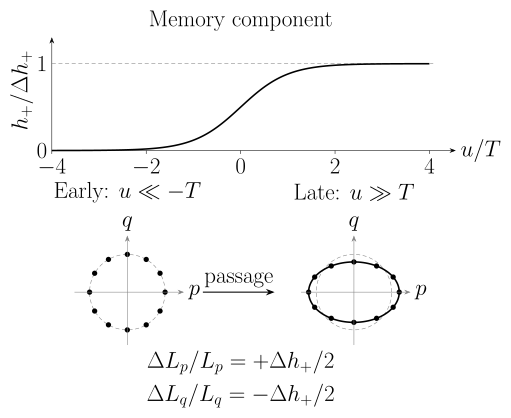
Permanent separation from , with . The curve shows against ; the early and late rings follow the linear geodesic-deviation response for initially comoving masses. The illustrative exaggerates the deformation. As , both and vanish, while the separation changes by . The waveform is a schematic transition, not a source simulation.
Ordinary displacement memory is electric parity on the sphere. It must not be relabeled as spin memory, which is a time-integrated magnetic-parity time-delay observable, or center-of-mass memory, which involves a different subleading electric-parity time moment.
Boundary with observation
Section titled “Boundary with observation”The equations define an asymptotic physical signal. Whether a particular instrument can retain a nonoscillatory offset depends on its transfer function, calibration, low-frequency control, observation duration, and noise model. Current searches or event-level conclusions belong to dated Research records and Gravitational-Wave Astronomy. They are not inferred from the existence of the classical memory solution.
Common pitfalls
Section titled “Common pitfalls”Equating ordinary and nonlinear memory. Ordinary memory is sourced by a change in asymptotic matter/Coulombic data. Nonlinear memory is sourced by radiative energy flux, including gravitational waves themselves.
Comparing endpoints in different frames. A translation, boost, or supertranslation changes the cut and component representation. Transform both endpoints into one declared Bondi frame before taking .
Expecting final curvature to remain nonzero. Memory is a displacement after an impulse-like tidal history. The late stationary era can have zero news and zero radiative curvature.
Exercises
Section titled “Exercises”1. No-change test. Show that a scattering description with identical sets of asymptotic velocities and masses before and after has zero ordinary memory in the particle formula, even if the bodies were strongly accelerated in between.
Solution
The formula depends only on the endpoint difference of
If the complete incoming and outgoing sets agree in one inertial frame, the tensors before TT projection are identical, so their difference and its TT projection vanish. The interaction can still emit oscillatory radiation and nonlinear memory; the conclusion concerns only the ordinary endpoint term.
2. Ring response. For the ejection example above, find the final fractional changes of initially orthogonal and separations.
Solution
Geodesic deviation gives . Hence
The first-order area change vanishes because the transverse memory tensor is trace free, while the differential arm change equals .
Thus the permanent pattern has the same plus-polarization geometry as an oscillatory wave even though its endpoint offset is nonoscillatory.